On this page
Choosing between two of the most established names in customer support software feels like a safe bet. But safe can be expensive. When weighing Zendesk vs. Freshdesk, the answer depends entirely on your team size, your budget structure, and how much you value a flat-rate alternative.
This comparison breaks down reliability, real-world features, AI costs, and pricing gotchas for both platforms, and highlights when a modern alternative makes more sense for your stack.
Who is this for? Small-to-mid support teams (3–20 agents) evaluating help desk software for the first time, or considering a switch from an incumbent.
When to use these tools? When your team's needs are entirely email- and web-chat-focused, and you have budget for per-seat licensing.
When to look elsewhere? If you need native multi-channel support (WhatsApp, Telegram, Instagram, Facebook Messenger), flat-rate pricing, or AI resolutions that cost cents instead of dollars.
Quick Answer
- Zendesk is the best choice for teams of 20+ agents who need enterprise-grade compliance (SOC 2, HIPAA), a massive app marketplace, and complex workflow automation, at a premium per-seat price.
- Freshdesk offers a better value for teams of 3–10 agents, with generous out-of-the-box features at a lower per-agent cost, but ticket volume caps can force upgrades.
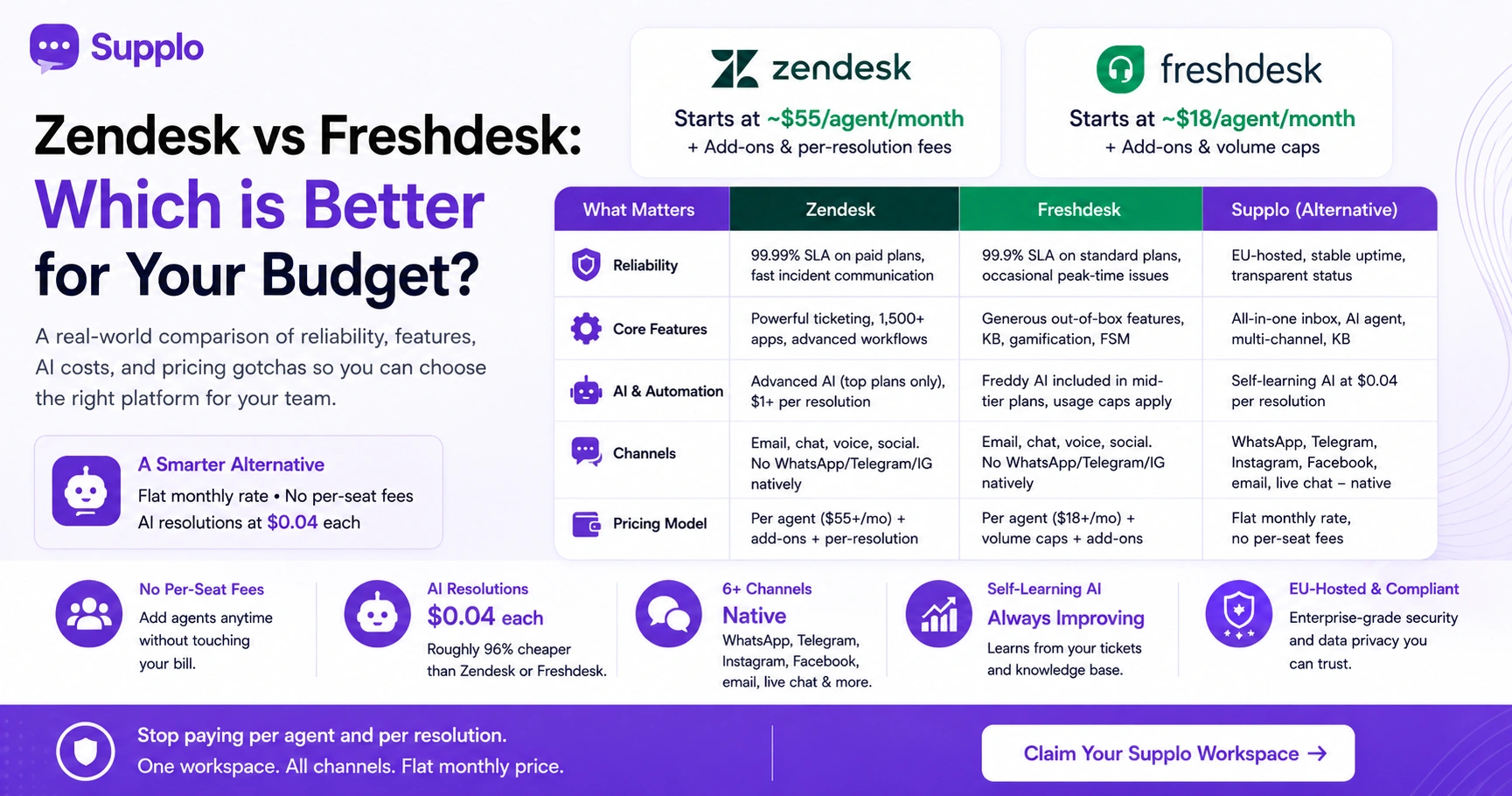
- Both platforms charge per agent and per AI resolution, making scaling expensive. Zendesk’s Suite Team plan starts at ~$55/agent/month; Freshdesk’s Growth plan is ~$18/agent/month.
- Neither supports WhatsApp, Telegram, or Instagram natively without paid add-ons or custom API work.
- For teams that hate per-seat billing and channel limitations, a flat-rate, AI-first alternative like Supplo eliminates both with a single, simple monthly price.
Which Platform Stays Online When You Need It Most?
Let’s be real: uptime is table stakes. Both Zendesk and Freshdesk run on mature cloud infrastructure, but their histories tell slightly different stories. Zendesk has historically posted strong SLA guarantees (99.99% for paid plans), while Freshdesk has experienced more public outages during peak usage periods over the last 24 months. For mission-critical support teams, reliability is often less about raw uptime and more about how quickly each platform recovers, and how many seats you lose access to during a blackout.
- Zendesk’s architecture is globally distributed but complex; a regional DNS issue can lock out entire teams.
- Freshdesk’s multi-tenant setup means one noisy tenant can degrade performance for others.
- Both platforms offer status pages, but Zendesk’s communication during incidents tends to be faster and more transparent.
- For small teams, reliability also includes how well their mobile apps work during travel or off-hours.
If you need guaranteed uptime for a high-volume support team (1000+ tickets/day), Zendesk’s SLA provides stronger contractual protection. For smaller teams, Freshdesk’s uptime is generally sufficient.
Zendesk Features vs Freshdesk Features: The Raw Capability Breakdown
Zendesk leans heavily on its mature ticketing system and massive third-party app marketplace, but many "core" features like automations, SLA policies, and multilingual support require mid-tier or top-tier plans. Freshdesk offers a surprisingly generous free tier with basic ticketing, a knowledge base, and team collaboration baked in. The gap narrows significantly as you pay more, but entry-level teams get more out of the box from Freshdesk.
- Zendesk’s app marketplace has 1,500+ integrations, but sifting through them to find functional ones is a chore.
- Freshdesk includes gamification (like leaderboards) natively; Zendesk charges extra for basic quality-of-life features.
- Both support email, social, and voice, but Freshdesk offers native field service management if that's in your stack.
- Zendesk’s macro system is more robust for complex automations; Freshdesk’s is simpler to set up but less flexible.
For entry-level teams, Freshdesk delivers 80-90% of the capability at 50-60% of the cost. Zendesk's value proposition kicks in when enterprise compliance or massive app ecosystems become non-negotiable.
Freshdesk vs Zendesk Capabilities: Where Automation and AI Actually Differ
Zendesk's advanced AI automation (such as answer bots, intelligent triage, and sentiment analysis) is locked behind the highest-tier plans and billed per resolution, which can add up fast. Freshdesk’s Freddy AI is included with more mid-tier plans and handles basic categorization and canned responses effectively, though it’s less sophisticated than Zendesk’s high-end offering. Neither platform offers a flat-rate AI resolution model; both charge per "successful" AI interaction.
- Zendesk’s agent workspace collates history across channels, but its AI requires heavy training data upfront.
- Freshdesk’s automation builder uses a visual workflow interface that non-technical managers appreciate.
- Both platforms offer sentiment analysis, but Zendesk’s is more accurate in non-English conversations.
- The hidden cost: AI "resolutions" on both platforms can easily exceed $1.00 per successful deflection on high-volume queues.
With both Zendesk and Freshdesk, AI deflections are billed per resolution, not per conversation. That dollar per successful deflection adds up fast on high-volume queues.
Zendesk vs Freshdesk Pricing: The Real Cost of Scaling Your Support Team
Zendesk’s per-agent pricing starts at around $55/agent/month (billed annually) for its Suite Team plan, but that number climbs fast when you add advanced features, sandbox environments, or higher ticket limits. Freshdesk’s Growth plan starts at roughly $18/agent/month and includes more automation at the base level. The kicker: both platforms charge by the agent, so a 10-person team on Zendesk is easily $700+/month, while Freshdesk cuts that closer to $250/month.
- Zendesk enforces "light agent" limits for basic users, with separate billing tiers that make budgeting confusing.
- Freshdesk caps ticket volume on lower plans, forcing upgrades if your team handles high volume.
- Both offer discounts for annual billing, but Zendesk’s discount is less aggressive on mid-tier plans.
- Neither platform offers a true flat monthly rate for a full team; the cost always scales linearly with headcount.
Trying to budget? Run a 14-day trial of both platforms with identical ticket volumes to see where the real costs hit. If per-seat pricing already feels like a trap, test Supplo’s flat-rate model at the same time. Start your free trial at Supplo.
Zendesk Pricing vs Freshdesk Pricing: Hidden Fees and Per-Seat Traps
The most common frustration with both Zendesk and Freshdesk is the per-seat model itself. Add one new agent in a busy week, and your monthly bill jumps immediately. Zendesk hits you with fees for basic API access, sandbox testing, and higher-ticket-volume bumps. Freshdesk’s fees are more transparent, but their free tier becomes essentially unusable after 10–15 tickets per day. Neither includes multi-channel support (WhatsApp, Telegram, Instagram) in base pricing without third-party integrations.
- Zendesk charges extra for voice minutes, SLA reports, and even custom roles on many plans.
- Freshdesk’s "free" version stops including phone support after the first 30 days.
- Both charge for premium analytics and CSV exports, which feels archaic for modern SaaS.
- The total cost of ownership (TCO) for a 15-person team on Zendesk can easily reach $1,500–$2,000/month, including add-ons.
Neither Zendesk nor Freshdesk includes WhatsApp, Telegram, or Instagram in their base pricing. You’re looking at paid add-ons or custom API work for channels your customers already use.
Freshdesk Cost vs Zendesk Cost: The Value Proposition for Small Teams
For a bootstrapped startup or small support team of 3–7 people, Freshdesk wins on raw cost and feature density. You get significantly more tools (automation, knowledge base, basic reporting) at a lower monthly per-agent price. Zendesk’s value proposition truly kicks in only when you need enterprise-level compliance, a massive app ecosystem, or global-scale ticket routing. For everyone else, Freshdesk delivers 80–90% of the capability at 50–60% of the cost.
- Freshdesk’s free tier supports up to 3 agents and includes basic ticketing, knowledge base, and help widget.
- Zendesk’s Suite Team plan costs ~$55/agent/month but includes phone support and multi-brand capabilities.
- Both offer trial periods, but Freshdesk’s 21-day trial is more generous in terms of feature access.
- The tipping point: once your team reaches 10 agents, Zendesk’s advanced features (such as sandbox environments and custom analytics) become harder to ignore, but the price gap widens.
Zendesk Freshdesk Value Proposition: What You Actually Get for Your Money
The value proposition comes down to trade-offs. With Zendesk, you’re paying a premium for brand reliability, a massive integration marketplace, and the ability to handle complex enterprise workflows. With Freshdesk, you get better out-of-the-box features for a fraction of the cost, but you might outgrow it more quickly if your needs become highly customized. Both are solid products, but neither offers a flat-rate, inclusive pricing model, and both charge per-resolution fees for AI.
- Zendesk’s value peaks in regulated industries requiring SOC 2, HIPAA, or multi-region data residency.
- Freshdesk’s value peaks for product-led companies that need omnichannel ticketing without a massive monthly commitment.
- Both platforms lack native support for channels like Telegram, WhatsApp, or Instagram without paid add-ons or API work.
- The real value metric: how much time your team spends configuring vs. actually resolving tickets.
The Setup and Migration Reality: How Painful Is It to Switch?
Migrating between Zendesk and Freshdesk is not a plug-and-play operation. Both platforms offer import tools for tickets and users, but the formatting of historical data often breaks. Zendesk’s API rate limits are notoriously restrictive during bulk migrations, while Freshdesk’s import tool caps file sizes and field mapping options. Expect to spend at least a week on data cleanup and user training regardless of which direction you’re moving.
- Both platforms offer professional migration services, but they’re priced per ticket volume and can cost thousands.
- Custom fields, macros, and automations rarely transfer cleanly; expect manual recreation.
- Freshdesk’s migration wizard is more guided for beginners; Zendesk’s API documentation is better for technical teams.
- The most common pain point: losing threaded conversation history when moving between platforms.
Migrating is a headache; don’t make it worse with surprise fees. If you’re already struggling with per-agent costs and channel limits, switch to a platform that charges a single, simple monthly rate. See Supplo pricing.
When Neither Fits: The Alternative for Flat-Rate, AI-First Support
If per-seat pricing, per-resolution AI costs, or channel limitations (no native WhatsApp, Telegram, or Instagram) are dealbreakers, both Zendesk and Freshdesk leave you wanting. Supplo is an AI-first, EU-hosted customer support platform that bundles live chat, a shared inbox, a self-learning AI agent, and multi-channel routing into one workspace, billed at a flat monthly rate with no per-seat fees: no per-seat fees, no per-resolution meter. AI resolutions cost roughly $0.04 each, about 96% cheaper than what you’d pay with Intercom or Zendesk’s answer bots.
- Supports WhatsApp, Telegram, Instagram DMs, Facebook Messenger, email, and live chat natively, no third-party middleware.
- The self-learning AI agent that costs $0.04 per resolution learns from your knowledge base and past tickets, not generic training data, reducing false deflections.
- One flat rate per month for your entire team; add agents without touching your billing.
- Built for small-to-mid support teams that want enterprise-grade features without the enterprise invoice.
- Includes native WhatsApp support without third-party middleware and a shared inbox that routes Telegram, Instagram, and email.
- EU-hosted compliance for data privacy and all features in one workspace.
Compliance line: Supplo is not affiliated with any app or website. Please follow each app's terms and local regulations.
Which One Wins for Your Support Stack?
Choose Zendesk if you need enterprise-grade compliance, a massive app ecosystem, and your team is 20+ agents with a dedicated admin. Choose Freshdesk if you’re a smaller team looking for solid features at a reasonable price, without vendor lock-in anxiety. But if you hate per-seat billing, need multi-channel support without expensive add-ons, and want AI that costs pennies per resolution, consider a modern alternative like Supplo that aligns pricing with actual team growth.
- Zendesk is the safe bet for established companies with compliance checklists.
- Freshdesk is the pragmatic choice for cost-conscious teams that don’t need enterprise overhead.
- Neither platform is bad; they’re just built for a different era of support economics.
- The support tool market is shifting toward flat-rate, AI-native solutions. Don’t sign a long-term contract without testing the new wave.
The support tool market is shifting toward flat-rate, AI-native solutions. Don’t sign a long-term contract without testing the new wave.
Stop paying per agent and per resolution. Support your team across WhatsApp, Telegram, Instagram, email, and live chat, all in one workspace, all at a fixed monthly price. See how real teams switched from per-seat pricing to flat-rate. Claim your Supplo workspace.
Key Takeaways
- Zendesk excels at enterprise compliance, massive app ecosystems, and complex workflows, at a premium per-seat cost.
- Freshdesk offers a better deal for small teams with generous out-of-the-box features, but ticket volume caps can force expensive upgrades.
- Both platforms charge per agent and per AI resolution, making scaling costly.
- Neither supports WhatsApp, Telegram, or Instagram natively without paid add-ons.
- For teams that want flat-rate billing, native multi-channel support, and cheap AI ($0.04 per resolution), a modern alternative like Supplo is worth evaluating.
FAQ
Is Zendesk or Freshdesk more reliable in terms of uptime?
Both offer strong uptime guarantees (Zendesk at 99.99% on paid plans, Freshdesk at 99.9% on standard plans). Zendesk has a slightly better track record for recovery speed during outages.
Which platform is cheaper for a team of 5 agents?
Freshdesk is cheaper for smaller teams. Its Growth plan costs ~$18/agent/month, while Zendesk’s Suite Team plan starts at ~$55/agent/month. Both charge per agent and have volume caps.
Does Freshdesk have better AI than Zendesk?
Zendesk’s high-tier AI is more advanced, but Freshdesk’s Freddy AI is included in more mid-tier plans and is simpler to set up. Zendesk charges per resolution; Freshdesk caps usage on lower plans.
Can I use WhatsApp or Telegram with Zendesk or Freshdesk?
Not natively. Both require third-party integrations or paid add-ons. Supplo offers native WhatsApp and Telegram support in a single flat-rate workspace.
Which platform is easier to migrate from?
Neither is easy. Both require significant manual recreation of automations, macros, and custom fields. Freshdesk has a slightly more beginner-friendly import wizard; Zendesk has better API documentation for custom migrations.
Do Zendesk and Freshdesk offer flat-rate pricing?
No. Both charge per agent and per resolution for AI features. Zendesk also charges for add-ons like voice, sandbox, and premium analytics.
Is Freshdesk good enough for a growing startup?
Yes, for early stages. It offers solid features at a low cost. But as you scale beyond 10 agents, you may hit ticket volume limits and feature gaps that require upgrading to expensive plans or switching platforms.
Compliance line: Supplo is not affiliated with any app or website. Please follow each app's terms and local regulations.