On this page
AI customer support isn’t a futuristic fantasy anymore; it’s how your customers expect to be helped right now. Tons of businesses are already using AI to handle everything from email support to Instagram DMs. And honestly? The tech has come a long way from those clunky FAQ bots of the past. If your team is still manually reading and routing every single ticket, you’re making life harder than it needs to be.
Quick Answer
- AI customer support is already here, handling tickets across email, chat and social media for thousands of teams.
- The best AI support is self-learning. It gets smarter by studying your knowledge base and past conversations.
- Key tech to look for: a unified inbox, self-learning AI and pricing that doesn't punish you for growing your team.
- Real success isn't about vanity numbers. It's about resolution rate, customer satisfaction and cost per resolution.
Why AI Customer Support is the Present
A couple of years ago, everyone was talking about AI as the next big thing. But 2024 and 2025? That's when it stopped being hype and started being reliable. Modern AI agents do more than spit out pre-written answers. They understand context, switch between languages and most importantly, they know exactly when to tap out and pass a tricky issue to a human.
The real difference between "future tech" and "present tech" is how you pay for it. If a tool has flat, predictable pricing, it's ready for prime time. If it gouges you for every new team member you add, it's still living in the past. Businesses that treat AI support as a core part of their workflow, not just an add-on, are seeing the biggest efficiency gains.
- AI adoption has matured. We're past the hype cycle. It's about reliability now.
- Context is everything. Modern AI doesn't just reply; it understands the full conversation.
- Flat pricing wins. Scalable support needs a predictable bill. Period.
- Core workflow, not an afterthought. That’s where you get real ROI.
AI Customer Service Statistics That Prove the Shift is Real
Let's look at the numbers from last year. They tell a pretty straightforward story: customers want answers instantly and they want them to be right, 24/7. Companies are betting big on AI to deliver exactly that. While specific stats can change month to month, the direction is clear.
- Customers often try to solve things themselves before ever reaching out to a human. AI makes that self-service actually work.
- The cost to resolve a ticket with AI is dramatically lower- think pennies instead of dollars.
- Support teams using AI report higher job satisfaction. Why? Because they’re spending their time on harder, more interesting problems instead of answering the same question about password resets for the hundredth time.
- The most-cited benefit isn't even speed; it's consistency. AI gives the same correct answer every single time, which reduces human error in repetitive tasks.
5 Emerging AI Customer Support Technologies You’ll See Everywhere This Year
The exciting stuff in AI support right now isn't about flashy, futuristic demos. It's about practical tools that work. Here are the key trends you'll see more of:
- Self-learning knowledge bases: Imagine an AI that trains itself on your team's real conversations and resolved tickets. No more manually mapping out decision trees.
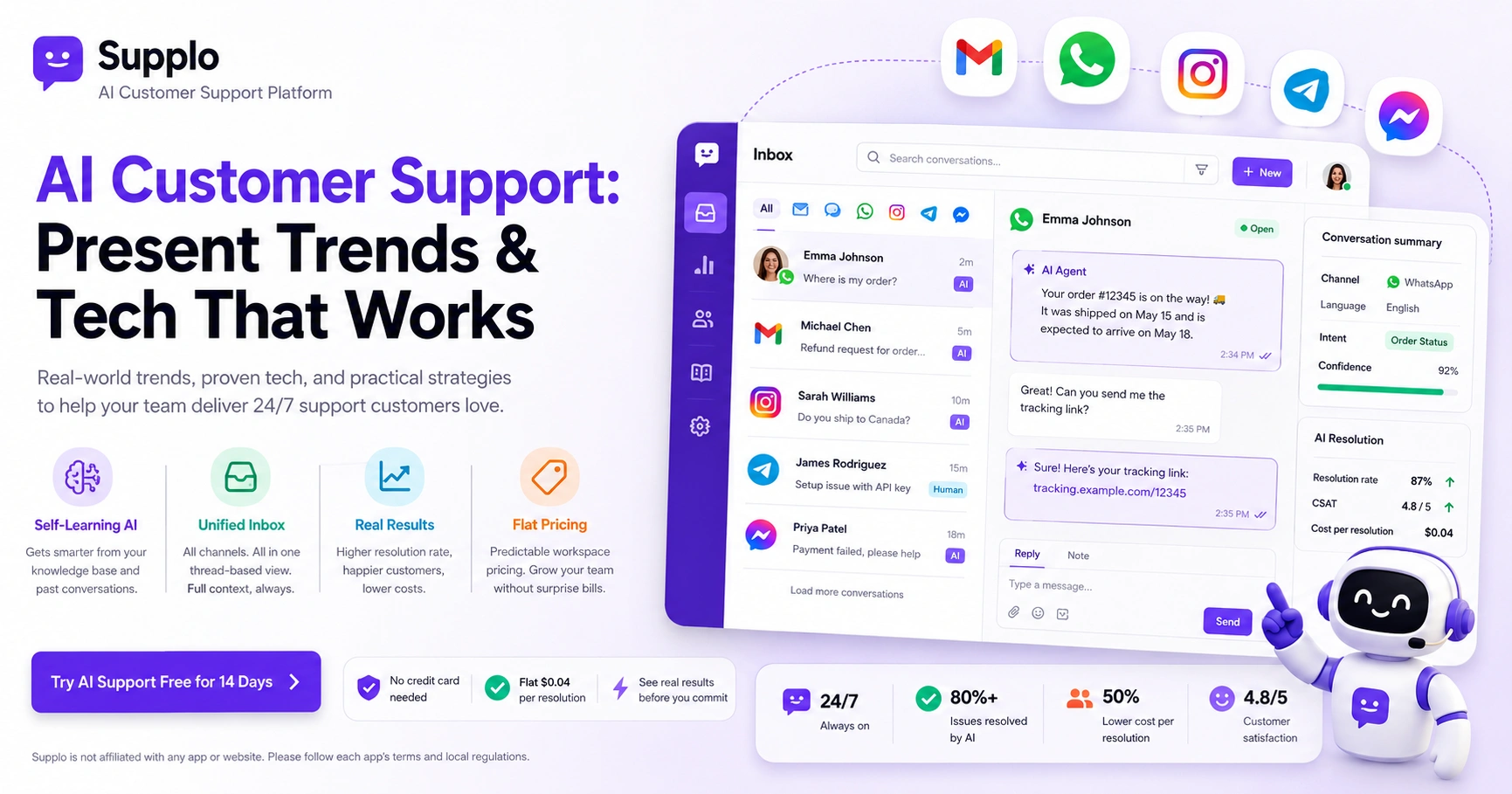
- Cross-platform inbox unification: A single place that brings together email, live chat, WhatsApp, Instagram and Telegram into one thread-based view. It’s a game-changer for keeping context.
- Proactive AI agents: These systems can actually detect frustration in a customer's tone and automatically escalate the issue to a human before it boils over.
- Crypto and alternative payment support: Support stacks are now integrating payment options like Binance Pay, GCash and Payeer, making the entire support experience seamless.
- Transparent AI pricing: Goodbye per-seat pricing that punishes team growth. The trend is towards flat workspace fees that stay predictable.
AI Chatbots Customer Service Trends: From Scripted to Self-Learning
The old way of building a chatbot was a nightmare. You had to map out every single conversation path and customers still ended up stuck in dead ends. That's dying fast. The new trend is self-learning AI that studies your actual team's responses.
This is the biggest shift we're seeing in chatbot effectiveness. You don't need to be a developer to train it. It learns from the resolved tickets your team already handles.
- Train once, improve forever. The best models get smarter on their own without you micromanaging them.
- Graceful handoffs. Modern AI knows when it’s out of its depth and hands the conversation to a human without making the customer repeat themselves.
- Built-in language translation. One bot can serve customers in any language.
- Better metrics. Teams are moving away from measuring "conversations handled" and focusing on "resolution rate per interaction."
Why a Unified Inbox is the Key to a Real AI Multichannel Strategy
Here’s the thing: a multichannel strategy only works if all those channels live in the same place. If your email is in one tool, your live chat is in another and your Instagram DMs are in yet another, you've created chaos.
A unified inbox isn't a luxury. It's the only way to scale. When your AI lives in that inbox, it sees the full conversation history, not just one snippet. This makes the AI infinitely smarter.
- Customers switch channels mid-conversation all the time. A unified inbox lets your AI pick up where it left off, no matter how the customer reaches out.
- Your AI agents can handle email tickets, Instagram DMs and WhatsApp conversations all from the same workspace.
- The best tools use a thread-based view, so every reply is connected to the original question.
- Without this, your "multichannel" support actually creates silos that frustrate customers.
For a look at how this works in practice, check out how Supplo’s inbox unifies all your channels.
AI for Live Chat and Email Support: What’s Actually Improved
Live chat and email aren't going anywhere. They're still the backbone of support and AI has made both dramatically better.
On live chat, AI handles the first touch instantly. It greets the customer, gathers context and often resolves the issue before a human even gets involved. For email, AI can triage incoming tickets, tag them by priority and even draft responses that your agents can review and send in seconds.
- Instant first response. Wait times drop from minutes to under a second.
- Smart email classification. Spam, priority and billing requests get sorted automatically.
- AI-drafted replies. Your agents review and edit, which cuts composition time in half.
- Quality control is built-in. Good systems let agents easily override or edit AI drafts.
This is exactly the kind of workflow that a platform like email ticketing is designed to handle.
AI Social Media Customer Service Trends: Instagram, WhatsApp and Telegram
Customer support on social media isn't just a PR thing anymore. It's real ticket volume. AI agents can now handle Instagram DMs, WhatsApp messages and Telegram chats. They can answer product questions, process returns and even take payments without a human in the loop until necessary.
The trend is for AI to mirror your brand's tone consistently across every social platform.
- WhatsApp Business API integration lets you automate order updates, FAQs and shipping queries.
- Instagram DMs are incredibly high-volume for eCommerce brands. AI can handle the flood of "where is my order" messages.
- Telegram support groups benefit from AI moderation and automated answers to common setup questions.
AI must follow each platform's terms and local regulations. Supplo is not affiliated with any app or website. Please follow each app's terms and local regulations.
For more on this, see how Supplo handles WhatsApp and Telegram customer support.
AI Chatbot Effectiveness in Customer Support – When Does It Actually Resolve Issues?
AI chatbots are great at one thing: high-frequency, low-complexity issues. Think password resets, order status, FAQ answers and simple billing inquiries. They're predictable and easy for AI to handle.
But AI should fail gracefully. If a customer is emotionally escalated, needs a nuanced exception, or has a problem your knowledge base hasn't covered, your AI needs to know its limits and hand off cleanly.
- High accuracy areas: Cart checkouts, tracking requests and policy questions.
- Struggle zones: Account disputes, complex technical support, or anything needing empathy and judgment.
- Confidence scoring is key. A reliable AI will cap its certainty (say, at 80%) and transfer to a human.
- The real metric: Not deflection rate, but resolution quality and customer satisfaction after the interaction.
Measuring AI Customer Support Success: Metrics That Matter, Not Vanity Numbers
Here's a trap many teams fall into: they measure AI success by "conversations handled" or "tickets deflected." Those are vanity numbers that can hide a lot of unresolved customer frustration.
Real success metrics are different. They tell you if your AI is actually helping.
- Resolution rate: The percentage of AI-handled conversations that end without needing a human.
- CSAT after AI interaction: Are customers happy with the AI experience? Measure this directly.
- Handle time vs. resolution quality: Faster isn't always better. If the AI rushes to close a ticket without fixing the problem, you'll see repeat contacts.
- Cost per resolution: What does it actually cost when AI solves a ticket vs. a human? This is your real bottom line.
Tools like those from Supplo give you per-agent and per-AI breakdowns to track these metrics.
AI Customer Service Automation Impact: Where It Shines and Where It Still Needs Humans
AI automation has a massive, positive impact on operational efficiency. But let's be real: it's not a silver bullet.
It shines in high-volume, predictable ticket categories like order status and password resets. It struggles with context-heavy issues, emotional customers and any scenario where a single mistake can damage trust.
The smartest strategy? Let AI handle the 80% of common queries and let your humans handle the 20% that need real judgment.
- Reduces agent burnout. AI handles the boring, repetitive tickets that kill team morale.
- Human agents get AI sidekicks. Tools that suggest answers, surface relevant KB articles and translate messages in real time.
- Seamless handoffs are a must. No hold times, no customers having to repeat themselves.
- The bottom line: AI doesn't replace support; it elevates it by letting your team focus on work that actually matters.
How to Start Building a Reliable AI Customer Support Stack
You don't need a massive budget to get started. The key is picking the right platform from the beginning.
Start with a unified inbox that has built-in AI, not a chatbot you bolt onto the side. Prioritize tools that train your AI on your actual knowledge base and past conversations. And look for flat-fee per-workspace pricing. Everything else is negotiable.
Steps to Build Your AI Support Stack
- Consolidate your channels into one shared inbox. This is the foundation. (Supplo’s inbox unifies email, widget, WhatsApp, Telegram, Instagram and Messenger).
- Turn on the self-learning AI agent. It will immediately start resolving tickets from your knowledge base and past conversations.
- Set up the handoff rule. AI handles what it can and when it's unsure, it passes the conversation to a human with full context.
- Check the pricing. Look for flat-workspace pricing (like Supplo’s), so your bill doesn't increase as you hire more team members.
- Start with a free trial. See real results before you commit a single dollar.
To see how this works, check out the AI agent and how it learns from your team.
Try AI support free for 14 days: no credit card needed. See if a self-learning AI agent can resolve your customer tickets at a flat $0.04 per resolution before you commit. Start at Supplo.io.
Key Takeaways
- AI customer support has matured beyond basic bots into self-learning agents that resolve common issues by learning from your knowledge base and past conversations.
- A unified inbox is not optional. It’s essential for a real multichannel AI strategy to bridge all your channels into a single thread-based view.
- Real success metrics are resolution rate, customer satisfaction (CSAT) and cost per resolution. Ignore vanity numbers.
- Customers expect 24/7, accurate support across all channels. AI delivers that, but only when it’s trained well and knows when to hand off to a human.
FAQ
Is AI customer support safe for handling sensitive customer data?
Yes, when the right platform is used. Reputable AI support tools encrypt data in transit and at rest and comply with GDPR and SOC 2 standards. Always check that the platform doesn’t train its public model on your private conversations. Supplo is not affiliated with any app or website and you control what data your AI agent accesses.
Can AI really resolve complex customer issues without human help?
For high-frequency, low-complexity issues (order status, billing FAQs, policy questions), AI reliably resolves them. For nuanced or emotionally charged issues, the best AI knows when to hand off to a human. Never rely on AI for sensitive account disputes or urgent technical support without human oversight.
What if the AI gives a wrong answer to a customer?
Effective AI platforms include confidence scoring; if the AI isn’t sure (e.g., below 80%), it passes the ticket to a human. Always audit your AI’s answers regularly and train it on your latest knowledge base content to minimize errors.
Which channels should I include in my AI customer support stack?
Start with your highest-volume channels, typically email and website live chat. Then add WhatsApp, Instagram DMs, Facebook Messenger and Telegram as your business grows. A unified inbox like Supplo’s handles all of them in a single thread-based view, so your AI sees the full picture.
Does AI customer support replace human agents?
No, it augments them. AI handles repetitive tickets that burn out agents, allowing human agents to focus on complex, high-value interactions. Most teams find they can either serve more customers with the same headcount or reduce ticket volume without adding hires.
How do I measure if my AI support is actually working?
Focus on resolution rate (how often AI solves the ticket without escalation), customer satisfaction (CSAT) after AI interactions and cost per resolution. Vanity metrics like “chats started” are less useful than “tickets resolved by AI.”
What if my AI support isn’t improving over time?
Check your knowledge base. Self-learning AI needs well-curated, updated content. Also verify that the AI is allowed to learn from past resolved tickets (if your platform supports that). If not, consider switching to a platform that does.
Compliance line: Supplo is not affiliated with any app or website. Please follow each app's terms and local regulations.