On this page
Let's be real for a second. When you're trying to figure out whether to go with an AI chatbot or stick with a rule-based one, the decision usually comes down to two things: budget and how complicated it all seems. On paper, rule-based bots look like the easier, cheaper option. But in practice? They tend to fall apart fast when real customers start typing real questions. AI chatbots, meanwhile, actually get better over time. They learn. They adapt. And they scale in ways that rule-based systems can't touch.
This guide is for anyone running support who wants to reduce ticket volume without making customers pull their hair out. We'll break down what actually makes these bots different, where the hidden costs live, and how to pick the right one for the long haul.
Quick Answer
- Rule-based chatbots work on rigid "if-this-then-that" logic. The moment a customer asks something that doesn't fit the script, like a question with two different requests, the bot either loops or punts to a human. That's not helpful.
- AI chatbots use large language models to figure out what someone actually means. They draw on your knowledge base and past chats, and they give real, contextual answers without needing every path to be manually mapped out.
- Cost isn't what it seems. Rule-based bots look cheap upfront, but the hidden costs from constant maintenance and high escalation rates add up fast. AI chatbots often work out cheaper in the long run, especially with per-resolution pricing (think around $0.04 per solved ticket).
- Time to upgrade? If your support involves complex questions, multiple channels, different languages, or your current bot escalates more than 40% of chats, you're ready for AI.
What Is a Rule-Based Chatbot, and How Does It Work?
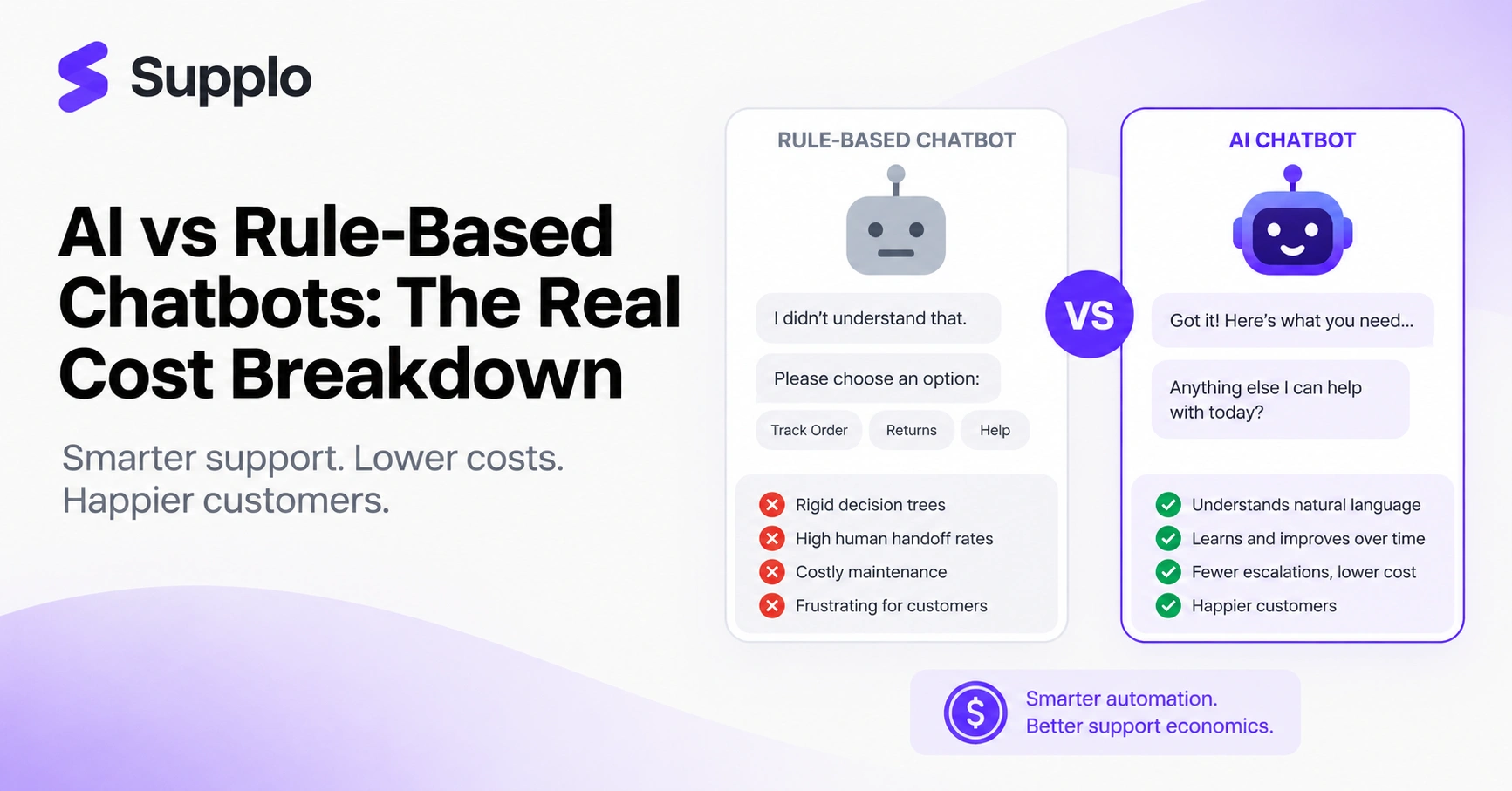
A rule-based chatbot is basically a decision tree with a chat window slapped on top. It scans for keywords or follows preset button paths. If a customer types something even a little off-script, like using slang, making a typo, or combining two questions, the bot either repeats itself or says "I didn't understand" and dumps the conversation to a human.
These bots rely on strict "if-this-then-that" logic. There's no natural language understanding happening under the hood. Every time you add a new product, change a policy, or update an FAQ, someone has to rewire the whole thing manually. Sure, it works okay for simple stuff like checking store hours or tracking an order. But what happens when a customer asks something unexpected? Game over.
They only understand exact keywords or button clicks. AI chatbots use advanced language models to interpret meaning. Explore Supplo’s AI agent.
What Is an AI Chatbot, and How Does It Learn?
AI chatbots work differently. Instead of hunting for keywords, they use large language models (LLMs) to understand intent. They pull answers from your knowledge base and previous conversations, so they can rephrase things, summarise, and handle follow-up questions without needing a script. Over time, they learn what works and adjust based on feedback. Basically, it's like having a support agent who never sleeps and keeps getting sharper every shift.
This means AI bots handle synonyms, typos, and compound questions without breaking a sweat. You can train them on your actual support docs and chat history, and they'll keep improving by tracking which responses actually resolved tickets. Plus, they handle multiple languages without needing separate branches, and they remember context across an entire conversation. That's a big deal when a customer asks a question, then follows up with "actually, can you also check this other thing?"
Rule-Based Chatbot Problems: Why They Fail in Customer Support
Here's the thing about rule-based bots: they can't adapt. When a customer asks something the script didn't anticipate, like a question about a promo you just launched or a weird product variant, the bot either gives a useless answer or hands off to a human. At that point, you're paying for the bot and the agent. Not exactly efficient.
These systems tend to hit human fallback rates of 60-80%. That's a lot of chats that didn't get resolved. Every time you change a product or policy, someone has to manually rebuild decision trees, which creates a growing maintenance headache. And customers? They learn to game the bot by typing random stuff to reach a human faster. It kills CSAT scores and makes the whole experience feel robotic and frustrating.
Advantages of AI Chatbots Over Rule-Based Bots for Support Teams
AI chatbots handle nuance. They scale without needing scripts rewritten every other week. And they learn from every single interaction. That means they resolve more tickets without a human handoff, respond faster, and maintain consistent quality across email, chat, WhatsApp, and social DMs. For support teams, the real win isn't just speed, it's that the AI actually gets what the customer needs.
An AI agent can handle complex, multi-step support scenarios without escalating instantly. It learns automatically from resolved tickets and knowledge base updates, so you're not stuck manually tuning it all the time. And it unifies your channels, email, WhatsApp customer support integration, Instagram DMs, all of it, into one coherent system. The bot doesn't break down when someone uses casual language or throws in a mixed topic. It just... works.
Differences Between AI and Rule-Based Support Chatbots
At the core, it's flexibility. Rule-based bots are rigid decision trees. AI chatbots understand intent, context, and language variation. Here's a head-to-head look.
While rule-based chatbots rely on exact keyword matches, rigid decision trees, and manual script updates with high fallback rates to human agents and a lack of context, AI chatbots are more advanced. AI chatbots leverage intent and context understanding to adapt to natural language, auto-learn from knowledge base updates, resolve 70-80% of queries independently, handle multilingual support on the fly, and maintain context across entire conversation threads, offering greater adaptability than the limited, non-adaptive nature of rule-based systems. While rule-based bots offer fast setup for simple flows, AI chatbots require hours or days to optimise but offer significantly greater capabilities.
Why Rule-Based Bots Struggle with Complex Customer Queries
Complex queries often bundle multiple requests into a single query. Think: "I want to cancel my order, but also change the shipping to a different one." A rule-based bot can't untangle that. It tries to jam the whole sentence into one branch, fails, and punts to a human, so much for automation.
These bots can't split compound questions into separate intents. They can't read emotional tone either. When a customer is frustrated, a rule-based bot keeps chugging along with the same script, which often makes things worse. And because they lack context, customers end up having to repeat themselves after being transferred to a human. That inflates average handling times and frustrates everyone involved.
AI Chatbot Cost vs Rule-Based Chatbot Cost: A Real Pricing Breakdown
Rule-based chatbots look cheaper upfront. Some charge flat monthly fees or per-chat rates. But here's what gets overlooked: the fallback rate. If 70% of chats end up needing a human, you're paying for the bot and the agent. That math doesn't work well at scale.
AI chatbots, on the other hand, resolve most tickets on their own. At $0.04 per resolution with a platform like Supplo, the numbers start to look a lot better once you're past a few hundred tickets. Rule-based solutions might cost $15–$50 monthly, but the hidden labour costs from unresolved chats eat away at any savings. AI chatbots with per-resolution pricing mean you only pay for what actually gets solved. And since pricing is flat per workspace, not per seat, adding team members won't spike your bill.
See the Difference in Real Numbers
Run your own comparison. Start a free 14-day trial with Supplo and watch the AI resolve tickets while your rule-based bot logs escalations.
Cost-Effectiveness of AI vs Rule-Based Bots Over Time
Over a full year, rule-based bots tend to cost more when you add up maintenance and missed resolutions. Every time you update a product or policy, someone has to rebuild the decision trees manually. And every unresolved ticket still eats up agent time. AI bots continuously learn from your knowledge base and past conversations, so they improve without needing extra labour. Once you cross 500+ monthly tickets, the total cost of ownership shifts dramatically in favour of AI.
Rule-based maintenance requires ongoing developer or admin hours for every change. AI chatbots, meanwhile, automatically ingest new knowledge base articles and chat logs. With per-resolution pricing, your costs stay predictable as volume grows. And while rule-based resolution rates decline as your product evolves, AI rates tend to hold steady or improve. That's a much more reliable automation bet.
AI Chatbot Pricing Models: What You Actually Pay For
Most AI support chatbots charge per resolution, per conversation, or per seat. Per-resolution models are the most transparent; you pay only for what the bot actually solves, not for unanswered chats or idle seats. Per-seat pricing punishes growing teams. Per-conversation models often count every interaction, even ones the bot couldn't handle. Look for flat workspace pricing that doesn't spike as you add agents or channels.
Supplo, for example, charges $0.04 per resolution. That's clear and predictable. Per-conversation models count every thread, even those that need human help, and per-seat models penalise scaling teams. Flat workspace pricing avoids surprise overage fees. And watch out for hidden add-ons for multilingual support, advanced analytics, or key integrations; those can sneak up on you.
When to Keep a Rule-Based Bot And When You Must Upgrade
Rule-based bots still work for narrow, predictable use cases: password resets, store hours, and simple FAQs that don't change. But if your support team handles anything beyond 5-10 predictable scenarios, like product troubleshooting, billing disputes, or multi-channel queries, rule-based logic breaks down. The real trigger to upgrade is when your team spends more time fixing the bot than it saves.
You might keep a rule-based bot if you have fewer than 10 static support scenarios, like fixed hours or return policies. But it's time to upgrade to AI if customers ask varied questions, use multiple languages, or need troubleshooting help. If your bot escalates more than 40% of chats, you're overpaying. And if you need to support multiple channels like email, WhatsApp, Telegram, or Instagram, an AI solution is the way to go.
Check out our all-in-one unified inbox.
How to Choose the Right Chatbot for Your Support Stack
Start by mapping your most common support scenarios. If all your questions are predictable and low-volume, a simple rule-based bot might work. But if you're scaling, handling multiple channels, or dealing with nuanced product questions, AI is the only reliable path. Look for a tool that unifies email, chat, and social DMs into a single inbox, learns from your knowledge base, and charges per resolution rather than per seat. Supplo does all that at $0.04 per resolution with a free 14-day trial.
Audit your top 20 customer questions. How many have single, unchanging answers? Those might work with a rule-based approach. How many need branching logic or multiple intents? That's where AI shines. Evaluate your multi-channel needs, email, website chat widget, Telegram support and Instagram DMs. Check for self-learning capability: Can the chatbot improve without constant manual editing? Compare pricing models, prioritising per-resolution transparency. And always trial both types with free tiers before committing.
Supplo is not affiliated with any app or website. Please follow each app's terms and local regulations.
Stop Paying Twice for Support Automation
Rule-based bots charge you a subscription and your agent's time on every unresolved ticket. Supplo charges $0.04 per resolution, flat per workspace, no seat fees. No surprises.
FAQ
Can a rule-based chatbot handle multi-intent customer queries?
No. Rule-based bots scan for one keyword or path per message. If a customer says, "I want to change my address and also check if my order shipped," the bot usually can't split those intents and escalates the request.
Do AI chatbots require a lot of training data to work?
Most modern AI chatbots work with your existing knowledge base. Onboarding takes a few hours, and the AI improves by learning from real customer chats. You don't need months of data to start.
Is rule-based chatbot maintenance expensive?
Not in dollar terms, but in time. Every product or policy change requires manually rewriting decision trees. That's an ongoing labour cost that adds up faster than a flat $ 0.04-per-resolution AI bot.
What's the biggest downside of rule-based chatbots for support teams?
The high fallback rate. Most rule-based bots fail to resolve more than 20-30% of incoming queries, forcing handoffs to human agents. That means you're paying for the bot AND the agent, doubling the cost per ticket.
Can an AI chatbot work across multiple messaging apps?
Yes, if it's built for omnichannel. Supplo unifies email, website chat widget, WhatsApp, Telegram, Instagram DMs, and Facebook Messenger into one thread-based inbox with shared AI.
If my rule-based bot is already set up, should I replace it?
Only if you're seeing high escalation rates, low CSAT, or maintenance drag can you keep it for simple flows and add an AI bot alongside to handle the rest; eventually, one replaces the other.
Does an AI chatbot translate messages automatically?
Many do, including Supplo. The AI translates incoming messages so your team can respond in their native language, and it answers customers in their language without needing separate flows.
Compliance line: Supplo is not affiliated with any app or website. Please follow each app's terms and local regulations.