On this page
For customer-focused businesses, waiting is the enemy. Every minute a customer's issue remains unresolved can chip away at their satisfaction and loyalty. Understanding, measuring, and actively working to reduce your support team's average resolution time is not just a nice-to-have; it's a critical component of healthy business growth.
This guide will break down exactly what average resolution time is, why it's a cornerstone of effective customer support, and how to optimise it without sacrificing quality.
Quick Answer
- Average resolution time measures the total time from when a customer submits a support ticket to when their issue is fully resolved, and the ticket is closed.
- Calculating it involves summing up all resolution times for closed tickets and dividing by the number of tickets resolved.
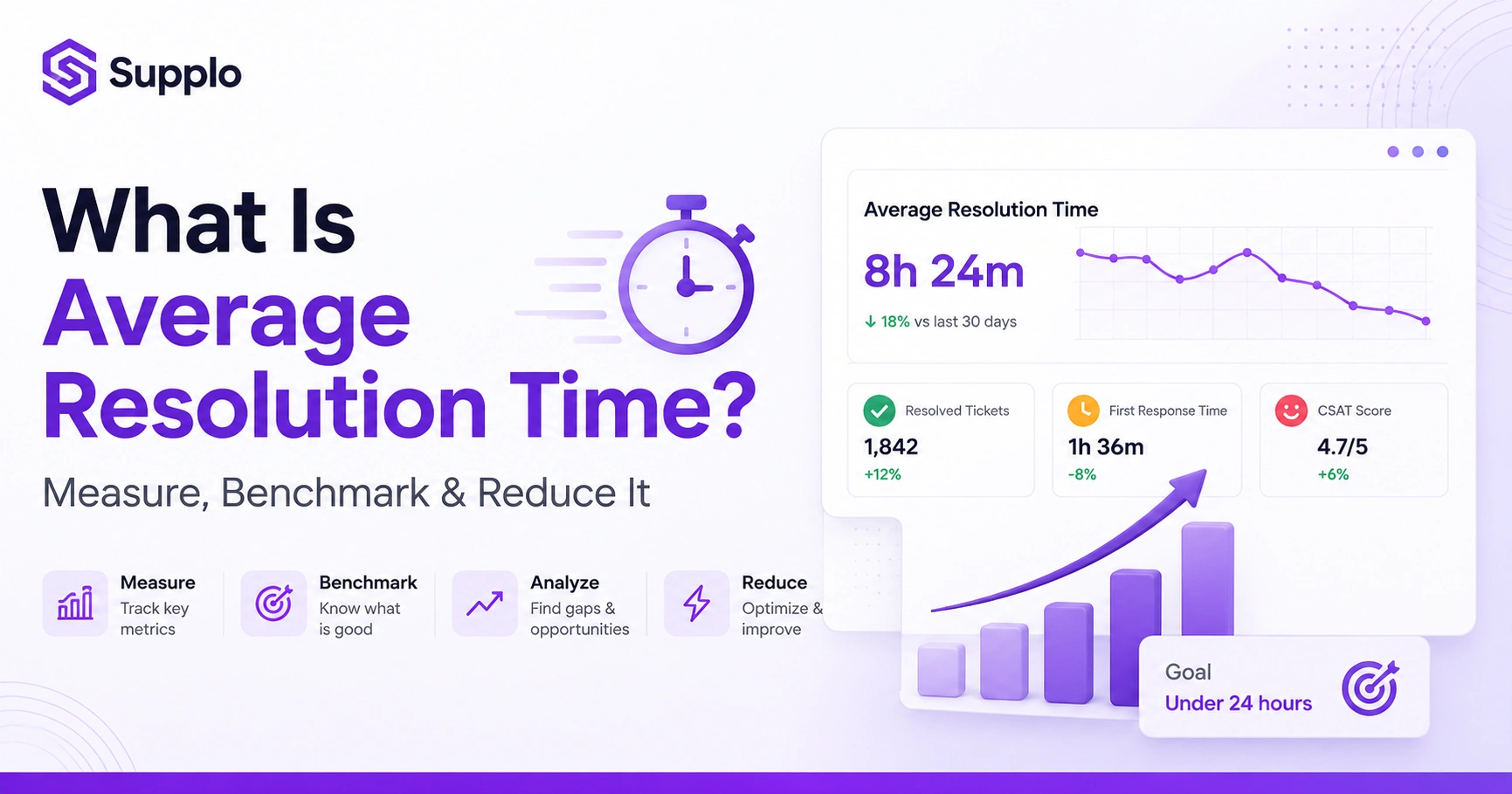
- Good benchmarks generally fall under 24 hours for standard issues for SaaS and tech, with critical issues needing resolution in under 2 hours.
- To reduce it, focus on robust knowledge bases, AI automation, unified inboxes, smart routing, and empowering your agents.
- Avoid pitfalls such as counting customer waiting time in your averages or ignoring the distinction between simple and complex tickets.
What Exactly Is Average Support Resolution Time and Why Does It Matter?
Here's the simple version: average support resolution time tracks how long it takes from the moment a customer fires off a ticket to the second that issue gets fully closed out. It's one of those KPIs that tells you more about your business than most leaders realise.
Why does it matter so much? Because every minute left unresolved chips away at customer trust. When your team takes forever to solve problems, customers notice, and they leave. A lower resolution time typically means happier customers, less churn, and a support team that isn't drowning in backlog.
This metric also helps you spot the ugly bottlenecks in your workflow. You know, those tickets that bounce between three agents before anyone actually solves them? Resolution time catches that. When you optimise it, your agents handle more tickets without burning out, and your customers feel heard.
How to Calculate Average Support Ticket Resolution Time With a Simple Formula
The math here is refreshingly simple. Add up the total resolution time for all closed tickets in a given period, then divide by the number of tickets resolved.
Formula: Total Resolution Time (in minutes or hours) ÷ Total Tickets Resolved
Example time: Say your team resolved 500 tickets this month, and the total time spent was 50,000 minutes. That gives you an average of 100 minutes per ticket. Not bad, but you'll want to dig deeper.
Here's what to keep in mind when calculating:
- Only count tickets that are fully closed. Ones still in progress don't belong in your average.
- Let your help desk software do the heavy lifting; it should track timestamps automatically from creation to resolution.
- Break it down by ticket type or priority. A password reset shouldn't be lumped in with a complex API integration issue.
- When calculating for your email ticketing systems, track from the moment the email enters your system until the final reply is sent and the ticket closes.
- Consider measuring median resolution time alongside the average. Outliers can skew your numbers badly.
What Is a Good Benchmark for Support Resolution Time?
Let's be real: benchmarks vary wildly depending on what you do. But here's a rough guide to help you calibrate:
- SaaS and tech: Under 24 hours for standard issues. Critical issues? Aim for under 2 hours.
- E-commerce: Most teams target under 12 hours. Customers expect fast help when their order goes sideways.
- Enterprise support: Up to 48 hours for complex tickets is normal. These issues often involve multiple departments.
Your specific benchmark should align with your industry, ticket complexity, and team size. Fintech and healthcare usually have stricter timelines thanks to compliance requirements. Companies using AI support tools often see resolution times drop by 30-50% compared to teams that rely solely on manual processes.
One thing to remember: first response time is not the same as resolution time. The first response is just the opening act. Resolution time is the whole show, from open to close. Use your past data to set a realistic baseline before chasing industry averages.
Measuring Customer Support Resolution Time
Tracking resolution time in isolation? That's like driving the speedometer without checking the fuel gauge. You need context.
Pair resolution time with first response time, ticket backlog, and customer satisfaction scores. That's how you get the full picture. Also measure resolution time by channel, email, chat, and social media. You might discover your team crushes it on WhatsApp but struggles with email.
Some practical tracking tips:
- Use tiered tracking to separate straightforward requests from complex issues needing escalation.
- Monitor resolution time trends weekly, not just monthly. Waiting a month to catch problems is too late.
- Compare resolution times across individual agents to identify training opportunities.
- Automated reporting in tools like Supplo can surface these metrics without the need for manual spreadsheets. For insights into WhatsApp customer support resolution, track it separately to understand a key high-volume channel.
Track Support Ticket Turnaround Time Without Getting Lost in Data
Here's the thing about tracking: you don't need to drown in data to get useful insights. Set up clear categories and use dashboards that highlight exceptions, not every single datapoint.
Focus your tracking on the average resolution time by priority level, team member, and channel. The goal is actionable insight, not a spreadsheet full of numbers nobody looks at.
Practical steps:
- Create a simple dashboard showing your current average resolution time, target, and weekly trend.
- Set up automatic alerts when the resolution time exceeds your threshold.
- Segment tickets as first touch resolution versus multi-touch for cleaner data.
- Use Supplo's inbox to view resolution timelines per thread. It makes tracking feel less like math and more like management.
How to Decrease Support Ticket Resolution Time Without Sacrificing Quality
Let's clear something up: decreasing resolution time isn't about rushing your agents or telling them to type faster. It's about removing friction from your process.
Start with a solid knowledge base. When customers and agents can find answers instantly, everyone wins. Then implement a unified inbox that prevents tickets from getting lost across email, chat, and social channels.
Here's what actually works:
- Use AI to auto-suggest responses from past solved tickets and your knowledge base.
- Route tickets intelligently based on topic, language, or customer tier.
- Empower agents with tools that reduce manual typing and ticket switching.
- Regularly review ticket tags to spot recurring issues that can be addressed proactively.
Faster Customer Support Resolution
These aren't theoretical. These are strategies you can start using today.
Automate routine inquiries with an AI agent. Let it handle where my order is? And how do I reset my password? questions.
Use a shared inbox so no ticket falls through the cracks. When everything lives in one place, nothing gets lost.
Pre-write templated responses for common scenarios. Templates speed things up, and personalise them so you don't sound like a robot.
Measure first response time and resolution time together. This shows you where you're losing minutes.
Train agents to ask clarifying questions upfront. One good question at the start can save five back-and-forth messages later.
Some quick wins:
- AI agents can resolve up to 80% of routine tickets, freeing your team to focus on complex work.
- A unified inbox reduces the time agents spend toggling between email, WhatsApp, Instagram, and other channels.
- Templates speed up responses, but personalise them to avoid sounding robotic.
- Clear upfront communication reduces the number of replies per ticket.
Reducing Help Desk Resolution Time With Automation and Smart Workflows
Automation is the backbone of modern help desk optimisation. Period.
Smart workflows can route tickets to the right agent instantly, auto-assign priority based on keywords, and trigger follow-ups if a ticket sits idle. Supplo's self-learning AI learns from past resolutions and your knowledge base, so it gets faster at handling repeat issues over time without extra setup.
Here's what automation can do for you:
- Automate ticket tagging and routing to cut down manual triage time.
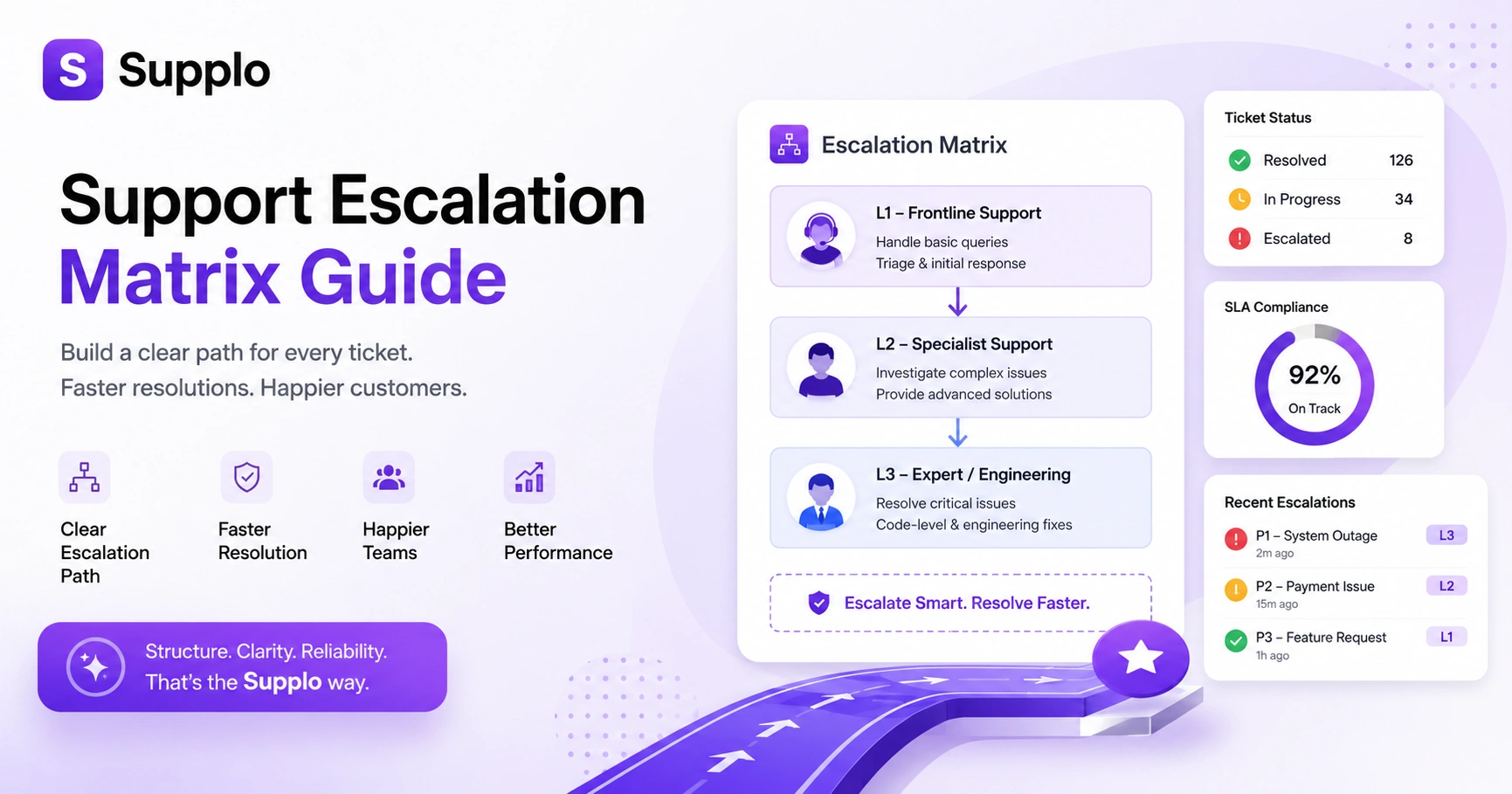
- Set up escalation rules so complex tickets reach senior agents without delay.
- Use auto-responders outside business hours to acknowledge tickets and set expectations.
- Let AI handle tier-1 questions and hand off seamlessly when a human is needed.
Strategies to Shorten Support Resolution That Your Team Can Start Today
Three strategies you can implement this week:
Audit your most frequent ticket types and create knowledge base articles for each. Let customers help themselves before they even create a ticket.
Set up a triage process so urgent issues skip the queue. Critical problems shouldn't wait behind password resets.
Enable translation features to avoid language barriers slowing down international support.
These moves cost almost nothing but can noticeably reduce resolution time.
- Knowledge base articles reduce resolution time by letting customers self-serve before they even create a ticket.
- Triage prioritisation ensures critical issues don't wait behind slow non-urgent tickets.
- Translation tools remove the need for a multilingual team, which can bottleneck resolution.
- Supplo's built-in translation lets agents support customers in any language without new hires.
Ready to see how a unified inbox can shrink your resolution time? Start your 14-day free trial at Supplo and test the difference firsthand, no credit card required.
Improve Resolution Time Metrics With Better Tooling and Team Habits
Improving resolution time metrics isn't just about the dashboard. It's about real changes in how your team works.
Invest in tools that unify communication channels and reduce context switching. Build habits around daily backlog reviews and quick internal feedback loops. Your agents will resolve tickets faster without sacrificing thoroughness.
What that looks like in practice:
- Switch to a single workspace like Supplo that pulls email, chat, Instagram, WhatsApp, and Telegram support into one thread-based inbox.
- Hold a quick 5-minute daily standup to flag blockers that are slowing resolution.
- Encourage agents to cross-train on common issues so fewer tickets need to be reassigned.
- Track resolution time per channel and adjust staffing based on where volume is highest. Compare Supplo's flat-rate pricing model against per-seat models that might penalise team growth.
Common Pitfalls That Inflate Your Support Resolution Time KPI
Your resolution time KPI can be misleading if you're not careful. Here are the traps:
- Counting idle time: When tickets are waiting on customers to reply, that time shouldn't count against you.
- Ignoring weekends and off-hours, consider business-hour resolution time versus actual calendar time, depending on your SLA.
- Failing to segment: Don't mix simple and complex tickets in the same average. It tells you nothing useful.
- Closing tickets too early: Make sure tickets are truly resolved before marking them closed.
Regularly audit your time tracking to ensure you're getting an honest picture of your team's performance.
If your resolution times aren't improving despite your best efforts, it might be time to upgrade your tool. Supplo's AI agent handles up to 80% of tickets automatically, and you pay a flat $0.04 per resolution, not $0.99. Start free and see the metrics move.
Key Takeaways
- Average resolution time is a vital KPI for customer satisfaction and operational efficiency, as it reflects the full lifecycle of a support ticket.
- Accurate measurement requires consistent tracking from ticket creation to closure, ideally segmenting by priority or complexity.
- Industry benchmarks provide a starting point, but your ideal resolution time will depend on your specific business, customer expectations, and ticket types.
- Automation through AI agents and smart workflows can significantly reduce resolution times by handling routine queries and streamlining ticket routing.
- A unified inbox and a robust knowledge base are foundational tools that empower agents and enable customer self-service, both of which contribute to faster resolution.
- Continuous monitoring and process refinement, along with the avoidance of common measurement pitfalls, ensure that improvements in resolution time are meaningful and sustainable.
Stop letting sprawling inboxes and expensive per-seat tools dictate your resolution time. Supplo gives you one workspace for all channels, transparent pricing, and AI that actually learns. Launch your free trial now.
FAQ
What is the difference between first response time and average resolution time?
First response time is how long a customer waits for an initial reply, while resolution time is the total time from ticket creation to closure. Both matter, but resolution time shows how efficiently you fully solve issues.
How can I measure average resolution time without expensive software?
You can track it manually in a spreadsheet with ticket creation and closure timestamps, then apply the formula: total resolution time divided by the number of tickets resolved. That said, using a tool like Supplo automates this and reduces human error.
Why is my average resolution time higher than the industry benchmark?
Common causes include tickets waiting on customer replies, complex multi-step issues, team understaffing, or inefficient routing. Audit your process to find where time is being lost between touches.
Does faster resolution mean better customer satisfaction?
Not always. Speed matters, but accuracy and the quality of the interaction matter more. Resolution time should be optimised alongside satisfaction scores, not at their expense.
What is a realistic resolution time goal for a small support team?
For a small team, aim for under 24 hours for standard tickets and under 2 hours for urgent ones. Adjust based on your ticket volume and complexity, then improve from there.
How does AI help reduce average resolution time?
AI can auto-respond to routine questions, suggest answers from your knowledge base, and route tickets to the right agent instantly. This significantly reduces both first-response and total resolution times.
Compliance line: Supplo is not affiliated with any app or website. Please follow each app's terms and local regulations.