On this page
Quick Answer
Customer Effort Score (CES) is a metric that measures the ease of a specific interaction with your company (e.g., support tickets or purchases). On a 7-point scale, lower scores (1-3) indicate low effort and high customer loyalty, while higher scores (4+) suggest friction and an increased risk of churn. Use it immediately after an interaction to identify and reduce support friction, which is a stronger predictor of repeat business than general satisfaction (CSAT).
- It's transactional, not emotional. CES ties to one specific event, a ticket, a chat, a purchase, not how someone feels about your brand overall.
- Scales vary. You'll usually see a 1-to-7 scale or a 5-point agreement scale.
- It's research-backed. The Corporate Executive Board (CEB) popularized CES with a landmark study showing effort predicts loyalty better than satisfaction ever could.
Why CES Matters More Than Satisfaction: CSAT
Here's the thing about satisfaction scores: they're emotional. A customer can be happy with your agent but frustrated they had to wait three days. CES cuts through that noise. It measures friction, not feelings.
And friction is what actually drives behavior. A 2010 CEB study found that 94% of customers who reported low-effort experiences said they'd buy again. For high-effort experiences? That number dropped to just 4%. In 2025, with self-service and AI handling most interactions, CES has become the real standard for whether your support actually helps or gets in the way.
- CSAT asks, "How did that feel?" It's easily skewed by mood, price perception, or a good joke from your agent.
- CES asks, "How hard was that?" It measures process friction objectively.
- High-effort interactions increase churn by up to 150% according to multiple industry analyses.
- CES directly correlates with customer lifetime value (CLV) and how likely someone is to recommend you.
The Real Definition of Customer Effort Score and How It Works
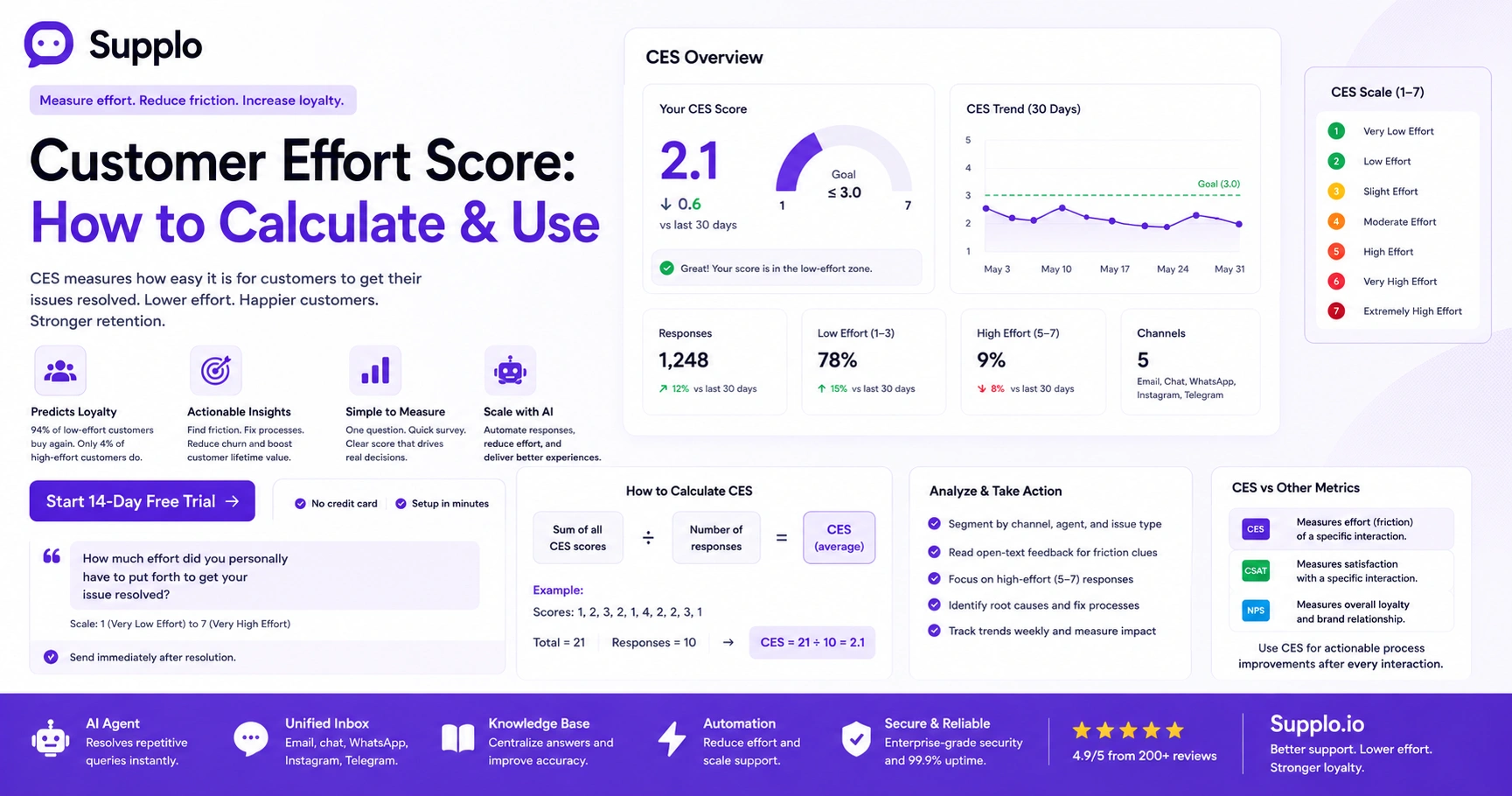
Straight to the point: Customer Effort Score captures the perceived ease of a specific interaction with your company. You ask one question right after a ticket closes or a purchase completes. The score is the average of all responses, a single number that tells you how much friction your support process creates.
- Typically measured on a 1-7 scale (1=Very Low Effort, 7=Very High Effort) or a 5-point agreement scale.
- Industry benchmark for "good" CES: below 3.0 on a 7-point scale.
- A CES over 4.0 is often a leading indicator that customers are about to leave.
How to Calculate Customer Effort Score
This is where the rubber meets the road. Here's exactly how to calculate customer effort score, no fluff, just math.
Step 1: Collect all individual CES responses from your survey.
Step 2: Add up every single score.
Step 3: Divide that total by the number of responses.
That's it. The average is your Customer Effort Score.
Example:
Let's say you had 10 responses: 1, 2, 3, 2, 1, 4, 2, 2, 3, 1.
Total = 21. Number of responses = 10.
CES = 21 ÷ 10 = 2.1
- The formula: Total sum of all individual CES scores ÷ Total number of responses.
- Track over time. A single CES number is useful, but weekly or monthly trends tell the real story.
Ready to measure and reduce customer effort? Start your 14-day free trial at supplo.io to unify your support channels and deploy an AI agent that resolves tickets automatically.
What Is the CES Survey Question? Best Practices for Asking About Customer Effort
The classic CES question: "How much effort did you personally have to put forth to get your issue resolved?"
Other variations focus on time or ease: "How easy was it to get the help you needed today?"
The golden rule? Ask it immediately after a single interaction. One question. Clear and direct. Don't mix in satisfaction questions; you'll muddy the data.
- Use a 7-point Likert scale from "Very Low Effort" to "Very High Effort."
- Send the survey right after resolution, within minutes, not hours.
- One question only, plus an optional open-text field for context.
Sample Customer Effort Score Questions: Templates You Can Steal
Here are three proven templates. Copy, paste, deploy.
- Template 1 (Effort): "How much effort did you personally have to put forth to handle your request?"
- Scale: 1 (Very Low Effort) to 7 (Very High Effort)
- Template 2 (Ease): "How easy was it to get your issue resolved today?"
- Scale: 1 (Very Easy) to 5 (Very Difficult)
- Template 3 (Agreement): "The company made it easy for me to handle my issue."
- Scale: Strongly Agree to Strongly Disagree
Need a better way to collect CES feedback? Use Supplo's integrated survey tools right inside your live chat and email ticketing, no extra plugins. Start free at supplo.io.
How to Analyze CES Results and Turn Data into Action
Don't just stare at the average. That number hides the real story.
Segment your scores. By channel (chat vs. email vs. phone). By agent. By issue type. If your chatbot CES is 4.5 but your email CES is 2.1, the problem isn't your product; it's your bot.
Read the open-text feedback. "Had to repeat myself." "Couldn't find the answer." These phrases tell you exactly what to fix.
- Watch for the "detractor zone": Responses of 5, 6, or 7 on the CES scale.
- Correlate high CES with specific agents or processes. Then investigate.
- Track weekly. See if a process change actually reduced effort.
CES vs. NPS vs. CSAT: When to Use Each Metric
Here's the cheat sheet:
- NPS measures overall brand loyalty. Broad. Strategic.
- CSAT measures happiness with a single interaction. Emotional. Momentary.
- CES measures the friction of that interaction. Practical. Actionable.
If you want to predict churn, CES beats CSAT every time. If you want to assess brand perception broadly, use NPS. The best approach? Use CES for post-interaction feedback and NPS for quarterly relationship surveys.
- CES: Best for measuring process friction after a support ticket.
- CSAT: Best for measuring satisfaction after a purchase or specific interaction.
- NPS: Best for measuring overall brand loyalty and likelihood to refer.
Customer Effort Score Measurement Pitfalls to Avoid
Three mistakes I see teams make over and over:
- Bad timing. Sending the survey 24+ hours after resolution? Memory fades, and positive scores get inflated. Send it within 5-10 minutes.
- Bad scaling. A 5-point scale lacks granularity on the high-effort end. You can't spot severe friction with only two "bad" options.
- Missing context. No open-text field means you see a number but have no idea what to fix. Always ask "why."
- Bad timing: Survey sent 24+ hours after resolution inflates positive scores.
- Bad scaling: A 5-point scale can compress high-effort feedback into the middle.
- Missing context: No open-text box means you can't diagnose the source of friction.
How to Reduce Customer Effort with AI Support
The fastest way to lower your CES? Eliminate the root causes of customer effort: waiting, repeating information, and searching for answers.
AI-powered tools like Supplo's AI Agent handle up to 80% of repetitive tickets automatically. They answer questions instantly from your knowledge base, translate messages in real time, and, when a handoff to a human is needed, pass the full conversation context. No repeats. No frustration.
- Deploy an AI agent that resolves common issues (password resets, order status, account questions) instantly.
- Use a shared inbox so all conversations live in one thread, not scattered across email, chat, and DMs. Check out Supplo's Inbox.
- Unify channels across WhatsApp, Instagram, Telegram, and Facebook Messenger so customers don't have to switch apps. Supplo makes this seamless with dedicated integrations like WhatsApp and Telegram.
Supplo is not affiliated with any app or website. Please follow each app's terms and local regulations.
Using CES to Forecast Churn and Improve Retention
A consistently high CES is a red flag. If a customer's last three interactions scored 5 or higher, they are statistically far more likely to leave.
Proactive retention works. Reach out to those customers directly. Offer a personal apology or discount. But more importantly, fix the root cause of their friction.
- Set up automated alerts for any customer with a CES of 5+ on two consecutive tickets.
- Use CES data to identify which agent, product, or process causes the most friction.
- Offer high-effort customers a personal follow-up from a senior support rep.
Putting It All Together: A Simple CES Workflow for Your Team
Step 1: Add one CES question to your post-interaction survey.
Step 2: Calculate your baseline over one month.
Step 3: Segment by channel and identify the highest-effort interaction type.
Step 4: Deploy fixes, better self-service, AI automation, and agent training.
Step 5: Re-measure after 30 days to see if your changes reduced friction.
- Step 1: Deploy a 1-question CES survey immediately after ticket resolution.
- Step 2: Calculate your baseline CES and segment by issue type and channel.
- Step 3: Prioritize the highest-effort interaction type. Fix it. Re-measure.
Stop guessing what your customers are feeling. Measure CES accurately and reduce support friction with Supplo. Use our AI agent, shared inbox, and multichannel automation, starting at flat $0.04 per resolution. Try free now.
Key Takeaways
- CES measures customer effort: it quantifies how much work a customer had to do to get help.
- CES predicts loyalty better than CSAT: Low-effort experiences are more likely to lead to repurchases.
- Calculate CES with a simple formula: Sum all individual CES scores and divide by the number of responses.
- Use specific CES questions: ask about effort immediately after the interaction to obtain more accurate results.
- Analyze CES by segmenting scores: Identify high-effort areas and address them.
- Leverage CES with other metrics: Use CES for post-interaction feedback and NPS for overall brand loyalty.
- Avoid common CES pitfalls: Send surveys promptly, use detailed scales, and include open-text fields.
- Reduce effort with AI support: Deploy tools like Supplo's AI agent to handle repetitive tasks.
- Forecast churn with CES: High CES strongly indicates potential customer churn.
- Implement a CES workflow: Segment, analyze, fix, and re-measure regularly.
FAQ
What is the difference between CES and CSAT?
CES measures the effort a customer had to put in to get help, while CSAT measures overall satisfaction. CES is a better predictor of future loyalty because low effort drives repeat business.
When should I send a CES survey?
Send it immediately after a support interaction ends, within 5-10 minutes. Waiting hours or days introduces memory bias, which skews the score.
What is a good Customer Effort Score?
On a 7-point scale where 1 is low effort and 7 is high effort, a score below 3.0 is generally considered good. Scores above 4.0 indicate significant friction.
Can CES be used for sales interactions?
Yes. You can ask "How much effort did it take to complete your purchase today?" after a checkout or onboarding flow. It's not just for support tickets.
How many questions should a CES survey have?
One quantitative question (the CES rating) and one optional open-text field for context. Anything longer will tank your response rate.
Does CES work for chatbot interactions?
Absolutely. In fact, CES is the best metric for evaluating chatbot performance because it measures whether the bot solved the issue or forced a handoff to a human.
What should I do with a high CES score?
First, read the open-text feedback for clues. Then, investigate the specific interaction: was the agent lacking info? Was the process clunky? Fix the root cause, then re-measure after two weeks.
Compliance line: Supplo is not affiliated with any app or website. Please follow each app's terms and local regulations.