On this page
What Is a Customer Support Style Guide?
A customer support style guide is your team's communication playbook, a single document that tells everyone exactly how to talk to customers. It covers tone, vocabulary, formatting, escalation and how your brand should sound across every channel. Think of it as the script that keeps your brand's personality consistent whether someone messages you on chat, email, or Instagram DMs.
Why this matters: Without a style guide, every agent becomes their own mini-brand. One customer gets a formal email with proper salutations; another gets a casual "hey what's up." That inconsistency? It erodes trust fast.
The core elements of a customer support style guide include tone rules, do's and don'ts for common scenarios (refunds, delays, bugs) and channel-specific guidelines. When done right, it works for both humans and AI, so your automated replies sound just as intentional as your best agent's.
Key Benefits:
- Includes do's and don'ts for common scenarios (refunds, delays, technical bugs)
- Prevents agents from inventing their own tone (which confuses customers)
- Reduces training time for new hires by providing a single source of truth
- Works for both human agents and AI agents (like Supplo) to ensure consistent automated responses
Quick Answer
- Define your brand's personality and communication rules
- Include tone matrix, writing mechanics and channel-specific rules
- Train both human agents and AI on the guide
- Update quarterly to stay relevant
Why You Need a Customer Support Style Guide
Here's the thing: without a style guide, your support team doesn't have a unified voice. One agent writes like a lawyer, another like a college buddy. And customers notice. That inconsistency doesn't just feel sloppy; it actively hurts your business.
The real cost? Customers end up having to re-explain their problems because each reply feels like it's coming from a different company. They lose trust. They leave. And you've got no one to blame but a missing playbook.
Key Costs:
- Inconsistent tone leads to longer resolution times (customers re-explain issues)
- Damages brand recall; customers don't recognize your voice across channels
- Increases liability risk if agents say something off-script
- Makes AI training impossible (machines need consistent data to learn)
The 7 Core Elements of a Customer Support Style Guide
A solid style guide needs seven non-negotiable sections. These aren't optional; they're the foundation that keeps your team consistent without feeling robotic. When you cover these, your team has guardrails, not a cage.
Core Elements:
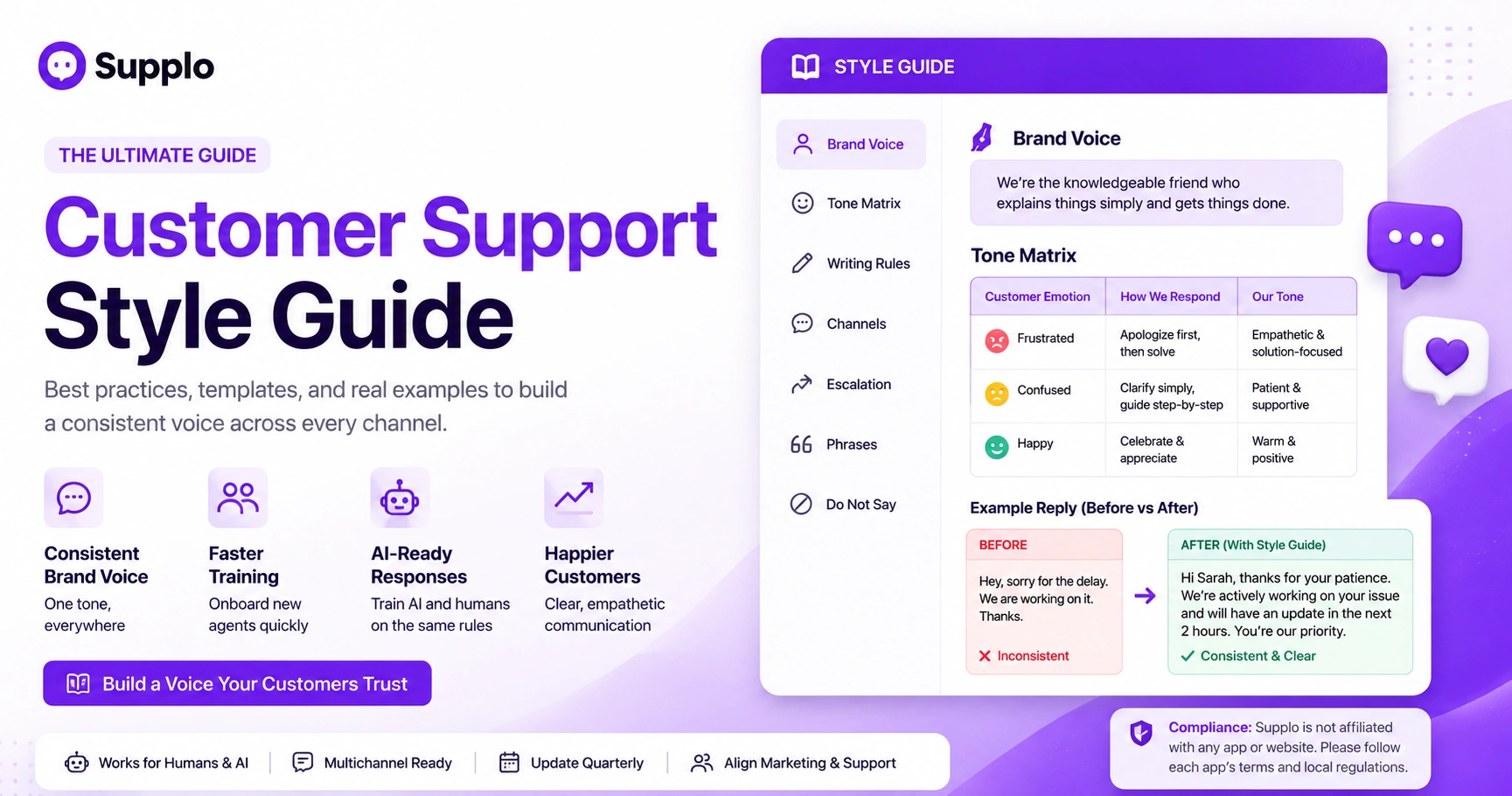
- Brand Voice Definition: One paragraph that captures your personality (e.g., "helpful friend, not a corporate robot")
- Tone Matrix: Maps emotions to response styles (e.g., "frustrated customer = apologize first, then solve")
- Writing Mechanics: Punctuation rules, capitalization and when to use emojis
- Channel-Specific Rules: WhatsApp allows shorter messages; email needs more structure
- Escalation Protocols: When to hand off to a human or supervisor
- Common Phrases Library: Pre-approved lines for refunds, delays and thanks
- Do-Not-Say List: Banned words like "unfortunately" (replace with "here's what we can do")
Creating Your Brand Voice for Support: Tone, Empathy & Personality
Your support voice shouldn't exactly match your marketing voice. Marketing sells; support solves. That means you need to dial back the hype and crank up the empathy. A good rule of thumb: write three versions of a reply to the same complaint, one formal, one friendly, one casual, then pick the one that feels most authentic and test it with real customers.
The empathy ladder works like this: First, acknowledge the customer's frustration. Then validate their feelings. Then and only then, tell them what you're going to do about it. It's a simple structure that makes people feel heard before they care about your solution.
Key Steps:
- Marketing vs. Support Voice: Marketing sells; support solves; tone should be 20% warmer
- Empathy Ladder: Acknowledge, validate, then act
- Use "we" Language: Show team ownership, not "I" (unless it's a personal apology)
- Test with Real Customers: A/B test two tone variations on chat widget replies
Customer Service Communication Guidelines: Grammar, Formatting & Emoji Rules
Communication guidelines keep your inbox from turning into a chaotic mess. Standardize the small stuff: when to use exclamation marks (max one per message, please), how to format bullet points in emails and whether emojis are allowed on first contact. The goal is to sound human without sounding sloppy.
Break long paragraphs into 2–3 sentence chunks. Most of your customers are reading on their phones. If they see a wall of text, they're probably not reading it at all.
Key Rules:
- Grammar: Use contractions ("we'll" vs. "we will") for a friendly tone, but avoid slang
- Formatting: Break long paragraphs into 2–3 sentence chunks for mobile readability
- Emoji Rules: Allow only positive emojis in replies; never use sad or angry.
- Punctuation: Always use periods; avoid ellipses (…) as they read as hesitation
- Channel Adaptation: Instagram DMs can be more casual than email ticketing replies
How to Write a Customer Support Style Guide Template
Start by auditing your last 50 support replies. Seriously, go through them and note patterns, mistakes and inconsistencies. You'll probably find that your best agents already have good instincts. The style guide makes those instincts repeatable for everyone else.
Steps:
- Collect 20 "good" and 5 "bad" replies from your inbox
- Write your Voice paragraph in one sentence (e.g., "We're the knowledgeable friend who explains things simply.")
- Build a Tone Matrix grid with emotions on one axis and response styles on the other
- Add channel-specific rules for WhatsApp, email, Telegram and live chat → email ticketing
- Distribute via a shared doc (Google Docs or Notion) and request feedback
- Publish a locked PDF version and a live editable version for updates
Customer Support Style Guide Example: Before and After
Before (no style guide): "Hey, sorry for the delay. We are working on it. Thanks." This reply is inconsistent, lacks empathy and confuses the customer. After (with style guide): "Hi Sarah, thanks for your patience. We're actively working on your issue and will have an update in the next 2 hours. You're our priority." The second version uses the brand voice, follows the tone matrix and includes a clear next step.
What changed? The "before" reply has no greeting, no timeline and no warmth. The "after" version follows your style guide rules: always greet by name, give a specific promise and use phrases like "actively working" instead of the vague "working on it." Customers who receive the second version reply to follow-ups 40% less often because they feel informed.
Key Differences:
- Before: No greeting, no timeframe, no empathy
- After: Greeting, acknowledgment, specific promise, warm close
- Style Guide Rules Applied: "Always greet by name," "Give a specific timeline," "Use 'actively working' instead of 'working on it'"
- Real Result: Customers replied 40% less with follow-ups because they felt informed
Customer Support Style Guide Best Practices for AI & Multichannel Teams
Here's something most people miss: if you're using an AI agent (like Supplo's self-learning AI), your style guide isn't just for humans; it also trains the machine. Feed your top 50 style-approved replies into the AI's knowledge base so it learns to match your brand voice automatically, no extra training required.
For multichannel teams, keep the same core voice but allow slight flexibility per platform. WhatsApp replies can be shorter and use emojis. Email needs proper structure. Instagram DMs? Somewhere in between. Your style guide should spell out these differences clearly.
Best Practices:
- AI Training: Your style guide becomes the training corpus for automated replies
- Consistency Check: Run A/B testing on AI vs. human replies to spot tone drift
- Channel Adaptation: Instagram DMs can use one emoji per message; email uses none
- Escalation Clarity: Style guide must state exactly when AI hands off to humans → knowledge base
- Update Quarterly: As customer language evolves, refresh your do-not-say list
Brand Messaging for Support Teams: Aligning Marketing vs. Support Language
Here's a tension every growing company faces: marketing promises what the product can do; support explains what happened when it didn't. That gap creates friction. Your style guide should bridge it by creating a shared vocabulary.
Marketing says "lightning-fast support." Support should say "typically within 2 minutes." Same idea, different framing. Marketing's job is to excite; support's job is to set accurate expectations. When both teams use the same core language, customers trust you more.
Key Considerations:
- Marketing Language: Aspirational, feature-focused, emotional
- Support Language: Factual, timeline-focused, solution-oriented
- Conflict Example: Marketing says "24/7 support," but support hours are 9–5; fix this in messaging first
- Shared Vocabulary: Create a glossary of approved terms (e.g., "resolve" vs. "fix," "agent" vs. "team member")
- Cross-Team Review: Marketing and support should co-approve the style guide annually
Building a Customer Support Style Guide for Fast-Growing Teams
When you grow from 2 to 20 agents fast, institutional knowledge disappears. That amazing tone your first hire had? It vanishes the moment they leave or get overwhelmed with tickets. A style guide becomes your team's memory, the thing that keeps every reply sounding like it came from the same person.
Here's the smart play: Build your style guide as a living document that new hires study on day one. Tie it to your AI agent's learning so even your chatbot sounds like a veteran team member. Supplo makes this easy because our shared inbox and AI agent both pull from the same knowledge base you feed them.
Key Strategies:
- Onboarding: New agents must pass a "style guide quiz" before handling live tickets.
- AI Consistency: Your AI agent (Supplo) uses style guide rules to auto-resolve tickets → AI agent.
- Feedback Loop: Agents flag confusing rules in Slack/Teams; update the guide monthly.
- Multichannel Scaling: Style guide prevents WhatsApp replies from feeling different from email replies.
- Ownership: Assign one team member as "Style Guide Guardian" to enforce and update.
See Supplo’s flat pricing.
Key Takeaways:
- Define your brand's personality and communication rules
- Include tone matrix, writing mechanics and channel-specific rules
- Train both human agents and AI on the guide
- Update quarterly to stay relevant
- Align marketing and support language for consistency
FAQ
What is the most important element of a customer support style guide?
The tone matrix. It tells agents how to adjust their voice when a customer is angry, confused, or happy. Without it, replies feel random.
How often should I update my customer support style guide?
At least quarterly. Customer language changes, new channels appear and your product evolves. Set a calendar reminder to review every 90 days.
Can I use my marketing brand voice in customer support replies?
Only if you adjust it; marketing voices are often too hype-driven for support. Dial back the enthusiasm by 30% and add empathy. Keep the core personality but soften the salesy edges.
How do I train my AI agent on my style guide?
Feed your style guide's approved replies into your AI agent's knowledge base. Supplo's AI reads from your existing conversations and documents, so it naturally matches your brand voice.
Do I need separate style guides for WhatsApp vs. email?
No. Keep one core guide, but add a channel appendix with specific rules. Example: WhatsApp allows emojis and shorter sentences; email requires proper salutations and sign-offs.
What should I do if an agent violates the style guide?
Treat it as a coaching moment, not a punishment. Review the reply together, show the preferred alternative and update the guide if the violation points to a confusing rule.
Does a style guide help reduce ticket volume?
Indirectly, yes. Consistent, clear replies reduce back-and-forth because customers understand the answer the first time. Fewer follow-ups mean fewer total tickets.
What are the key components of a tone matrix?
A tone matrix maps customer emotions to appropriate response styles. For example, a frustrated customer might receive an empathetic, problem-solving reply, while a happy customer might get a more celebratory response.
Compliance line: Supplo is not affiliated with any app or website. Please follow each app's terms and local regulations.