On this page
Introduction
Let's be real, AI customer support for e-commerce isn't some futuristic gimmick anymore. It's what your customers expect, and honestly, it's what keeps your team sane. This guide walks you through building automated support that actually works, no fluff, no overpromising, just practical steps you can take today.
Whether you're running a Shopify store, managing a WooCommerce site, or juggling multiple channels, you'll find actionable advice here. We'll cover what makes AI support reliable, where it falls short, and how to set up a system that your customers will actually thank you for.
Quick Answer
- Reliable AI handles common tasks like order status and returns.
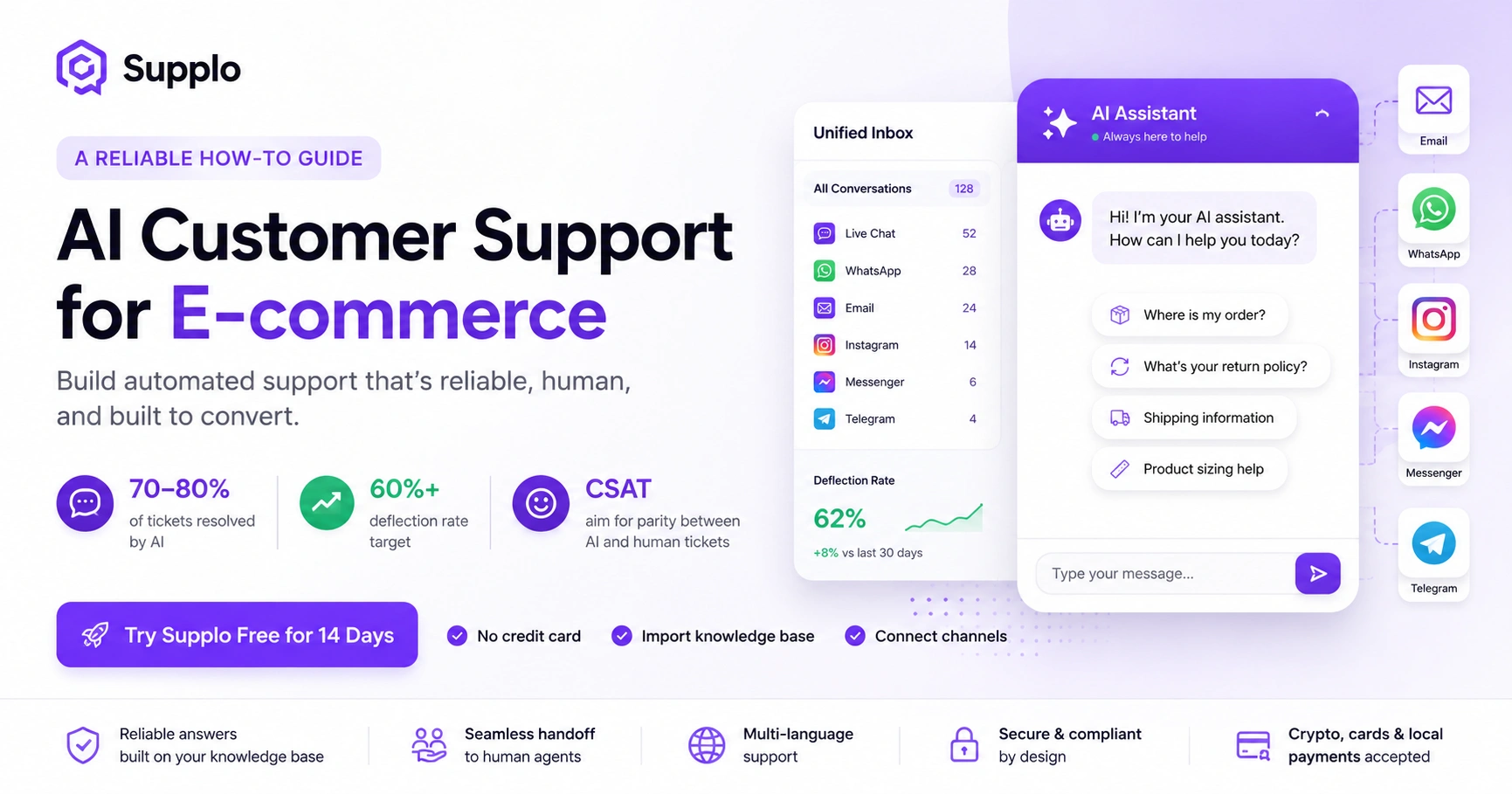
- Automate the first five common questions to resolve 70-80% of volume.
- Use a unified inbox to manage all support channels.
- Measure success with metrics like deflection rate and CSAT.
Why Reliability Matters More Than Speed in E-commerce Customer Service
Here's the thing: customers will forgive a slightly slower response if the answer is actually correct. Speed without accuracy? That's just fast frustration.
In e-commerce, one wrong AI answer can cost you a sale and earn you a nasty review. Imagine your chatbot telling a customer a product is in stock when it's not, or promising a physically impossible shipping window. That's not just embarrassing, it's expensive.
- A reliable AI agent builds trust. Shoppers come back when they know your chatbot consistently provides accurate information. It's that simple.
- Common failure point: AI guessing return policies or stock availability. A solid knowledge base prevents this entirely.
- Speed without reliability leads to more escalations, not fewer. Your human team ends up cleaning up messes rather than addressing real problems.
Your self-learning AI agent needs to be trained on verified data, not just scraped from the web. That's where a properly maintained knowledge base comes in.
E-commerce Chatbot Best Practices for a Trustworthy Customer Experience
A trustworthy chatbot starts with honesty. Your bot should clearly state when it's AI and when it might hand off to a human. No tricks, no pretending to be a person.
Best practices? Train your bot only on verified knowledge base content. Set fallback phrases that don't frustrate. Something like "Let me get a human for you" works way better than "I don't understand." And never, ever let the AI promise something it can't deliver.
- Always include an "I'm not sure, let me transfer you" option. Confident wrong answers are the fastest way to lose trust.
- Test your chatbot weekly by asking typical order-status questions. You'll catch drift or knowledge gaps before they become problems.
- Use conversation logs to identify where customers get stuck. Update your training data accordingly; it's a living system, not a set-it-and-forget-it tool.
How to Set Up Your AI Chat Widget for Maximum E-commerce Conversion
Think of your chat widget as your digital storefront greeter. But here's the mistake most stores make: they only put it on the home page, big miss.
Place your widget on product pages and checkout pages, that's where cart abandonment happens. Set proactive triggers: show a chat bubble after 30 seconds on a product page, or when a user adds an item to their cart but hesitates.
- Widget timing matters. Don't pop up immediately. Give the shopper a moment to browse first. Nothing's more annoying than a chat bubble blocking the product image you're trying to look at.
- Mobile-first design is non-negotiable. Your widget must be thumb-friendly and absolutely cannot block the checkout button. Test this on an actual phone, not just a browser resize.
- Use the widget to answer sizing, shipping, and return questions in real time. These are top conversion killers; solve them instantly, and you'll see the difference.
Ready to see it in action? Try Supplo free for 14 days. Import your knowledge base, connect your channels, and let AI handle your first 100 tickets, no credit card required. Start a free trial at Supplo.io.
Automating E-commerce Support Without Losing the Human Touch
Automation should handle the boring stuff, order status checks, password resets, and tracking number requests. That frees your humans to handle the messy, emotional stuff like damaged items or VIP customer issues.
The trick? Set clear automation boundaries and design handoff workflows that feel seamless to the customer. They shouldn't feel like they're being passed around.
- Automate the first five common questions. You can typically resolve 70-80% of volume without a human. That's huge.
- For emotional issues, let the customer opt out of the bot immediately. No one wants to argue with a chatbot about a refund. Give them an escape hatch.
- Personalize automated responses with the customer's name and order number from your CRM integration. It makes a difference.
Your AI agent is only as good as its fallback. If your chatbot keeps giving wrong answers, it's time for a better-trained alternative. Supplo's AI learns from your actual conversations and updates in real time.
Building Your AI Helpdesk for Ecommerce: What Your Knowledge Base Needs
Your AI agent is only as smart as its training data. Period.
A good e-commerce knowledge base includes return policies, shipping cutoffs, size guides, care instructions, and FAQs for common scenarios. Keep it updated weekly, especially during holiday seasons when policies shift constantly.
- Organize knowledge base articles by customer journey stage: pre-purchase, checkout, post-purchase, returns. This makes it easier for both AI and humans to find what they need.
- Include visual examples, screenshots of tracking pages, and size charts that the AI can reference via links. Visuals help customers understand faster.
- Regularly audit for outdated info. Nothing erodes trust faster than a bot quoting last year's holiday shipping deadline. Set a calendar reminder if you have to.
You can set up a knowledge base in hours, not weeks. The key is keeping it current.
Online Retail Customer Support Tips to Reduce Ticket Volume and Boost Satisfaction
Want fewer tickets? Add a prominent FAQ section on your site and in your checkout flow. It's that straightforward.
Common tickets like "Where is my order?" or "How do I return this?" can be cut by 40% with a self-service portal. Train your AI to answer those before a human ever sees them.
- Add a "Quick Answers" section on your contact page. Customers often prefer self-service; they don't want to talk to anyone, they want answers.
- Use AI sentiment analysis to flag frustrated customers and prioritize them for human response. Angry customers need empathy, not scripts.
- Track the "deflection rate," the percentage of tickets resolved by AI without escalation. Aim for 60%+. It's a solid benchmark.
E-commerce Customer Service Strategy: When to Escalate from AI to Human
Not all issues belong to AI. Know when to hand off.
Escalate immediately when the customer requests a refund, reports a fraudulent charge, or raises legal or compliance concerns. Also, escalate when the AI detects anger or frustration based on language patterns; those situations need empathy, not automated responses.
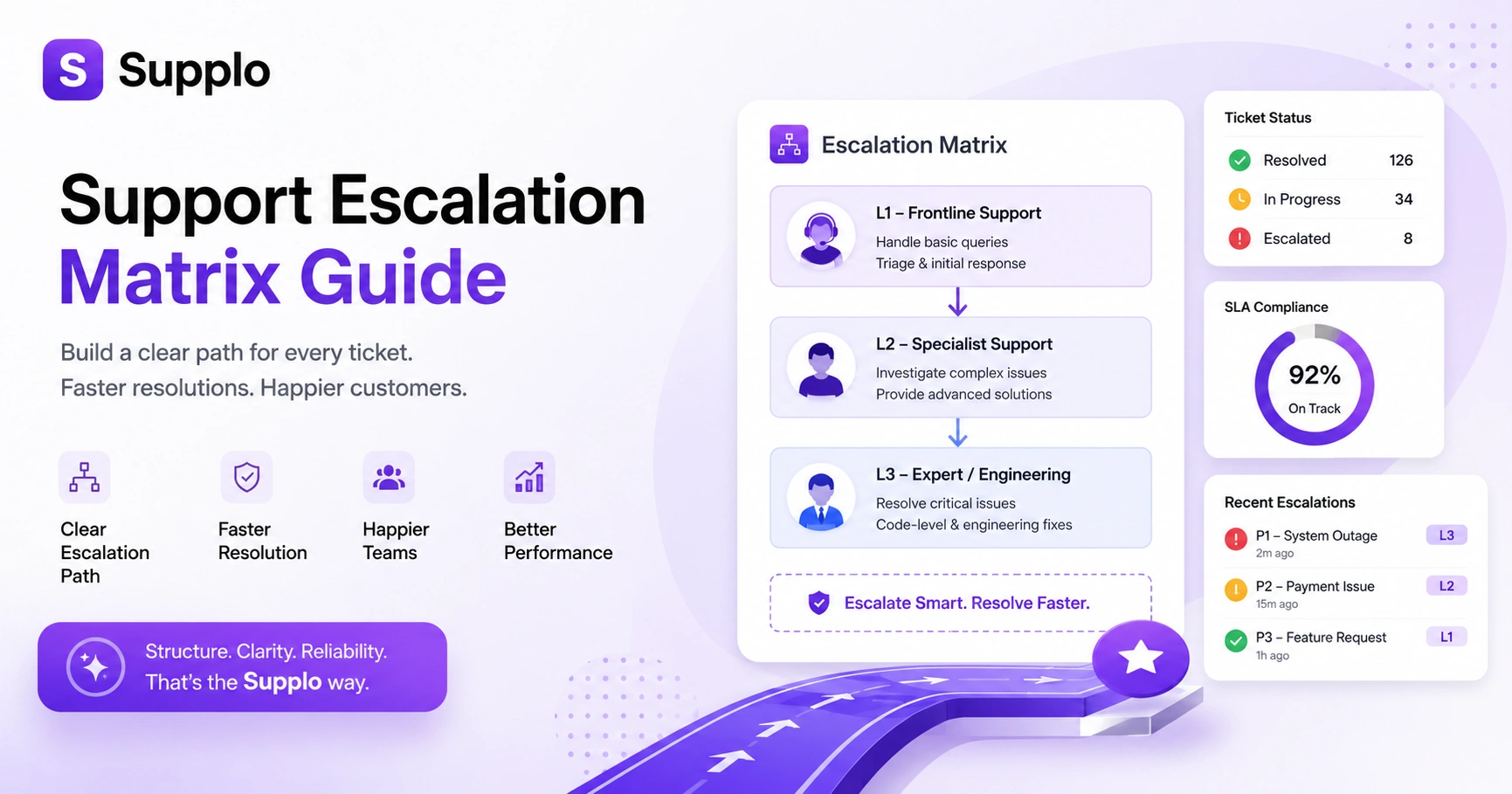
- Create a "triage matrix" that maps common issue types to AI, human, or automated escalation. Make it visible to your whole team.
- Set a limit on AI conversation turns, say, 3 exchanges, before suggesting a human. Don't let the bot loop forever.
- Train your team to handle the escalated ticket with the full conversation history visible. Nothing frustrates customers more than having to repeat themselves.
Best E-commerce Customer Care Practices for Multichannel Support
Customers expect consistent answers across email, live chat, WhatsApp, Instagram DMs, and Facebook Messenger. If they get different answers on different channels, they'll lose trust fast.
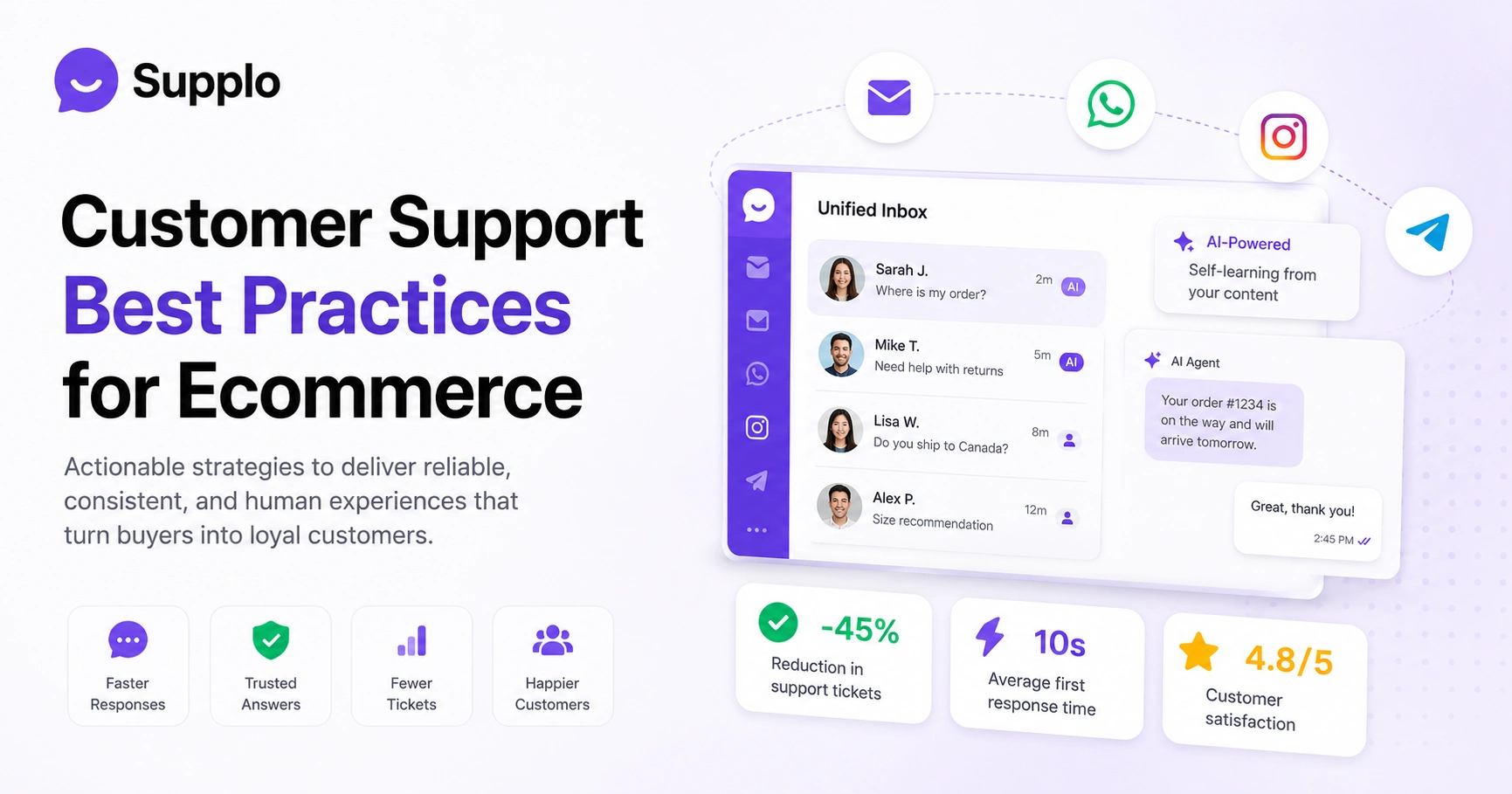
A unified inbox that threads all channels, like Supplo's, ensures no question gets lost, and the AI agent has context no matter where the conversation started.
- Avoid channel silos. If a customer starts on chat and switches to email, the AI should know the history. No repeating themselves.
- Set channel-specific response time SLAs. Chat under 1 minute, email under 4 hours. Be realistic but ambitious.
- Use AI to translate messages in real time across languages. You don't need separate teams for different languages; the AI handles it.
Supplo is not affiliated with any app or website. Please follow each app's terms and local regulations.
Real-Time Support for Online Stores: Live Chat vs. AI Agent Handoff
Live chat is still king for complex issues. But AI handles the volume. The sweet spot? An AI-first model where the bot resolves the easy stuff in seconds and hands off to a live chat agent for the hard stuff.
The customer never waits for a human for simple questions. That's the goal.
- Set AI to handle: order status, product info, shipping policy, basic troubleshooting.
- Humans handle: pricing negotiations, damaged goods, account security issues, VIP support.
- The handoff should feel seamless. Don't make the customer repeat their question to the human. The context should transfer automatically.
You can connect WhatsApp for support and other channels to make this work seamlessly.
Measuring Success: Key Metrics for Your E-commerce Customer Experience Improvement
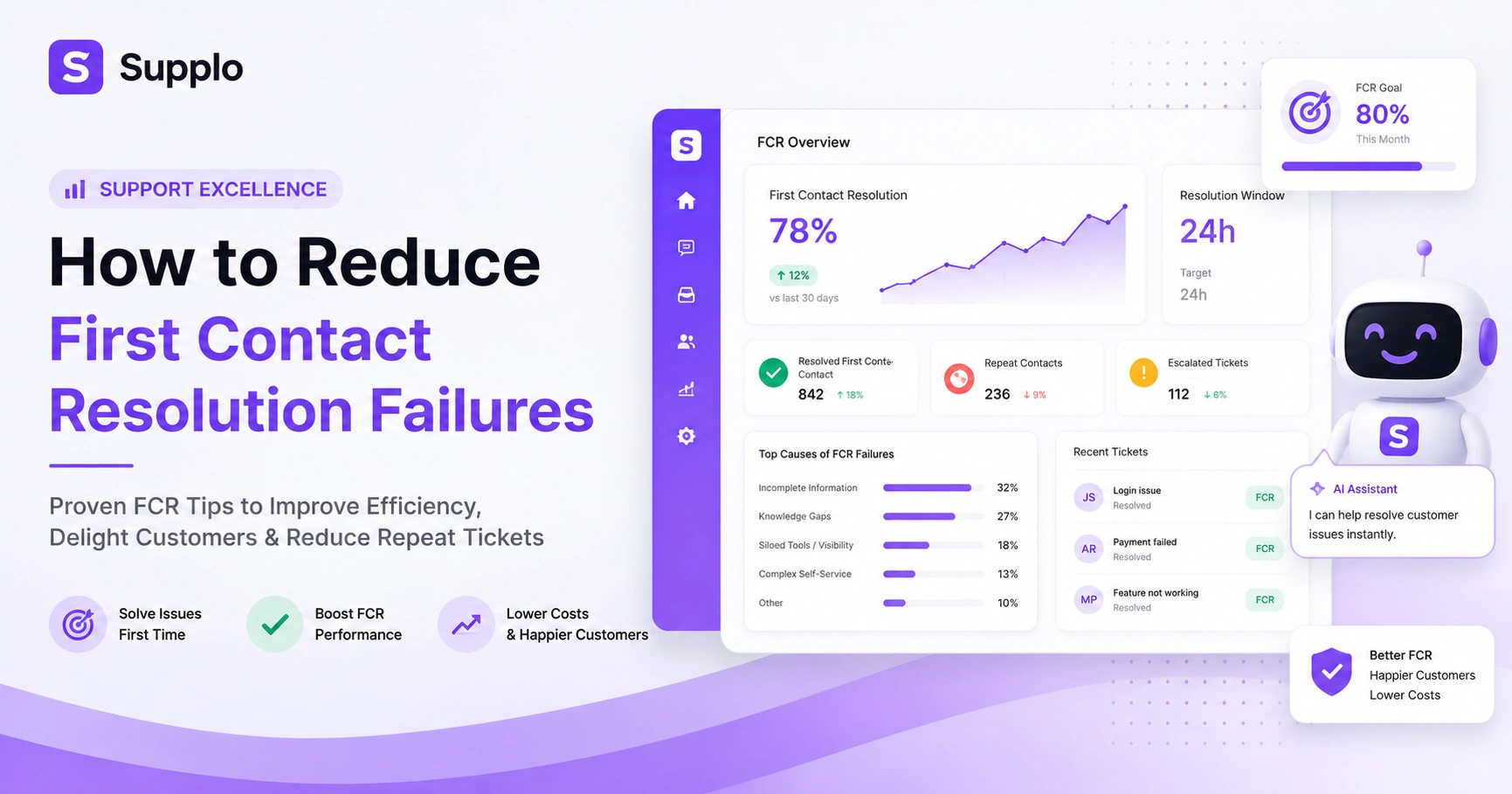
Track these three metrics: First Contact Resolution (FCR) rate, Average Handle Time (AHT), and Customer Satisfaction Score (CSAT).
For an AI-driven support model, also monitor Deflection Rate and AI Accuracy Score. A reliable system sees FCR above 70% and AI accuracy above 90% before human intervention.
- Compare CSAT scores between AI-resolved tickets and human-resolved tickets. Aim for parity; if AI scores are lower, something's off.
- Track "recontact rate": how often a customer returns for the same issue after AI resolution. Low recontact means the AI got it right the first time.
- Use sentiment analysis to spot emerging issues before they flood your inbox. Proactive beats reactive every time.
E-commerce support shouldn't cost you a fortune. At $0.04 per AI resolution (not $0.99 like legacy tools), Supplo keeps your support budget under control. Plus, we accept crypto (Binance Pay, Payeer, GCash, AmanPay), Skrill, Payoneer, and local payment methods like Nigerian and South African cards, DOKU, and QIWI Wallet. Check pricing.
Key Takeaways
- Reliable AI customer support starts with a well-maintained knowledge base
- Best practice: let AI handle order status, shipping, and FAQs; escalate refunds, damaged goods, and angry customers to humans immediately
- Measure success by deflection rate, first contact resolution, and CSAT parity between AI and human tickets
- A unified inbox across email, chat, WhatsApp, Instagram, and Telegram prevents channel silos and keeps context intact
FAQ
How quickly can I set up AI customer support for my e-commerce store?
If you start with a pre-built solution like Supplo, setup takes a few hours, including importing your knowledge base and connecting channels like email, WhatsApp, and live chat. Most store owners live within a day.
Will an AI chatbot handle returns and refunds correctly?
Only if your return policy is clearly documented in the knowledge base. The AI can explain the policy and initiate the process, but for complex or sensitive returns, escalation to a human is safest.
Can the AI support customers in multiple languages?
Yes. Modern AI agents with built-in translation can support hundreds of languages. The key is to ensure your knowledge base is accurate in your primary language; the AI translates responses in real time.
What happens when the AI doesn't know the answer?
The best AI agents have a "fallback flow" that politely says, "I'm not sure, but let me connect you with a support specialist." This prevents misinformation and maintains trust.
Will customers know they're talking to a bot?
They should. Transparency builds trust. Always label the AI agent as "AI Assistant" or "Bot," and give customers an easy way to request a human at any time.
How do I train the AI to understand my specific products and policies?
Upload your existing FAQs, product descriptions, shipping policies, and return rules into the knowledge base. The AI learns from those documents and from past conversations to improve over time.
Can the AI integrate with my e-commerce platform (Shopify, WooCommerce, BigCommerce)?
Yes. Most modern AI support platforms offer direct integrations with major e-commerce backends, allowing the AI to pull real-time order and inventory data for accurate responses.
Compliance line: Supplo is not affiliated with any app or website. Please follow each app's terms and local regulations.