On this page
Let’s be real for a second: your customers don’t care about your internal workflows. They want a straight answer, fast. And if they get a wrong one, you’ve lost more than just that sale. Reliable support is the real backbone of any ecommerce store that actually grows. It’s not just about hitting a reply in three seconds or throwing a chatbot on your homepage. It’s about giving consistent, accurate answers that make people trust you enough to buy again.
So, what does that look like in practice? Let’s walk through the essential customer support best practices for ecommerce that actually move the needle.
Quick Answer
- Prioritise reliability: A slow but correct answer beats a fast wrong one every time.
- Reduce ticket volume proactively: A good knowledge base and smart AI can stop questions before they’re asked.
- Unify communication channels: One inbox for email, chat and DMs means nothing slips through the cracks.
- Leverage AI for efficiency: Let it handle the easy stuff, so your team can focus on the tricky, emotional cases.
- Train agents effectively: Give them empathy, clear rules and the power to make judgment calls.
Why Reliability Is the Missing Piece in Most Ecommerce Customer Support Strategies
Most stores obsess over speed or the latest automation toys. But they miss the big one: reliability. I’m talking about consistent, accurate answers that don't leave a customer guessing if you actually know what you’re talking about. Reliability means your support is there when promised, fixes the issue on the first try and doesn't lose the thread between email and live chat.
Here’s the thing: a slow but correct answer converts better than a fast, wrong one every single time. When your inboxes are fragmented (email over here, Instagram DMs over there), tickets fall through the cracks. A self-learning AI that trains on your own knowledge base builds that consistency, giving customers the same high-quality info no matter how they reach you.
Best Practices for Ecommerce Customer Service That Actually Reduce Ticket Volume
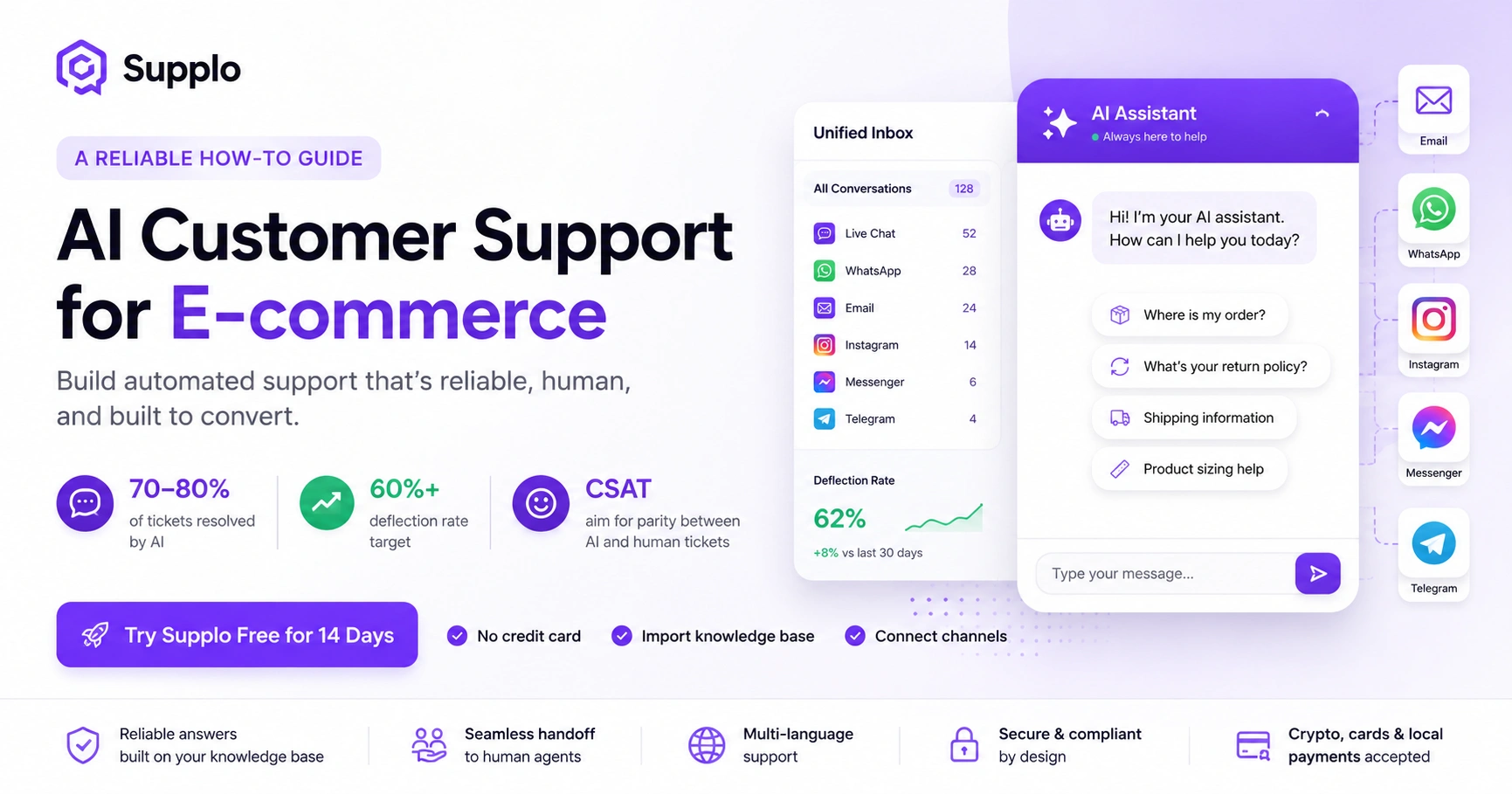
The best support strategy is the one where you never have to answer the question in the first place. Seriously. A solid knowledge base, clear shipping and return policies and automated order updates can significantly reduce the volume of repetitive tickets. Train your AI on past conversations so it responds like your best agent, not a clueless robot.
Make your FAQ or help centre visible on your site and link to it in every automated email. Use proactive chat triggers for things like time on page or an abandoned cart. Teach your self-learning AI agent the common stuff: tracking, sizing, returns- so it resolves issues without ever needing to escalate.
Ready to see how a self-learning AI can cut your support tickets? Start your free trial at https://supplo.io and test with your own store for 14 days.
Ecommerce Live Chat Best Practices: Speed, Tone and Escalation
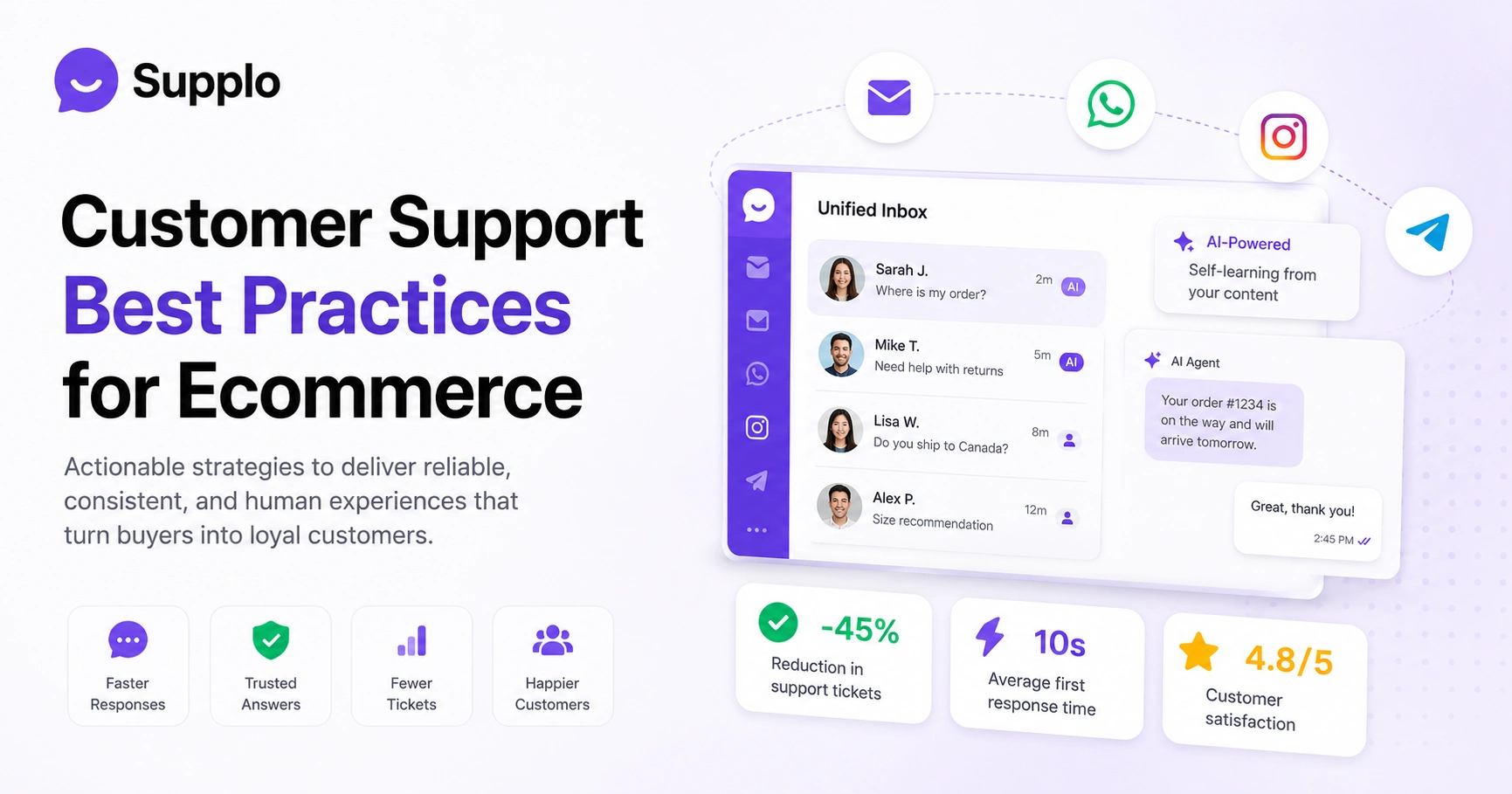
Good live chat feels human, even when it's AI on the other end. Try to get that first response out in under 10 seconds, but don't rush it so much that you get the facts wrong. Use a friendly, conversational tone that sounds like your brand and always, always give the customer a clear path to a human if the issue gets messy.
Greet customers by name and reference their cart or order to personalise the chat. Set expectations upfront: if the AI can’t solve it, it says so and hands off cleanly. Monitor your chat transcripts weekly to spot recurring pain points you can bake into your automation.
How to Choose the Best Live Chat for Ecommerce Without the Bloat
You don’t need a Swiss Army knife with 100 features you’ll never touch. The best live chat for ecommerce unifies your email, chat, WhatsApp, Instagram and Telegram into one shared team inbox. It includes a self-learning AI and charges transparently, ideally not per seat. Avoid legacy tools that bill you per resolution; that’s just punishing you for success.
Multichannel unification is non-negotiable. Don’t let tickets get lost across siloed inboxes. Your AI should learn from your content, not a generic model, so the answers stay spot-on. If you need to include Instagram DM support, find a tool that does it natively. And look for flat pricing per workspace, not per agent, so your costs scale with your growth.
Ecommerce Chat Widget Best Practices: Placement, Timing and Triggers
Don’t slap that chat widget on every page and call it a day. Place it where people actually get stuck: on product pages, in the cart and at checkout. Use time-based triggers (like after 10 seconds on a page) or behaviour-based triggers (like when someone’s mouse heads for the browser close button).
Don’t load the widget on the homepage unless it stays hidden until the visitor scrolls or clicks. Add proactive offers, such as “Need help choosing a size?”, to product detail pages. And for the love of good UX, always include a way to minimise or close the widget completely. Forcing it to stay open frustrates people.
Not sure if your chat widget is set up for conversions? Try Supplo's free 14-day trial and get a widget that triggers based on behaviour, not guesswork.
Real-Time Support for Ecommerce: When AI Handles It and When Humans Take Over
Real-time support doesn’t mean a human has to reply instantly to every single message. AI can handle around 80% of common inquiries, order status, return policies and shipping times quickly and accurately. The key is a seamless handoff when the AI detects a complex issue, strong emotion, or something it genuinely can’t answer. Customers want to know they’ll speak to a human without having to repeat themselves, whether that’s via live chat or through WhatsApp support integration.
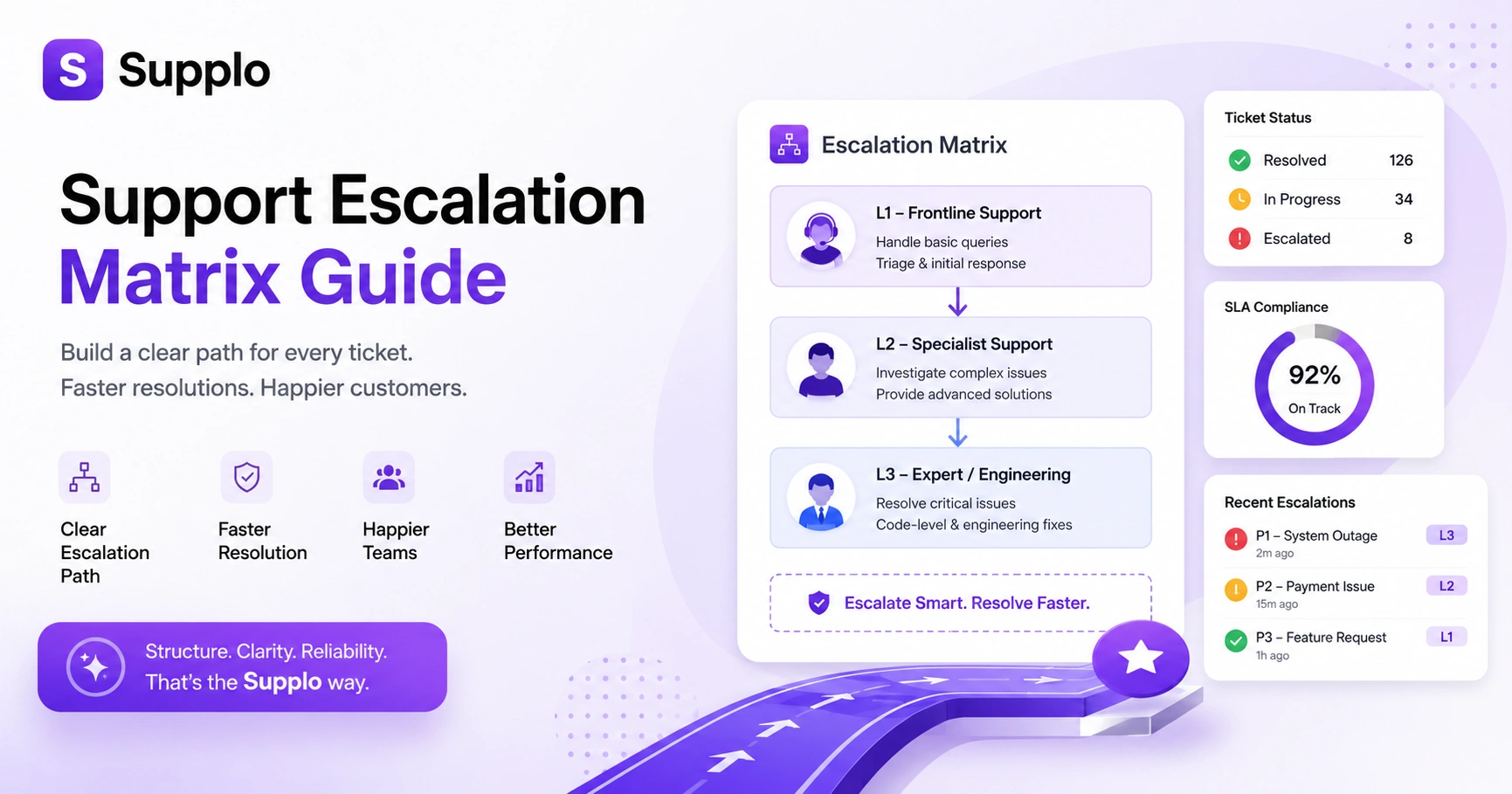
Let the AI route tickets by sentiment: calm = AI; frustrated = human. Make sure the handoff includes the full conversation history so the human doesn’t ask for context again. Train your AI to say “Let me get someone who can help better” instead of giving a generic error message.
Ecommerce Customer Support Training: Skills Every Support Agent Needs
Training goes way beyond just knowing your product catalogue. Your agents need empathy, conflict-de-escalation skills and the authority to make judgment calls regarding refunds or exchanges. Give them a clear escalation path and empower them to bend the rules slightly for loyal customers. Review tickets together as a team regularly to learn what’s working and what’s not.
Roleplay common complaint scenarios during onboarding so people practice staying calm when a customer is upset. Teach them to apologise, explain what went wrong and offer a specific solution. Using a shared inbox where agents can see each other's replies is a great way for the team to learn from real examples.
Best Practices for Ecommerce Support Agents Handling Complaints and Refunds
A well-handled complaint can turn a one-time buyer into a customer for life. Listen fully, validate the frustration and offer a resolution without making the customer jump through hoops. For refunds, make the process frictionless. If the policy allows, process the refund immediately without first asking for the item back.
Never use “per our policy” as a shield. Explain why the policy exists and offer a workaround when you can. For damaged or wrong items, issue a replacement or refund before you even ask for a photo. Then, follow up 48 hours after the resolution to make sure the customer is actually happy.
Supplo is not affiliated with any app or website. Please follow each app's terms and local regulations.
How to Measure Success in Ecommerce Customer Service Excellence
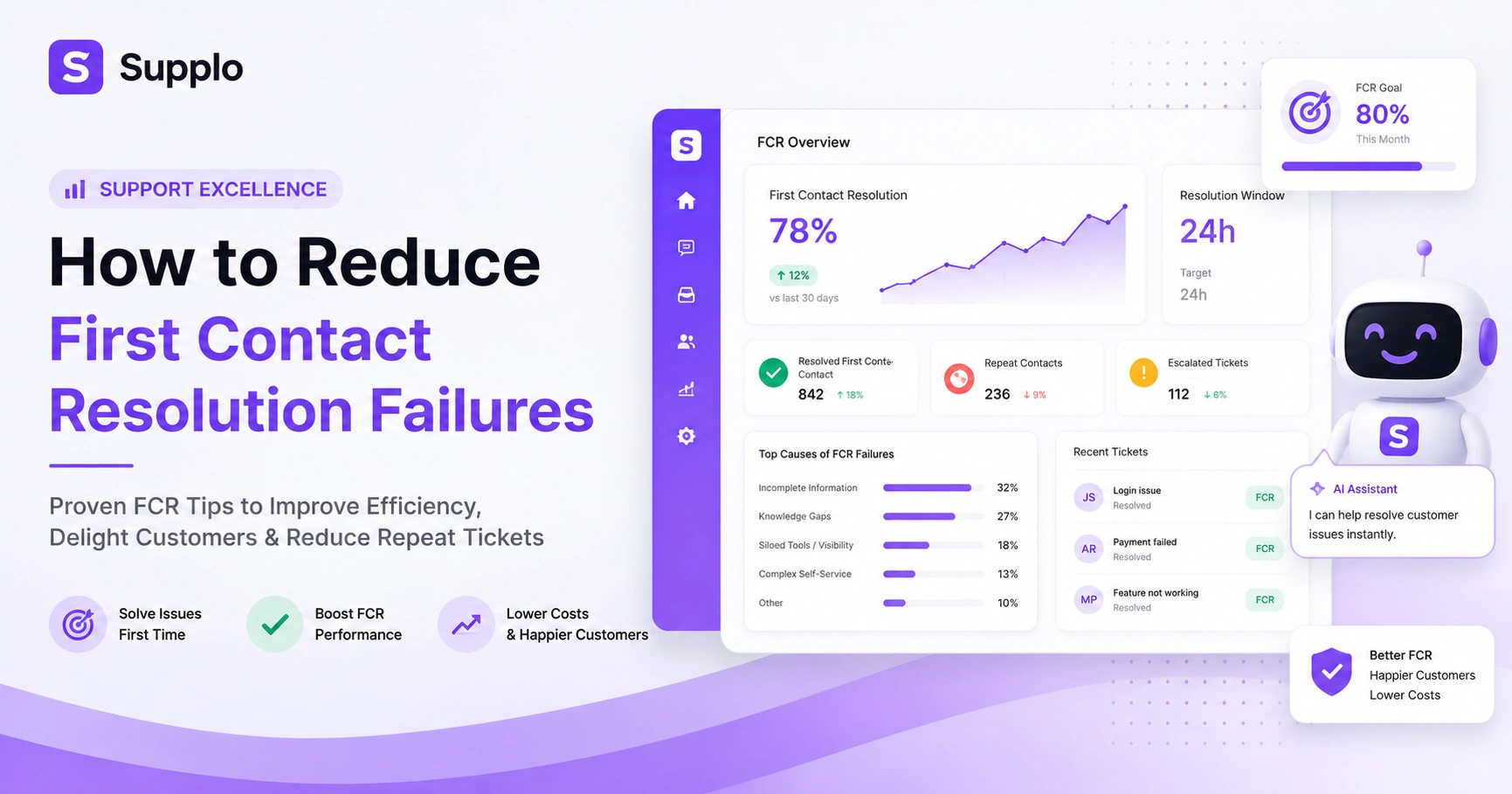
Don’t just stare at your CSAT score. Dig into first contact resolution rate, average handle time and ticket deflection rate. A high deflection rate with a steady CSAT means your AI is doing its job. Also, keep an eye on your repeat-contact rate for the same issue; that’s a red flag that your knowledge base or AI training has a gap.
First contact resolution (FCR) is the single best indicator of reliable service. Track which channels generate the most escalations and optimise those first. Use sentiment analysis on your transcripts to spot rising frustration before it ever hits your CSAT survey.
A Practical Ecommerce Customer Support Tips Checklist for Daily Operations
Here’s a simple daily checklist to keep things running smoothly: Check the shared inbox for any handoffs, review your AI agent logs for misinterpretations, update your knowledge base for new products or policies and confirm all your channels, like email ticketing, WhatsApp and Instagram DMs, are actually syncing. A ten-minute morning review can prevent a whole day of cascading issues.
- Monday: Review weekend ticket transcripts and update AI rules based on new patterns you see.
- Wednesday: Test the chat widget on both mobile and desktop to ensure it triggers correctly.
- Friday: Share one “win” and one “fix” from the week with the team.
Start Giving Reliable, Affordable Support Today
Reliable service isn’t a luxury anymore; it’s the price of entry for scaling your business. By implementing these best practices for AI, live chat, agent training and workflow management, you can reduce ticket volume, improve customer satisfaction and actually build loyalty. The right tools, like a unified inbox and a self-learning AI, make this kind of excellence practical and affordable.
Stop juggling five different support tools. Get a unified inbox with built-in AI, multichannel support and flat pricing at https://supplo.io. Start free today.
Key Takeaways
- Reliability is king. Consistent, accurate answers matter more than speed.
- Go proactive. A good knowledge base and AI can prevent tickets from being created.
- Balance speed and tone in live chat with clear escalation paths.
- The best tool is simple, unified channels, self-learning AI and transparent pricing.
- Place your chat widget strategically during moments of friction.
- Let AI handle routine stuff and hand off complex or emotional cases to humans.
- Train agents on empathy and empowerment, not just product specs.
- Make refunds and complaints easy to turn detractors into promoters.
- Track the right metrics, such as FCR and deflection rate, not just CSAT.
- A simple daily checklist can prevent small problems from becoming big ones.
FAQ
What are the most important ecommerce customer service best practices for a small store?
Focus on reliability: respond within 24 hours (or instantly with AI), unify your channels into one inbox and train your AI on your actual policies. A small store can't afford 20 different tools, so pick one that supports live chat, email and social DMs.
How do I choose the best live chat for ecommerce without overspending?
Choose a tool that charges per workspace, not per agent and offers a self-learning AI. Avoid platforms that bill per resolution; they penalise you for success. Look for free trials so you can test before committing.
Should I use AI for customer support or hire more agents?
Use AI for repetitive questions (order status, shipping times) and save human agents for complex complaints, refunds and emotionally charged conversations. This combo keeps costs low while preserving quality for high-stakes interactions.
How can I train my ecommerce support staff effectively?
Roleplay common complaint scenarios, give them a clear escalation path and empower them to make small judgment calls on refunds. Review transcripts as a team to identify areas for improvement. A shared inbox helps them learn from each other.
What chat widget best practices improve conversion rates?
Show the widget on product pages and checkout, not instantly on the homepage. Use behaviour-based triggers such as cart abandonment or exit intent. Keep the tone helpful and never force the widget to stay open.
How do I handle customer complaints on social media like Instagram or WhatsApp?
Acknowledge the complaint publicly (if needed) and move it to a private channel quickly. Use a unified inbox so every message is tracked. Respond with empathy, offer a clear solution and follow up after resolution.
What metrics should I track for ecommerce customer service success?
Track first contact resolution rate, average handle time, ticket deflection rate and CSAT. Also monitor repeat contact rate for the same issue; that's a sign your knowledge base or AI needs updating.
Compliance line: Supplo is not affiliated with any app or website. Please follow each app's terms and local regulations.