On this page
Quick Answer
Let's cut straight to it. First contact resolution rate (FCR) is the percentage of customer support issues you solve during the very first interaction- no follow-ups, no callbacks, no "let me check on that and get back to you."
Here's what you need to know upfront:
- A high FCR means happier customers and lower costs. It's that simple.
- You can boost FCR with a unified inbox, a smart knowledge base, and AI that actually learns from past conversations.
- Modern self-learning AI can handle up to 80% of everyday tickets on the first try, making great FCR achievable for teams of any size.
FCR Definition – What Does First Contact Resolution Rate Mean?
First contact resolution (FCR) rate measures how often your support team, or your AI agent, solves a customer's problem in one go. No repeats. No second chances needed. It's the kind of metric that separates "meh" support from "wow, they actually fixed it" support.
Here's what makes FCR tick:
- It applies everywhere: live chat, email, phone, WhatsApp, Instagram DMs, every single channel.
- FCR is calculated per ticket, not per agent. So it reflects how your whole system performs, not just one superstar rep.
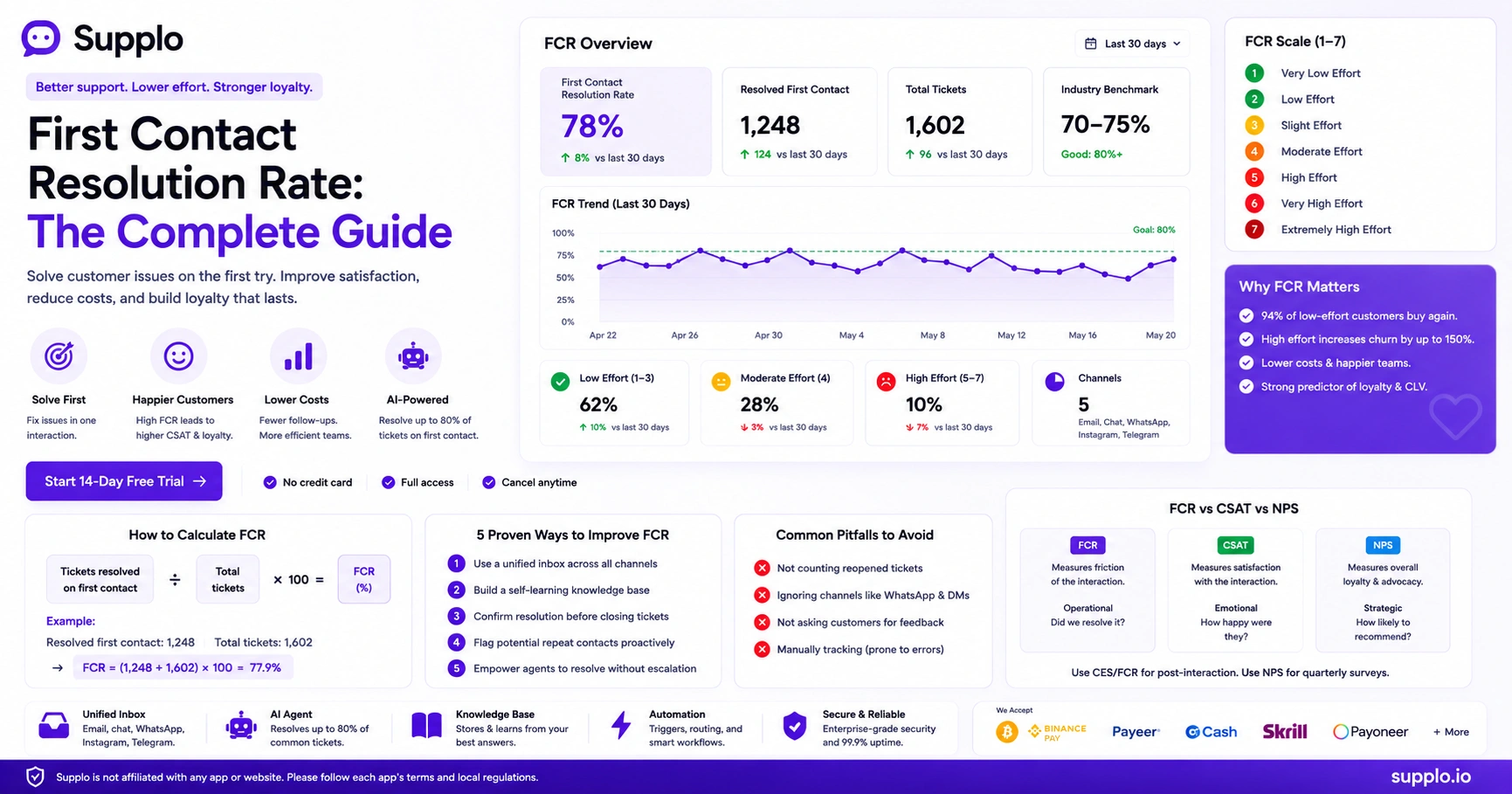
- Industry averages sit around 70-75%. The real standouts? They're hitting 80% or higher.
Think of it this way: FCR tells you how often your support operation gets it right the first time. When that number climbs, everything else tends to follow.
Why Is FCR Important? The Core Benefits of a High First Contact Resolution Rate
A strong FCR isn't just a vanity metric; it's a business driver. When customers don't have to repeat themselves, they trust you more. They're less likely to churn. And your team gets to spend their energy on complex problems instead of re-explaining the basics.
The ripple effects are real:
- Every avoided follow-up saves money and agent hours. Simple math.
- High FCR boosts first-pass satisfaction scores by a noticeable margin.
- Your team feels better when they're actually resolving things, not spinning their wheels.
For businesses juggling everything from email to Instagram DMs, FCR is the single most reliable sign that your support system actually works.
The Direct Impact of First Contact Resolution on Customer Satisfaction
Here's the thing about customer satisfaction: it's fragile. A customer who gets their issue fixed in one contact? They feel like you've got your act together. A customer who has to reach out two, three, four times? That frustration sticks, and no amount of follow-up sweetness can fully undo it.
The data backs this up:
- A single-resolution experience screams competence and reliability.
- Repeat contacts create higher effort scores, and effort is the real enemy of loyalty.
- FCR is actually a leading indicator of CSAT. Fix your FCR, and satisfaction usually follows.
First Contact Resolution Rate vs Customer Satisfaction – Understanding the FCR and CSAT Correlation
FCR and CSAT aren't the same thing, but they're dance partners. FCR measures the operational outcome: did we resolve it? CSAT measures the emotional outcome: were they happy?
Here's the tricky part:
- Low FCR + high CSAT often means your team is friendly but inefficient. Customers like you, but they're still coming back.
- High FCR + low CSAT usually indicate a resolution that technically worked but didn't really address the customer's underlying need.
- Tracking both together gives you the complete picture: are you reliable and satisfying?
Most teams find that when FCR improves, CSAT rises too. It's not guaranteed, but it's common enough to bet on.
How to Calculate Your First Contact Resolution Rate (FCR Formula)
The math is straightforward:
(Number of tickets resolved on first contact ÷ Total number of tickets) × 100
But here's where it gets tricky: defining "first contact." A ticket that the customer reopens? That's a non-resolution, even if your agent marked it as closed.
Key tracking rules:
- Include every channel: email, chat, WhatsApp, social DMs. If you miss a channel, your FCR is skewed.
- Watch for "silent repeats", when a customer starts a fresh ticket for the same issue.
- Automate tracking through your shared inbox or helpdesk software. Manual tracking is a recipe for errors.
The Hidden Cost of a Low FCR – What Happens When Resolutions Slip
A low first contact resolution rate isn't just a number on a dashboard. It's a leak in your budget. Every unresolved ticket requires a follow-up, which costs 2-3x as much to handle as the initial contact. Meanwhile, your customers are getting frustrated having to re-explain everything.
The downward spiral looks like this:
- Higher operational costs from duplicate contacts.
- Agent burnout from repetitive work and angry customers.
- Churn risk spikes, especially in subscription-based models.
Low FCR is often the hidden root cause of rising ticket volume and longer average handle times. Fix it, and many other problems start to shrink.
5 Proven Strategies to Improve Your FCR Without Overhauling Your Team
You don't need a complete rebuild. Small, smart changes can move the needle fast.
- Deploy a unified inbox that combines email, chat, and social DMs into a single thread. No more switching tabs or losing context. Unify your inbox.
- Build or connect a knowledge base that learns from past resolved tickets. Let your team (and your AI) find answers instantly. Use a self-learning knowledge base.
- Train agents to confirm resolution before closing a ticket. A quick "does this solve everything?" can prevent repeat contacts.
- Set automated triggers to flag potential repeat contacts for proactive outreach.
- Empower first-touch agents to resolve without escalating. Remove unnecessary bottlenecks.
Want to test these strategies risk-free? Start a 14-day free trial of Supplo with a unified inbox, knowledge base, and AI agent, no credit card required. See your FCR improve from day one.
Common FCR Measurement Pitfalls and How to Avoid Them
Most teams mess up FCR tracking in predictable ways. Here's what to watch for:
- Ignoring reopened tickets: If a customer reopens a ticket within 7 days, it should automatically be marked as unresolved.
- Excluding channels: Skipping WhatsApp or Instagram DMs hides a big chunk of unresolved contacts.
- Skipping customer surveys: Ask directly: "Was your issue resolved in this interaction?"
Fix these, and your FCR numbers will suddenly make a lot more sense.
If your FCR still looks low after cleaning up your tracking, try a tool that automatically monitors every channel. Supplo's shared inbox unifies email, WhatsApp, Telegram, and Instagram DMs into one thread, so you never miss a re-contact. Start free at supplo.io.
How FCR Drives Operational Reliability Across Support Channels
A high FCR rate signals that your entire support operation is reliable, not just one channel or one agent. When customers contact you via email and get a fast resolution, then reach out on WhatsApp and get the same quality, that consistency builds serious trust.
Why this matters:
- Reliable FCR across channels reduces customer effort and brand confusion.
- It enables smoother handoffs between AI and human agents without lost context.
- A multichannel FCR benchmark helps you identify which platforms need process improvements.
The Future of FCR – Why Self-Learning AI Is Changing the Metric
Here's where things get interesting. Traditional FCR improvement meant training humans, which is slow, expensive, and inconsistent. But self-learning AI agents can now resolve 80% of incoming tickets on first contact without escalation. And they get better over time because they learn from your knowledge base and past conversations.
What this means for your team:
- AI handles repetitive tickets instantly, freeing humans to focus on complex work.
- It tracks every channel- email, chat, WhatsApp, Telegram- from one inbox. Use AI for WhatsApp support.
- Flat per-workspace pricing (not per seat) makes AI gains accessible to teams of any size. Learn more about Supplo's AI agent.
The fastest way to a high FCR? A self-learning AI that handles first-contact resolutions at $0.04 each. Supplo's AI agent learns from your knowledge base and past conversations, handing off cleanly to humans when needed. Start your 14-day free trial today, no per-seat pricing, no surprises. Accepts payments via Crypto, Binance Pay, Payeer, GCash, AmanPay, QIWI Wallet, DOKU, Nigeria and South Africa cards, Skrill, and Payoneer.
Key Takeaways
- First contact resolution (FCR) measures the % of tickets resolved on the first interaction, no follow-up needed.
- A high FCR directly correlates with higher customer satisfaction (CSAT) and lower operational costs.
- Improving FCR involves a unified inbox, self-learning knowledge base, and AI agents.
- Self-learning AI can now resolve up to 80% of common tickets on first contact, making high FCR achievable for teams of any size.
- Tracking FCR accurately requires monitoring all channels and re-opened tickets.
FAQ
What is first contact resolution rate (FCR) in simple terms?
FCR is the percentage of customer support issues resolved during the very first interaction, with no follow-up needed. A high FCR means your team or AI solves problems efficiently on the first try.
How is FCR different from CSAT?
FCR measures operational success (was the issue resolved?), while CSAT measures customer sentiment (were they happy?). High FCR often leads to high CSAT, but the metrics track different parts of the experience.
What is a good first contact resolution rate?
Industry benchmarks range from 70% to 80%. Top-performing teams often hit 80% or higher, especially when using automation and a shared inbox.
Does FCR matter for chat support vs. email?
Yes, it matters for every channel: live chat, email, WhatsApp, or social DMs. Customers expect fast resolution regardless of how they reach you.
Can AI improve my FCR rate?
Absolutely. Self-learning AI agents can resolve up to 80% of common tickets on first contact by learning from your knowledge base and past conversations, which directly boosts FCR.
How do I measure FCR accurately?
Track tickets resolved on first contact divided by total tickets. Count reopened tickets or new tickets for the same issue as non-resolved. Use a unified inbox to get the full picture.
What hurts FCR the most?
Siloed channels, lack of a shared knowledge base, and requiring customers to repeat themselves across contacts. Poor agent empowerment also drags FCR down.
Compliance line: Supplo is not affiliated with any app or website. Please follow each app's terms and local regulations.