On this page
Feature requests can pile up fast. One day, you've got a handful of suggestions, the next, your inbox is flooded with customer ideas, complaints, and wish-list items. The trick? Having a system that doesn't just collect these requests but actually turns them into products wins.
This guide walks through exactly how to handle feature request support tickets, from the moment a customer hits send to the day you close the loop with a shipped feature (or an honest no). It's written for support teams and product folks who want less chaos and more trust.
Supplo is not affiliated with any app or website. Please follow each app's terms and local regulations.
Quick Answer
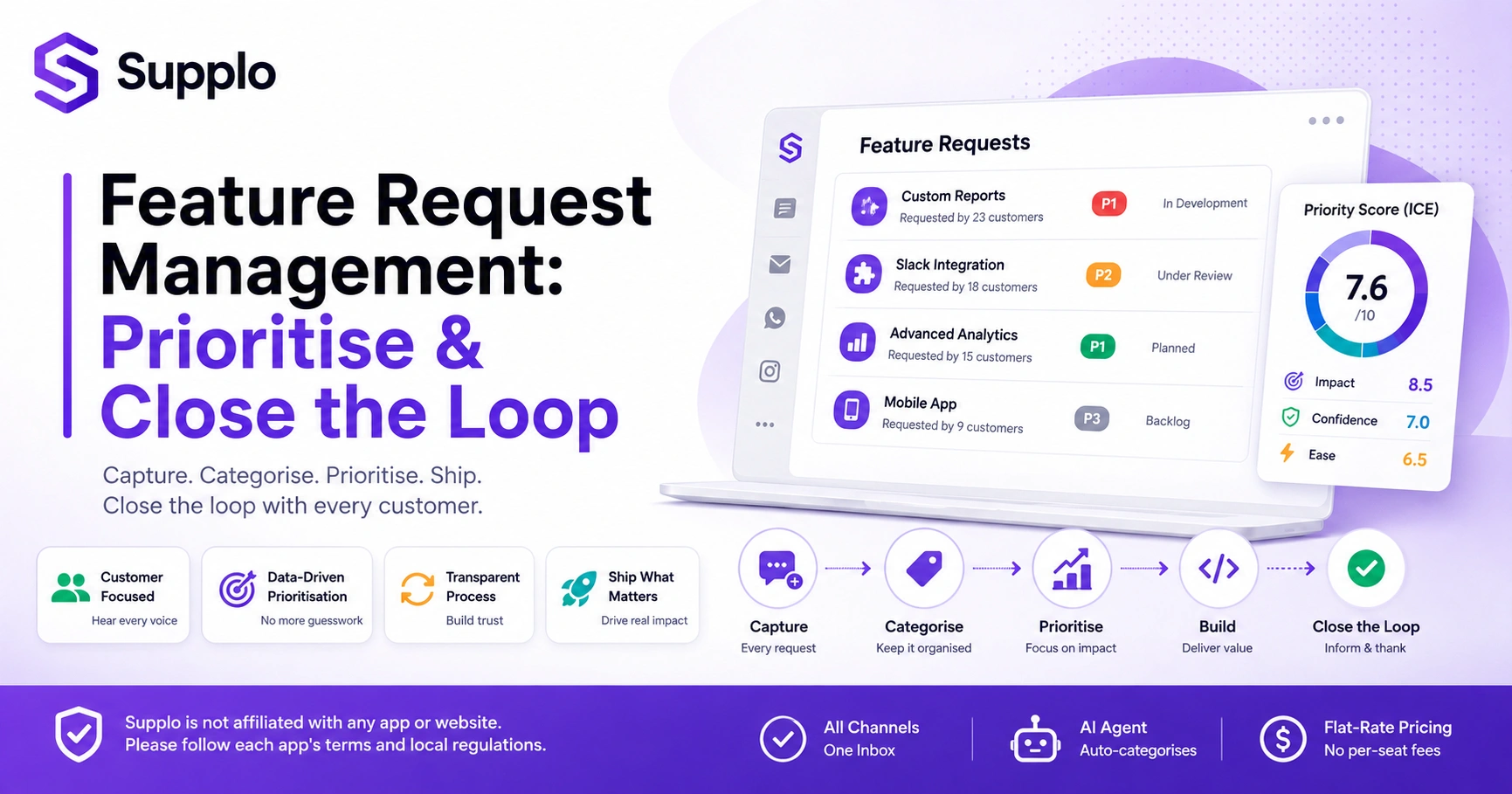
- Structure your process: Build a repeatable system to capture, categorise, prioritise, and respond to every customer feature request.
- Categorise effectively: Stick to a simple taxonomy, Bug Workaround, Enhancement, Net-New, Integration, so requests stay actionable.
- Prioritise objectively: Use frameworks such as ICE (Impact, Confidence, Ease) or P-levels (P0-P3) to balance customer needs against your product roadmap.
- Close the loop: Always personally inform customers when their requested feature ships, or when it's declined. Transparency builds trust.
- Integrate tools: Make your support platform the central hub for managing requests so support and product teams actually talk to each other.
What is a Feature Request Handling Strategy and Why Does It Matter?
A feature request handling strategy is simply the repeatable system your support and product teams use to capture, categorise, prioritise, and respond to customer suggestions. Without one? Requests vanish into inbox black holes. Teams argue over what's next. Customers feel ignored. A good strategy turns noise into a clear pipeline.
Think of it as the lifecycle of a feature request, from submission to resolution (whether that's shipped, declined, or backlogged). Without clear ownership, consistent evaluation criteria, and follow-up, most feature requests quietly die. And here's the thing: customers who feel heard stick around. The handoff between support and product is often where things break down, which is exactly why formalising this process pays off big time.
How to Categorise Feature Requests So Your Team Can Actually Act on Them
Categorisation is your first filter. Without it, your backlog is just noise.
Here's a simple four-bucket system that works:
- Bug Workarounds: requests that fix a current pain point
- Enhancements: improvements to existing features
- Net-New Features: something you don't offer yet
- Integrations: connections to other tools your customers use
Tag each request with the customer's plan tier and, if relevant, industry. That context helps you prioritise later. Create a simple taxonomy with 4–6 categories max so everyone on your team can tag consistently. Use tags or labels in your inbox tool, like Supplo's shared inbox, to sort requests instantly. Avoid over-categorising; too many buckets create confusion rather than clarity. Train your team to spot duplicates and merge identical requests before they hit the backlog. This makes your customer feature request process smoother.
Best Practices for Feature Request Support From First Touch to Final Resolution
Feature request support isn't just about logging a suggestion. It's about managing expectations from the moment a customer clicks send.
Acknowledge every request within one business day. Tell them what happens next. Never let a customer wonder if their idea vanished into a void. The best support teams treat feature requests as trust-building opportunities, not annoying administrative tasks.
Respond with empathy and specificity. Avoid generic thanks for your feedback scripts. Explain your triage process so customers know their request has a path. Set a follow-up cadence, weekly or monthly, for status updates on popular requests. Even a simple public roadmap shows customers what's being worked on. And whatever you do, never promise a timeline unless the product team has confirmed it. Under-promise, over-deliver. To handle feature request support tickets effectively, transparency is everything.
How to Prioritise Feature Request Tickets Without Guesswork
Most teams stumble here because they rely on gut feel or the loudest customer. Don't do that.
Use a weighted system that combines three signals:
- Request frequency: how many customers are asking for it
- Customer value: revenue or retention impact
- Effort: engineering time required
Score each request on these three axes. Stack-rank the list weekly.
Suppose 10 customers want the same thing, which generally outranks 10 unique requests. A feature that unlocks a new customer segment usually beats a nice-to-have for existing users. Prioritise quick wins first, low effort, high impact, to build momentum. Use a simple spreadsheet or your support tool's tagging system to track scores. Revisit priorities monthly because customer needs shift faster than roadmaps do. This systematic approach is how you nail effective support ticket prioritisation for feature requests.
The Ticket Prioritisation Framework That Balances Customer Needs and Product Roadmap
A strong framework removes politics from product decisions. The ICE framework (Impact, Confidence, Ease) works beautifully for feature requests:
- Impact: how many customers benefit
- Confidence: how sure you are of that impact
- Ease: relative development effort
Score each on 1–10, average them, and sort descending. That gives you a defensible, repeatable system. Example: Impact 8, Confidence 7, Ease 6 = average score of 7.0. Adjust the framework for your business; you might swap Ease for Strategic Fit if you're building a mature product. Pair ICE with a must-have tier for requests that block existing customers. Those automatically go to the top. Share the framework with your customers too, so they understand why some requests move faster than others.
How to Rank Feature Requests Using an Importance Scale
An importance scale turns abstract feelings into real numbers. Build a simple 4-tier system:
- P0 (Critical): blocks existing functionality, risk of churn
- P1 (High): requested by many, clear revenue impact
- P2 (Medium): nice-to-have, requested by a few
- P3 (Low): speculative, low frequency
Every feature request gets a P-level on intake, and that level determines how often it's reviewed. Write down each P-level so your whole team applies it consistently. Re-evaluate quarterly; a P2 can become a P1 as your customer base grows. Use P-levels as the filter for backlog grooming: review P0S weekly and P3S quarterly. Communicate the P-level back to the customer so they know where they stand. Stick to 4 tiers max; simplicity drives adoption for your feature-request importance scale.
Support Backlog Management for Features: Keeping the Queue Clean and Actionable
An unmanaged feature request backlog is just a graveyard of good intentions.
Set a recurring cadence, weekly for support leads, monthly with product, to review and clean the queue. Archive duplicates. Close requests that are no longer relevant. Move completed requests to a separate shipped list. A clean backlog helps your team focus on what actually matters.
Use your inbox tool's status system: New, Under Review, Planned, In Development, Shipped, Declined. Deduplicate aggressively, aim for one canonical ticket per request with all customer votes attached. Set a max age for unused tickets (6 months without activity = archive). Make backlog grooming a shared responsibility between support and product. And celebrating shipped features publicly closes the loop and encourages more feedback.
Closing the Feedback Loop on Feature Requests: Turning Requests Into Trust
Closing the feedback loop is the single most important step most companies skip.
When a feature ships, notify every customer who requested it. Send a personalised message explaining what was built and thanking them for the input. When a feature is declined, explain why: technical limitations, low demand, or strategic shift. Customers respect transparency far more than silence. This is the core of any effective feedback loop strategy.
Segment your notifications: different messages for requesters, voters, and watchers. Use your support tool to auto-tag requesters when a ticket moves to Shipped or Declined. Include a direct reply option so customers can continue the conversation. Track the feedback loop completion rate as a team KPI; aim for 100% within two weeks of the decision. And yes, close the loop even on declined requests. It builds long-term trust.
How to Build a Customer Feedback Process That Connects Support and Product
The customer feedback process is the bridge between your support team (who hears every request) and your product team (who decides what to build).
Create a shared Slack channel or a weekly sync where support surfaces the top 5 requests by frequency and product, and shares roadmap updates. Use a shared backlog tool, like Supplo's inbox with product tags, so both teams see the same data.
Define clear ownership: support owns collection and categorisation, product owns prioritisation and build decisions. Hold a weekly 15-minute feature request triage meeting with both teams, document every decision, why a request was built, postponed, or declined. Measure success by the percentage of shipped features that originated from support tickets. Start free with a 14-day trial at Supplo. No credit card required, see how a shared inbox and AI agent can handle your first 100 feature requests today.
Tools and Systems to Handle Feature Request Support at Scale
You don't need a separate product management tool for feature requests. Your customer support platform should be the hub.
With Supplo's shared team inbox, you can tag, categorise, and prioritise feature requests directly in the same workspace where you handle live chat, email ticketing, WhatsApp, and Instagram DMs. A unified inbox means your team never has to copy and paste a request from one tool to another.
Use tags like feature-request, P1, and integration to instantly sort and filter. Leverage the self-learning AI agent to auto-flag repeated requests across channels. Connect your knowledge base to capture feature request explanations so customers can self-serve. Supplo's email ticketing keeps every feature request in a single thread, even if the conversation spans weeks. Flat-rate pricing (no per-seat fees) means every team member can access the inbox without budget friction, making it easier to handle feature-request support tickets efficiently. See how Supplo compares to legacy tools in terms of pricing and flexibility.
Tired of support tickets piling up without a system? Try Supplo's flat-priced workspace and see how our AI agent handles the sorting so you can focus on closing the loop.
Key Takeaways
- Implement a structured, repeatable strategy for all feature requests, from capture to resolution.
- Categorise requests clearly using a limited number of defined categories.
- Prioritise objectively using frameworks such as ICE or P-levels, balancing customer needs against development effort.
- Prioritise transparency by communicating consistently with customers about their requests, whether they are built or declined.
- Use your customer support platform as the central hub for managing all feature request workflows.
Ready to turn feature requests into product momentum? Start your free trial at Supplo.io. No per-seat fees, no hidden costs, and a shared inbox that unifies every channel your customers use.
FAQ
What's the difference between a feature request and a support ticket?
A feature request is a suggestion for a new or improved capability, while a support ticket is a current issue or question. Feature requests should be tracked separately from support tickets to avoid cluttering your support queue with items the product team owns.
How do I prevent feature requests from overwhelming my support team?
Create a dedicated tagging system (e.g., feature-request + priority level) and route those tickets to a separate view or board. Use automation to acknowledge them immediately, and set a weekly cadence to batch-review requests, so your team stays focused on active support issues.
Should I respond to every feature request individually?
Yes, but you can automate the first response. Send a template that thanks the customer, explains your triage process, and sets expectations for follow-up. Personalised follow-ups on shipped or declined features earn far more trust than ignoring the request does.
How often should I clean up my feature request backlog?
Review your backlog at least monthly. Archive duplicates, remove outdated requests (older than 6 months with no activity), and update priority levels. A clean backlog ensures your team focuses on high-impact, current requests.
What if my product team doesn't want to build a requested feature?
Close the feedback loop honestly. Explain why the feature isn't being built: technical limitations, low demand, or strategic reasons. Customers appreciate transparency, and a clear no is better than indefinite silence.
Can AI help me handle feature request tickets faster?
Yes. AI agents can auto-categorise incoming requests, detect duplicates, and generate summary reports of the most-requested features. This frees your human team to focus on the strategic work of prioritisation and relationship-building.
How do I measure the success of my feature request process?
Track three metrics: feedback loop completion rate (percentage of requests that receive a final status update), percentage of shipped features that originated from customer requests, and customer satisfaction with how their request was handled.
Compliance line: Supplo is not affiliated with any app or website. Please follow each app's terms and local regulations.