On this page
Shipping complaints are just part of the game when you're selling online. But how does your team handle them? That can make or break your customer relationships. This guide is packed with practical strategies to help you quickly manage and resolve shipping issues with a human touch. Whether you're running a small store or managing a support team, you'll find actionable steps here to turn a shipping headache into a loyalty win.
Quick Answer
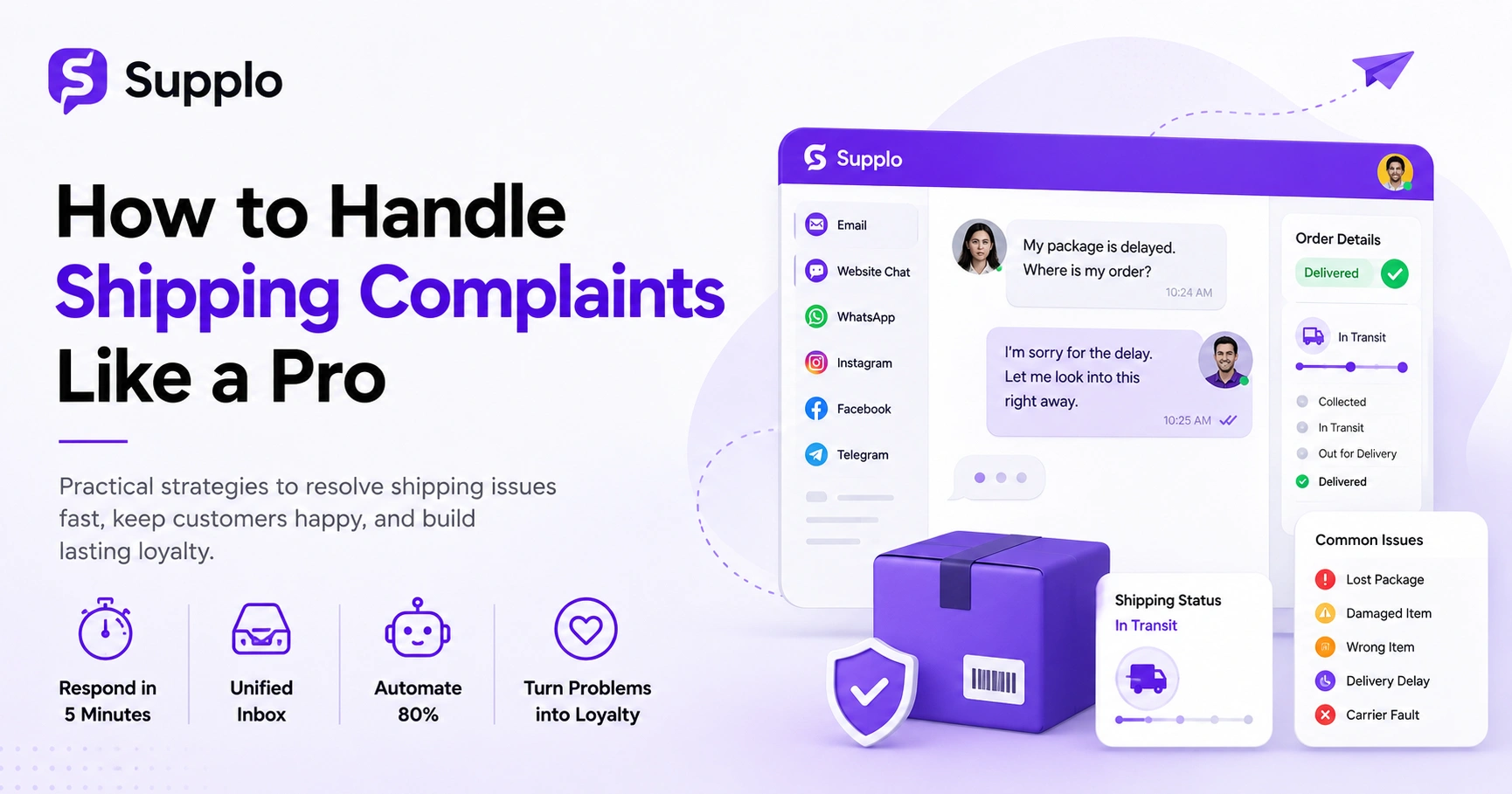
- Respond to shipping complaints within 5 minutes to dramatically cut down on customer frustration.
- Use a unified inbox to keep every conversation and customer history in one spot.
- Take ownership of carrier issues; never make your customer chase the shipping company.
- Automate 80% of routine shipping questions with AI and let human agents handle the tricky stuff.
- Turn bad experiences into good ones by offering real solutions and a sincere apology.
Why Shipping Complaints Are the Litmus Test of Your Customer Support
Here's the thing: shipping complaints show you the true quality of your support faster than almost anything else. If your team can't handle a lost package or a delay with both empathy and efficiency, you're going to lose that customer's trust and probably their next order, too. This section digs into why shipping problems are the ultimate stress test and how passing that test builds serious loyalty.
From the moment a customer clicks buy, there's often a little knot of anxiety. That shipping stress means any hiccup- a delay, a wrong turn, a dented box- makes their frustration spike fast. A poorly handled complaint can cost you way more than just the price of that one order. It can wipe out that customer's lifetime value overnight.
It's tempting to blame the carrier; I get it. But from the customer's perspective, you own the entire experience. When you own the problem, even if the carrier dropped the ball, you build trust. Honestly, a fast, empathetic fix to a shipping issue often creates stronger brand fans than if the package had just shown up on time.
Test your shipping complaint response time for free
Set up a free 14-day trial of Supplo and route your next shipping complaint through our unified inbox. See if you can hit that 5-minute first response.
The First 10 Minutes: Customer Service for Shipping Problems That De-Escalate Fast
The first 10 minutes of a complaint set the tone for the rest. Your job isn’t to magically find the package; it’s to validate their frustration and give them a clear, simple next step. A simple I see this; here’s what I’ll do to cut the anger in half.
One mistake I see all the time is asking for an order number before acknowledging the customer's feelings. Don’t do that. Start by empathising, then gather the details. A unified inbox lets your team see past interactions and jump right in, without requiring the customer to repeat their whole story.
Here’s a 60-second checklist for any shipping complaint:
- Validate: Acknowledge their concern and frustration.
- Investigate: Quickly pull up the order and tracking info.
- Communicate Timeline: Tell them what you’re doing next and when they’ll hear from you.
Example scripts:
- I get how frustrating it is when a package is delayed. Let me look into this right now.
- I'm sorry your order hasn't shown up as expected. I'm pulling up the tracking details to see what's happening.
- It sounds like the package got damaged in transit and I apologise for that. I’m checking the details to find the best way to make it right.
How to Build a Bulletproof Post-Shipment Support Strategy for Your Team
A solid post-shipment strategy means your team never panics when a complaint rolls in. Pre-write templates for the top six scenarios: lost package, damage, wrong item, delay, carrier fault, address mistake and route them through a shared inbox that logs every single action. The result? Consistent answers that don’t waste time reinventing the wheel every time.
A robust strategy includes:
- Standardised Responses: Create templates for the most common issues.
- Automated Updates: Set up auto-responses for Where's my order? queries, often linking to real-time tracking.
- Knowledge Base Integration: Use a comprehensive knowledge base to reduce repetitive tickets by enabling customers to help themselves.
- Clear Ownership: Assign one person per complaint so there's always a clear point of contact. A platform like Supplo unifies email, website chat, WhatsApp, Telegram, Instagram DMs and Facebook Messenger into one thread-based inbox, making it easy to manage these assignments.
Resolving Lost Package Complaints: Proof of Delivery vs Proof of Life
Lost package complaints are tough because you're dealing with an absence; the customer says it didn't arrive, but the carrier says it did. The best approach is a two-track process: ask the carrier for GPS-based proof of delivery while simultaneously checking your own fulfilment records. If the carrier’s proof is weak (e.g., a poor photo or the wrong address), escalate it immediately.
What proof of delivery actually looks like varies. It could be a grainy photo, a GPS coordinate, or a signature. If that evidence doesn't convince you (or the customer), push it higher. Expedite a carrier-level trace to find the last known location.
You need to set internal Service Level Agreements (SLAs) for lost package resolution and aim for first action within 24 hours. When you're faced with a discrepancy, decide between a refund and a replacement based on stock levels and the customer's preference. Often, a replacement is better because it makes sure they actually get what they want.
Supplo is not affiliated with any app or website. Please follow each app's terms and local regulations.
The Right Way to Handle Damaged Package Complaints and Shipping Claims
Damaged-package complaints require a specific playbook. Start with photos, then determine whether the damage is cosmetic or functional. If it's cosmetic, offer a partial refund or store credit. If it's functional, send a replacement immediately and file a claim with the carrier. Never, ever make the customer chase the carrier. You took their money; you handle the claim.
When you ask for damage photos, use language that’s clear and non-accusatory. To help us sort this out quickly, please send a few photos of the damage. It's also important to understand the difference between carrier liability (external damage from shipping) and your own responsibility (issues with internal packaging).
Filing a shipping claim efficiently requires specific documentation: photos of the damage, the packaging, the shipping label and the proof of purchase. Sometimes, for low-value items, it’s just cheaper and easier to reship than to fight a long carrier claim.
Managing Delivery Problems Without Sounding Like a Broken Record
The worst thing you can say to a customer about a delay is It’s on the way. They hear that as me not caring. Instead, give them a real update: the carrier, the current location, the new delivery window and offer a proactive solution, like free expedited shipping on their next order. You don’t control the carrier, but you do control how you communicate.
Avoid phrases like there's nothing we can do, it's out of our hands, or wait. Instead, use real-time tracking data to give precise info. If there's a significant delay, a small gesture like a discount on a future purchase or free shipping can go a long way. You can even use automation to proactively alert customers about known delays before they have to complain.
Using AI to Automate Response to Shipping Disputes Without Losing the Human Touch
AI can handle the first 80% of shipping disputes, status checks, proof-of-delivery requests, even offering a replacement, without a human ever touching the ticket. Supplo’s AI agent, for example, resolves up to 80% of incoming tickets automatically at flat pricing and only hands off to a human when the case gets complicated. The key is to train your AI on your shipping policies, not on some generic script.
A self-learning AI improves over time by analysing past resolutions of shipping complaints. You can set confidence thresholds so the AI flags uncertain cases for human review, ensuring complex or sensitive issues get the personal attention they need. With flat-per-resolution pricing, you can scale your shipping-heavy support without blowing your budget. For instance, an AI can automatically send compensation for common delay scenarios, freeing your team to focus on the stuff that really needs a human brain.
When your AI can’t handle a complex claim, code it for higher acceptance
Supplo’s AI agent handles the easy stuff (status checks, delay notices). For the edge cases, damage disputes and carrier liability, it hands off to your team with full context. Build your automation on a flat $ 0.04-per-resolution plan. Try it on Supplo.
When Carriers Let You Down: Customer Support for Logistics Issues and Carrier Escalation
Sometimes, the carrier is the problem: lost in transit, late without notice, or just careless handling. In those cases, your customer support for logistics issues becomes a two-front battle: you have to manage the customer’s expectations internally while escalating the claim externally. The best move is to apologise for the experience (not the carrier’s failure) and take full ownership of the resolution timeline.
Never tell a customer that’s the carrier’s fault. It makes them feel unheard and unsupported. Instead, explain that you're investigating the issue with the carrier on their behalf. Learn how to escalate issues to a carrier’s executive support team or, for persistent problems, to regulatory bodies. And it's important to know the difference between a service failure (carrier error) and a merchant error (like a wrong address), so you understand who's really responsible. Use carrier tracking data to explain delays without over-promising a specific delivery time.
Tracking the Fix: Resolving Delivery Disputes Customer Service Style
A delivery dispute usually comes down to one simple question: Did the package arrive or not? Your team needs access to tracking, delivery photos and customer communications to resolve it cleanly. A shared inbox like Supplo’s keeps the entire history in a single thread, so no one has to ask the customer to repeat themselves. Resolve it fast and document everything clearly.
Beyond your own systems, you might need to integrate with platform-level resolution centres (such as Shopify, Etsy, or Amazon) when applicable. You'll have to reconcile carrier tracking data with what the customer is telling you about non-delivery. This might mean a carrier trace or double-checking the delivery address. When you write a resolution statement, cover both the technical tracking details and the customer's emotional frustration. For suspected theft, understand the difference between a simple dispute and a real theft and how insurance claims come into play.
Turning a Shipping Disaster Into a Long-Term Customer: Post-Shipment Recovery
A shipping complaint is a real moment of truth. If you handle it well, fast, transparent and generous, you can turn a customer who was ready to leave into a loyal advocate. The trick is to over-communicate, follow up after the resolution and offer a small token of apology. One perfectly handled complaint is worth a hundred smooth transactions.
After you've resolved the complaint, a thoughtful follow-up can really solidify that loyalty. A short email to check in, or offering a small gesture like a coupon for their next purchase or a free upgrade, often works better than a huge refund in getting them to come back. Start measuring Complaint Resolution Satisfaction (CRS) as a key performance indicator (KPI) to help your team keep improving. And build a feedback loop to prevent the same shipping issues from happening again, turning problems into process improvements.
Keep a reliable support system for ongoing access without seat-bloat
Don’t let your support team size dictate your bill. Supplo prices per workspace, not per agent. Whether you have 2 or 20 agents, your monthly cost stays the same. Start your free trial today.
FAQ
How quickly should I respond to a customer's shipping complaint?
Aim for a first acknowledgement within 5 minutes. Even a simple We see this and are looking into it dramatically reduces escalation. The longer you wait, the more the complaint hardens.
What should I do if a customer claims a package is lost, but carrier tracking shows as delivered?
Ask the customer to double-check with neighbours or at a secure location, then perform a carrier proof-of-delivery trace (GPS coordinates, photo, signature). If the carrier’s evidence is weak, refund or replace immediately, then file a claim with the carrier.
Can I issue a refund for a shipping complaint without first seeing the item?
Yes, for lost or clearly damaged items, refund without requiring a return saves both parties time. For items that might be reusable, ask for a photo first. A policy against refunds only creates unnecessary friction.
Who is responsible for shipping damage: me or the carrier?
You are always responsible to the customer. The carrier is your vendor, not the customer’s. You handle the customer, then you file a claim with the carrier. Never make the customer chase the carrier.
How do I automate responses to common shipping complaints without sounding robotic?
Use an AI agent like Supplo’s that templates common replies (delay, status check, proof of delivery) but leaves a slot for personalisation. Always offer a human handoff option. Customers can forgive automation as long as it works and they can reach a person when it doesn’t.
Should I offer a replacement or a refund for a shipping error?
Replacement, ideally. A replacement shows commitment to fulfilling the order, not just walking away. Only default to a refund if the item is out of stock or the customer explicitly requests it.
What is the best way to train new agents on shipping complaint resolution?
Create a playbook covering the six most common scenarios and their corresponding scripts. Shadow calls, then simulate scenarios. Use a unified inbox to tag shipping complaint tickets for review and learning.
Compliance line: Supplo is not affiliated with any app or website. Please follow each app's terms and local regulations.