On this page
If you're running a support team and you don't know how your agents actually feel about their work, you're basically guessing. And guessing is expensive. Happy agents stick around, deliver better service, and actually care about the customers they're helping. Unhappy ones? They leave, they burn out, or they quietly check out while still answering tickets.
Measuring agent satisfaction isn't some HR fluff exercise. It's a strategic move that directly impacts your bottom line. But you can't just throw a survey together and call it a day. You need the right metrics, the right questions, and, most importantly, a plan actually to do something with the answers.
This guide walks you through exactly how to measure agent satisfaction in support teams, from eNPS implementation to turning feedback into real change. Whether you're a support leader, ops manager, or HR professional, you'll walk away with a practical playbook.
Quick Answer:
- Measure eNPS quarterly with a single question: How likely are you to recommend this team as a place to work?
- Combine quantitative data (turnover, absenteeism) with qualitative feedback (open-ended survey comments) for a complete picture.
- Close the loop by sharing survey results and acting on feedback; otherwise, agents stop participating.
- Use better tools, such as a unified inbox, to reduce agent frustration and improve engagement.
Why Measuring Agent Satisfaction Is Non-Negotiable for Support Teams
Here's the thing nobody tells you: customer satisfaction and agent satisfaction are two sides of the same coin. You can't have one without the other.
When agents are frustrated, overworked, or disengaged, it shows up in every single interaction. Response times slip. The tone gets robotic. Customers feel like they're bothering someone. And that's exactly when churn starts creeping up, both customer churn and agent churn.
The costs pile up fast. Replacing a support agent can cost anywhere from weeks of lost productivity to thousands in recruiting and training. Meanwhile, your remaining team picks up the slack, gets more stressed, and the cycle continues.
But here's the good news: measuring how your agents feel gives you a lever to pull. You can spot problems before they become crises. You can fix the things that are actually broken, not the things you think are broken.
Supplo is not affiliated with any app or website. Please follow each app's terms and local regulations.
The Core Metrics to Measure Customer Support Agent Satisfaction Effectively
One metric won't cut it. Sorry, but it's true. You need a mix of hard numbers and real human stories to get the full picture.
Think of it like a car dashboard. You wouldn't drive with only the speedometer, right? You need fuel, temperature, and oil pressure. Same thing here.
Key metrics to consider:
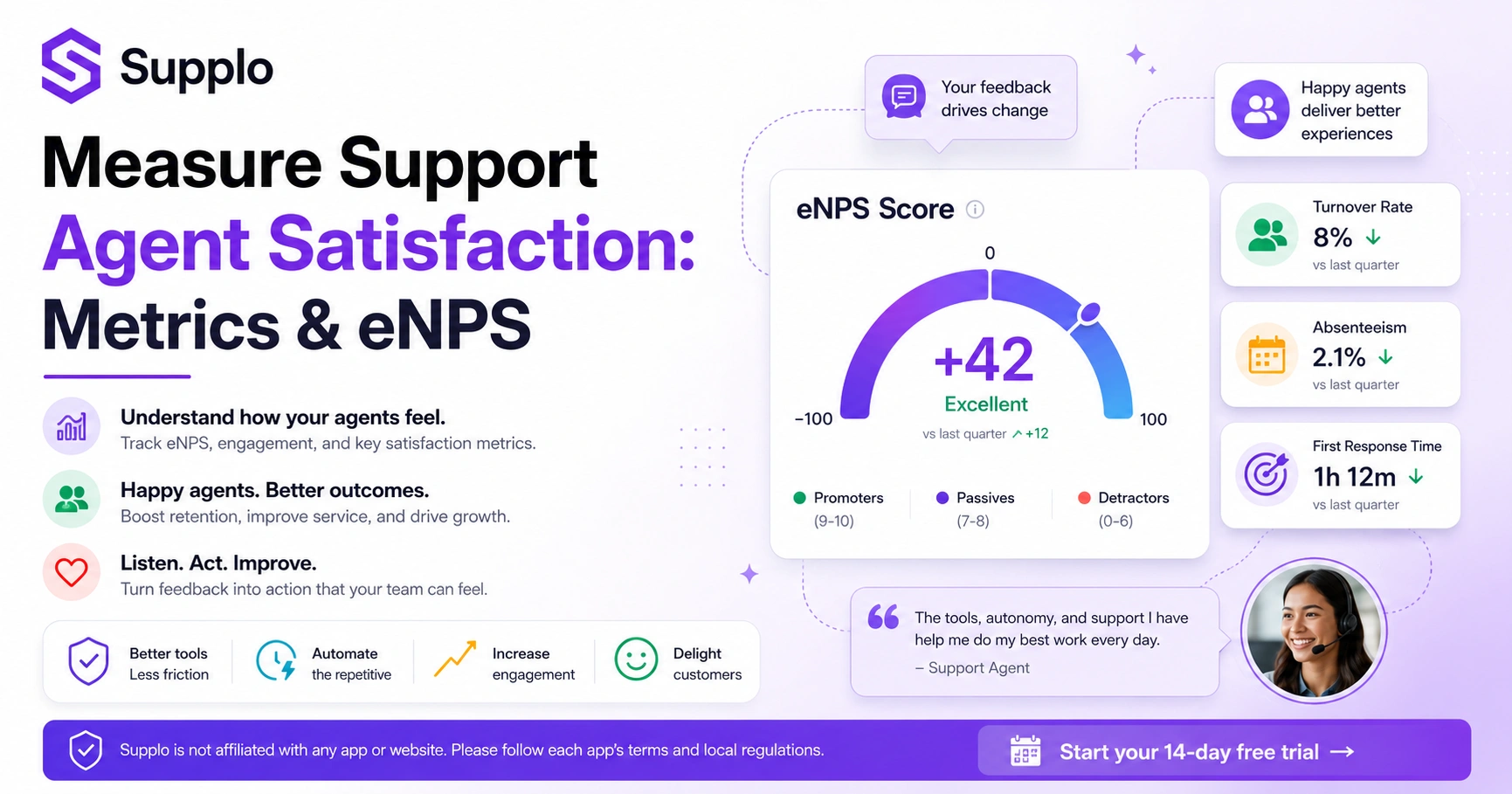
- eNPS (Employee Net Promoter Score): The gold standard. One question, huge insight into team loyalty.
- Turnover rate: High numbers here usually mean something's broken. Low numbers suggest you're doing something right.
- Absenteeism: When people start calling in sick more often, it's often burnout waving a red flag.
- Qualitative feedback: The why behind the numbers. Open-ended survey responses and 1:1 conversations are gold mines.
Pair these with operational data, such as first response times and resolution rates. Tools like a shared inbox make this way easier to track without micromanaging.
How to Assess Agent Satisfaction with Surveys That Actually Work
Bad surveys get bad results. Or worse, no results at all.
You've probably seen this before: you send out a 40-question survey, get a 15% response rate, and the answers are all middle-of-the-road fine responses. That's useless.
The secret is making surveys that agents actually want to complete. And more importantly, making them feel safe enough to be honest.
Follow these best practices to ensure your surveys are effective:
- Frequency matters: Pulse surveys every 2-4 weeks catch trends early. Annual surveys are often too slow to provide timely insights.
- Anonymity is non-negotiable: Agents will not be honest if they fear being identified. Ensure your survey tool guarantees complete anonymity.
- Keep it short: Aim for 5-10 questions at most to respect agents' time and encourage completion.
- Mix question types: Incorporate Likert scales for quantifiable data, open-ended questions for in-depth insights, and multiple-choice options for targeted feedback.
The Best Agent Satisfaction Survey Questions to Ask Your Team
Generic questions get generic answers. You need questions that actually dig into the agent experience.
Think about what matters to your team day-to-day: workload, tools, autonomy, growth. Ask about those things specifically.
Here are some of the most effective questions to include in your next survey:
- On workload: Do you have enough time to handle each ticket properly?
- On tools: Do the tools you use (like Supplo's inbox) make your job easier or harder?
- On autonomy: How much control do you have over how you handle customer conversations?
- On growth: Do you see a clear path for career development here?
- On teamwork: How supported do you feel by your teammates and leadership?
Measuring Support Agent Engagement: Beyond the Happy Score
Satisfaction is about how agents feel. Engagement is about how they act.
An engaged agent shows up ready to work. They contribute ideas. They help teammates. They care about the outcomes, not just finishing their shift.
Measuring engagement means looking at behaviors, not just emotions.
Metrics to watch for engagement often include:
- Response time and ticket resolution rate: Consistent performance in these areas can signal motivation.
- Proactive contributions include updating knowledge base articles, suggesting process improvements, and participating in team initiatives.
- Peer recognition: Observe instances where agents go above and beyond to help colleagues.
- The discretionary effort signal: Engaged agents often go above and beyond without being asked, showing initiative and commitment.
Watch for warning signs too. A sudden drop in quality scores, more customer complaints about a specific agent, or quiet quitting behavior all point to disengagement.
How to Improve Agent Engagement in Customer Support Teams
You can't force engagement. But you can create the conditions where it naturally grows.
Think about what frustrates your agents most. Is it clunky software? Lack of autonomy? No clear path forward? Fix those things, and engagement follows.
Here's what actually works to improve agent engagement:
- Give them better tools: Clunky, inefficient software is a major source of frustration. A unified inbox like Supplo's reduces context switching and workflow friction, making agents more effective.
- Empower them to solve: Trust agents to make decisions and resolve issues without requiring constant escalation.
- Recognize contributions publicly: Simple shout-outs, internal awards, or mentions in team meetings can significantly boost morale and motivation.
- Invest in learning: Provide dedicated time and resources for skill development, not just ticket handling, to foster growth.
Implementing eNPS for Support Teams
eNPS isn't complicated. But doing it right takes a little planning.
The goal is simple: ask one question, get honest answers, and actually do something with the feedback. Here's exactly how to make that happen.
Here's an exact playbook for implementing eNPS:
- Define promoter and detractor categories for your specific support context.
- Survey with a single question: How likely are you to recommend this team as a place to work? (on a 0-10 scale).
- Calculate the score (the next section covers this in detail).
- Segment by tenure, role, and shift to identify specific patterns or areas of concern.
- Share results with the team transparently and commit to an action plan based on the feedback.
How to Calculate Support Agent eNPS and Interpret the Results
The math is simple. The interpretation? That's where the real work lives.
Here's how to calculate and interpret your team's eNPS:
- Formula: (Number of Promoters / Total Responses * 100) - (Number of Detractors / Total Responses * 100).
- Promoters: Agents who score 9 or 10.
- Passives: Agents who score 7 or 8.
- Detractors: Agents who score 0-6.
- Range: Scores range from -100 to +100. A score of 30 or higher is generally considered excellent for a healthy, positive team environment.
- Context matters: Always compare your eNPS against your previous scores to track improvement, rather than relying solely on industry benchmarks, which may not align with your specific context.
- Watch for passives: Agents who answer 7 or 8 are neutral. Dig deeper into their feedback to convert them into promoters.
Support Team eNPS Implementation: Common Pitfalls and How to Avoid Them
The biggest mistake? Asking for feedback and then doing nothing.
It erodes trust faster than almost anything else. Agents stop participating honestly because they don't see the point.
Key pitfalls and how to avoid them:
- Pitfall 1: Survey fatigue. Solve this by limiting comprehensive eNPS surveys to quarterly or bi-monthly, with shorter, targeted pulse checks in between.
- Pitfall 2: Ignoring detractors. Their feedback is often your richest source of ideas for improvement. Engage with it constructively.
- Pitfall 3: No action plan. If agents don't see tangible changes as a result of their feedback, they will stop participating honestly.
- Pitfall 4: Treating eNPS as a standalone metric. Always pair eNPS with other satisfaction and engagement data, such as turnover and qualitative comments, for a holistic view.
Ready to start measuring agent satisfaction? Get a free 14-day trial of Supplo and see how a unified inbox can reduce agent frustration.
Customer Support Team Engagement Strategies That Move the Needle
Measurement without action is just data collection. You need strategies that actually change things.
Focus on what matters most: communication, growth, and workload. These three areas have the biggest impact on how agents feel about their work.
High-impact engagement strategies:
- Weekly 1:1s: Use these sessions for coaching and career development, not just status updates. Ask questions like, What's frustrating you? and How can I help you improve?
- Career pathing: Clearly show agents how they can grow, whether from junior to senior roles, or into quality assurance or management positions.
- Workload balancing: Leverage automation, such as Supplo's AI agent, to handle repetitive tickets, freeing agents to focus on complex, rewarding customer interactions.
- Team bonding: Implement virtual coffee chats, team challenges, and peer recognition programs to build a strong sense of connection and camaraderie.
How to Keep the Measurement Loop Running: From Data to Action
The loop only works if you close it. Measure, analyze, act, share. Repeat.
Without that final step, showing agents what changed because of their feedback, you're just collecting data for the sake of it.
Steps to ensure your measurement loop is effective:
- Schedule quarterly reviews: Present findings to both leadership and the front-line team. This fosters transparency and accountability.
- Create a You Said, We Did board to publicly show agents exactly which actions were taken based on their feedback. This builds trust.
- Iterate your survey questions: Continuously refine your survey. Drop questions that aren't yielding useful data and add new ones as your team evolves.
- Link to business outcomes: Demonstrate how improved agent satisfaction correlates with higher CSAT scores, better customer retention, and positive revenue impacts.
Don't let your data collect dust. Use Supplo to track agent engagement, automate repetitive tickets, and free your team to focus on what matters. Check our pricing page for details. Start your 14-day free trial →
Key Takeaways
- Agent satisfaction directly impacts business outcomes, including customer satisfaction, retention, and operational costs.
- A balanced approach to measurement combines quantitative data, such as eNPS and turnover, with qualitative insights from surveys.
- Anonymity is crucial for honest feedback in agent satisfaction surveys.
- Engagement is about action, not just feelings; empower agents with better tools and autonomy.
- Close the feedback loop by acting on survey results and communicating changes to the team.
FAQ
How often should I measure agent satisfaction?
Measure eNPS quarterly with a full survey, and use pulse surveys (2-3 questions) every two to four weeks to catch trends early. Annual surveys are too slow to be useful.
What's the difference between agent satisfaction and agent engagement?
Satisfaction is about how agents feel (happy, content, stressed). Engagement is about how they act (proactive, invested, discretionary effort). Both are important, but engagement is a stronger predictor of performance.
Can I use eNPS for a small support team of 3-5 people?
Yes, but be careful with anonymity. With a small team, individual scores can be guessed. Consider using a third-party tool for total anonymity, or focus on aggregated trends over time.
What should I do if my eNPS score is very low?
First, don't panic. Review the qualitative feedback to understand why. Then, prioritize one or two root causes to address (e.g., workload, tools, career growth). Communicate the plan to the team.
How do I get agents to participate honestly in surveys?
Guarantee anonymity, explain why their feedback matters, and show them the results of previous surveys. Nothing builds trust faster than seeing their input lead to real change.
What are the best tools for measuring agent satisfaction?
Beyond a simple survey tool, use a platform like Supplo to track agent engagement indicators (response times, resolution rates, and internal collaboration). Pair that with a dedicated eNPS survey tool.
Is it legal to measure agent satisfaction in all jurisdictions?
Yes, as long as you respect privacy and data protection laws like GDPR. Ensure surveys are anonymous, data is stored securely, and agents are informed about how their feedback will be used.
Compliance line: Supplo is not affiliated with any app or website. Please follow each app's terms and local regulations.