On this page
Customer support is the reactive, tactical function of helping customers solve specific problems with your product or service. It’s the team you call when an order is wrong, a login fails, or a feature breaks. Think of it as the safety net that catches issues after they happen.
Let’s be honest, when something goes wrong, you want it fixed now. That’s support’s job.
- Customer support centers on direct problem resolution through tickets, live chat, phone calls and emails, where a human (or AI) intervenes.
- Core functions include troubleshooting, refunds, account recovery and technical assistance.
- Simply put, customer support is the "fix-it" department, measured by speed and resolution rate. It’s tactical, it’s tangible and it’s often the first thing people think of when they hear “customer service.”
What Is Customer Experience? A Clear Definition
Customer experience (CX) is the holistic perception a customer has of every interaction with your brand, from the first ad they see to post-purchase follow-ups. It’s proactive, emotional and long-term. While support is a transaction, experience is the entire relationship.
Think of it this way: support is a single scene in a movie, but CX is the whole film. A great scene can't save a bad plot.
- Customer experience goes beyond support to include product usability, checkout flow, onboarding and even website load speed.
- A customer experience strategy maps every touchpoint to ensure consistency and delight, not just resolution.
- To define customer experience: it’s the sum of all feelings and impressions your brand leaves behind. It’s how a customer feels about you, not just what they get from you.
Customer Support vs Customer Experience: The Core Difference
The difference between customer support and customer experience comes down to scope and timing. Support is reactive (fixing a problem now), while experience is proactive (preventing the problem and shaping how the customer feels about your brand overall). One is a moment; the other is a memory.
It’s not a competition. It’s a relationship.
- Support focuses on individual interactions; CX focuses on the entire lifecycle.
- Support is often cost-driven (cheaper per ticket); CX is value-driven (higher lifetime value).
- The customer service vs customer experience debate misses the point: they’re not rivals; support is a critical subset of CX. You can’t have a great experience without reliable support, but great support alone won’t fix a bad product.
How Customer Support Functions Support the Larger Experience
Every support interaction is a micro-experience. If you define customer support as a series of isolated fixes, you miss that each fix either builds trust or erodes it. Fast, empathetic support functions directly improve CX by turning potential churn points into loyalty moments.
A cold, scripted “Your ticket has been resolved” email? That’s a missed opportunity. A quick, human “Hey, we fixed it and here’s a tip to avoid it next time”? That’s a loyalty builder.
- A resolved ticket with a human touch creates a better perception than a silent fix.
- Support teams that escalate issues to product teams help improve CX for everyone.
- When support is reliable, customers feel safe buying again; that’s the trust bridge between support and experience.
Why Your Customer Experience Strategy Needs Reliable Support
A customer experience strategy is only as strong as its weakest touchpoint and support is often the most visible when something goes wrong. If support culture is slow, scripted, or absent, even a seamless site design won’t save your CX scores.
You can have the best-looking website in the world, but if a customer can’t get a simple question answered, they’ll remember the frustration, not the design.
- 90% of customers say an immediate response is important when they have a service question.
- Strategy must include SLAs, omnichannel coverage and escalation paths.
- Reliable support prevents the "silent churn" where customers leave without complaining.
Defining Customer Support in a Multichannel World
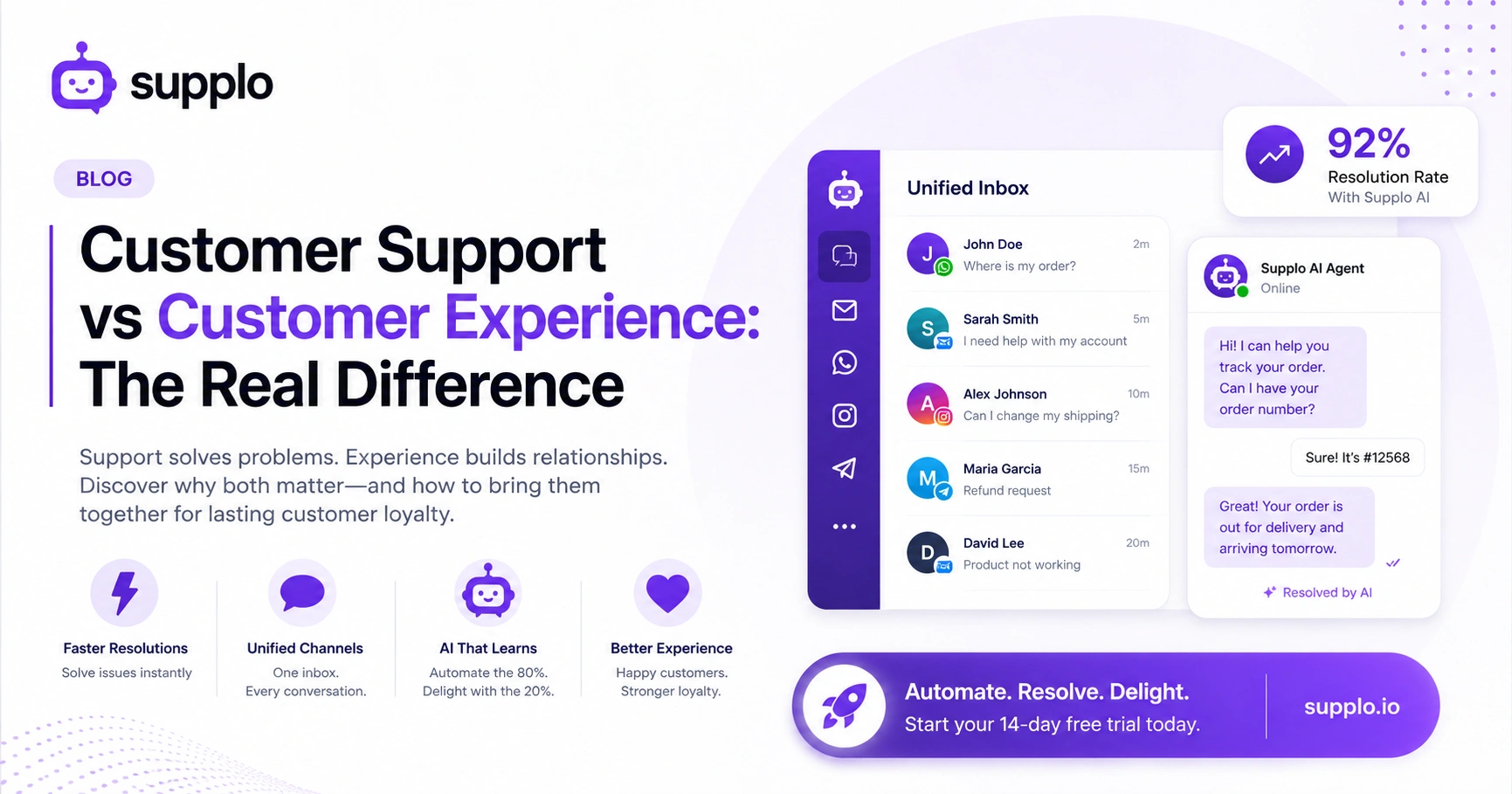
Defining customer support today means acknowledging it happens everywhere: live chat, email, social DMs, WhatsApp and even Telegram. Modern customer support functions must unify these channels into a single thread so nothing falls through the cracks.
Here’s the thing: customers don't care about your internal chaos. They want their problem solved, whether they emailed you or slid into your DMs.
- A fragmented inbox creates a fragmented experience; customers hate having to repeat themselves.
- Multichannel support isn’t just about being present; it’s about being consistent across channels.
- Tools like a shared team inbox turn scattered messages into a single conversation history.
Supplo is not affiliated with any app or website. Please follow each app’s terms and local regulations.
The Hidden Cost of Separating Support from Experience
Companies that treat support as a cost center (and CX as a marketing slogan) create a dangerous gap: customers get fixed but never feel valued. The difference between customer support and customer experience becomes a source of trust leakage. Fix the bug all you want, but if the interaction feels cold, the experience suffers.
Think of it like a restaurant with amazing food but rude servers. You might eat there once, but you won’t become a regular.
- Metrics like first response time don’t capture whether a customer felt heard.
- When support is outsourced to low-cost, scripted teams, CX drops even if tickets are closed.
- Blending support data with CX feedback loops reduces churn and increases referrals.
Building a Customer Experience Strategy That Actually Works
Your customer experience strategy needs defined moments: awareness, purchase, onboarding, support, retention. Each has a job. Support’s job is to be the reliable fixer; CX’s job is to ensure the fix feels seamless. Map both and you create a loop, not a gap.
A good strategy isn't a poster on the wall. It’s a living plan that connects every department.
- Use journey mapping to identify where support handoffs happen.
- Define customer experience KPIs (satisfaction, effort score) alongside support KPIs (resolution time).
- Strategy must include feedback collection from support interactions to inform product changes.
How Reliable AI Tools Bridge the Support-to-Experience Gap
Reliable AI customer support tools, like Supplo’s self-learning AI agent, handle routine issues instantly, freeing your team to focus on high-touch experiences that build relationships. When support is fast and accurate, the overall customer experience improves without adding headcount.
The best part? Your human agents only step in when it really matters, like a complex refund or an angry customer, while the AI handles the 80% of simple questions.
- AI that resolves common tickets at a flat rate (not per-seat) makes support predictable and scalable.
- A seamless handoff from AI to human ensures no loss of context, keeping the experience smooth.
- Unifying channels like email, WhatsApp, Instagram and Telegram into one inbox prevents fragmentation.
Ready to see reliable AI support in action? Start your free 14-day trial of Supplo and watch your ticket resolution rates climb without per-seat surprises.
Key Takeaways
- Customer support is reactive and tactical (fixing problems); customer experience is holistic and emotional (the entire brand perception).
- Good CX requires reliable support as a foundation. Neglecting one breaks the other.
- Modern tools that unify channels and automate routine tickets (like Supplo’s AI agent) bridge the gap between support and experience.
- A solid customer experience strategy maps every touchpoint, not just the help desk.
If your current support tool drops context or costs too much per resolution, it’s time to switch. Supplo charges a flat $0.04 per AI resolution, with no hidden fees. For pricing, see more details: https://supplo.io/pricing.
FAQ
What is the main difference between customer support and customer experience?
Customer support is reactive problem-solving for specific issues (e.g., fixing a broken login). Customer experience is the customer’s entire perception of interacting with your brand, from ads to checkout to follow-up. Support is one touchpoint; CX is the whole relationship.
Can you have a good customer experience without good customer support?
Rarely. A poor support interaction can undo a great website experience. CX is a sum of all parts and support is a high-stakes part. You need both working in sync.
How do you define customer support in a modern business?
Modern customer support is the function of resolving issues across multiple channels- live chat, email, social media, messaging apps- using a combination of human agents and AI tools. It’s measured by speed, accuracy and customer effort.
What are the key functions of customer support?
Core functions include ticket triage, technical troubleshooting, account management, refunds and returns, escalation to product teams and proactive follow-ups. The goal is accurate, timely resolution.
How do you build a customer experience strategy?
Start by mapping every touchpoint a customer has with your brand. Measure satisfaction at each stage. Improve the moments that cause friction, especially support handoffs and ensure consistency across channels.
Why do some companies confuse customer service with customer experience?
Because the terms overlap in everyday language, but strategy-wise, service is a subset of experience. Confusing them leads to treating CX as a tagline instead of a measurable, end-to-end practice.
What is the best way to improve both support and CX at the same time?
Use tools that unify channels and automate routine issues. When support handles fast tasks, like password resets or order status and humans handle complex, emotional issues, both metrics improve.
Compliance line: Supplo is not affiliated with any app or website. Please follow each app's terms and local regulations.