On this page
A good customer support agent isn't just someone who answers tickets. They're the human face of your business, the person who turns a frustrated customer into a loyal one, or, unfortunately, the one who drives them away forever.
Let's be real: support agents carry a huge weight. They handle anger, confusion, technical glitches, and sometimes just plain weird questions, all while staying professional and helpful. So what makes a good customer support agent stand out from the crowd? It's a mix of personality traits you can't fake and skills you can absolutely teach.
This guide is for support managers, team leads, HR folks, and anyone trying to level up their customer service game. We'll break down the qualities, skills, and traits that separate average agents from the ones your customers will rave about. Plus, we'll talk about when tech (like AI) can give your team superpowers instead of replacing them.
Quick Answer
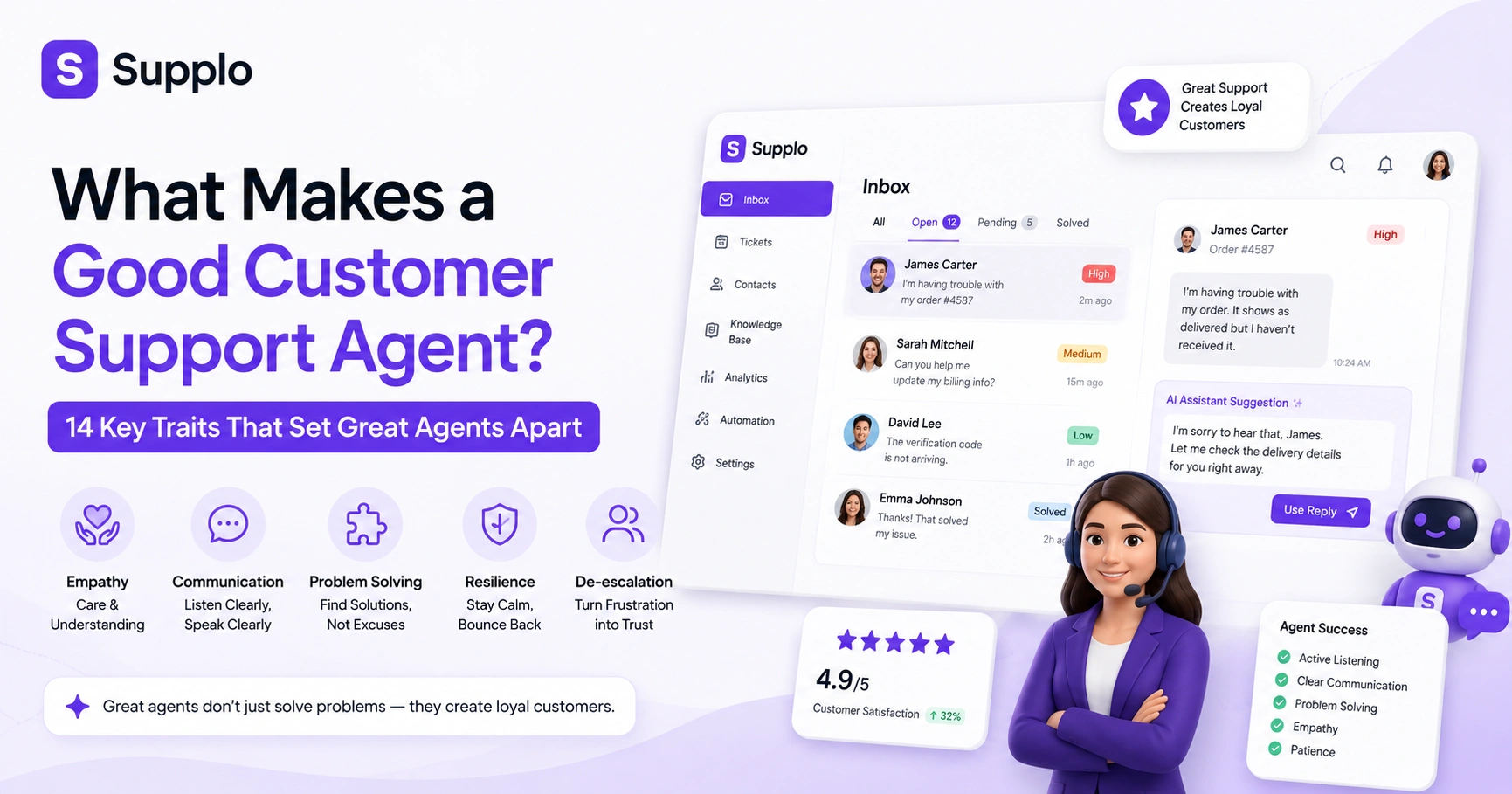
- Empathy is everything: If they can't feel what the customer feels, nothing else matters.
- Active listening & clear communication: They actually hear the problem before jumping to solutions.
- Problem-solving mindset: They're solution-finders, not excuse-makers.
- Resilience & adaptability: Support is stressful. Great agents bounce back fast.
- De-escalation mastery: They can calm a storm with the right words.
Essential Customer Support Agent Qualities – The Foundation of Great Service
You can teach someone your product. You can train them on your tools. But you can't teach someone to genuinely care about helping others, at least, not easily.
The core qualities every great support agent needs start with empathy. That's the ability to put yourself in the customer's shoes and actually feel their frustration. When a customer hears I totally get why that's annoying and believes it, half the battle is already won.
Patience is next. Some customers will repeat themselves. Some will rant. Some will take forever explaining something simple. A good agent doesn't rush them or interrupt; they let the customer vent, then gently steer things toward a solution.
Adaptability matters more than you'd think. The customer who was calm two minutes ago might be furious now. The issue that seemed simple might suddenly get complicated. Great agents pivot without missing a beat.
And finally, a problem-solving mindset. This isn't about having all the answers; it's about wanting to find them. The best agents treat every complaint like a puzzle they're excited to solve.
Characteristics of Successful Customer Service Representatives
Here's the thing about great support agents: some of their best qualities aren't obvious on a resume.
Take intellectual curiosity. The agents who really shine are the ones who want to understand why something broke, not just how to fix it this one time. They dig deeper, ask follow-up questions, and learn the product inside out.
Resilience is another quiet superpower. Support agents hear a lot of anger that isn't really about them. The customer isn't mad at you; they're mad at the situation. But it takes a certain mental toughness to absorb that without taking it personally. The best agents develop a thick skin without losing their warmth.
High conscientiousness means they follow through. If they say I'll email you the update by 3 PM, they do it. If they promise to escalate, they actually escalate. Customers notice this stuff.
And intrinsic motivation? That's the agent who feels genuinely proud when a ticket gets resolved, not because their manager is watching, but because they actually helped someone. That's gold.
Key Skills for Customer Support Agents – Technical & Soft Skills You Can't Ignore
Modern support isn't just about being nice on the phone. Today's agents need a real hybrid skillset.
Written clarity is huge, especially if your team handles email or chat. Tone is harder to read in text, so agents need to be careful with word choice. A short reply can sound cold. A long one can sound robotic. Finding the sweet spot takes practice.
Active listening sounds obvious, but most people are terrible at it. A great agent doesn't just hear the words; they paraphrase what the customer said back to confirm they got it right. Something like: To make sure I understand, you're saying the payment went through, but the confirmation email never arrived. Is that correct? That one sentence saves so much back-and-forth.
Technical literacy matters more than ever. Your agents should be comfortable navigating a shared inbox for email, managing tickets, and using tools like Supplo's unified inbox to keep everything in one place. The faster they can find the info they need, the faster the customer gets help.
Documentation skills are underrated. Every time an agent solves a unique problem, they should be thinking: Could I write this up so another customer can find the answer themselves? That's how you build a knowledge base that reduces tickets over time.
Time management is the glue that holds it all together. Support agents juggle multiple conversations, prioritise by urgency, and still need to sound human in every reply. That's not easy.
What Makes a Good Support Agent for Difficult Customers?
Let's address the elephant in the room: some customers are really, really hard to deal with. They're angry, they're frustrated, and sometimes they're just having a terrible day.
The best agents don't take it personally. They validate first, fix second. I can see why that would be frustrating. It tells the customer, "I hear you." I get it. I'm on your side.
Key Approaches for Difficult Customers:
- Validate feelings before fixing: Address the emotional side first. Logic doesn't work when someone's upset.
- Speak with concrete certainty: I'm going to check this and get back to you in 30 minutes sounds way better than I'll try to look into it.
- Avoid defensive language: Don't say You didn't provide the right info. Say, let's clarify what we need to fix this.
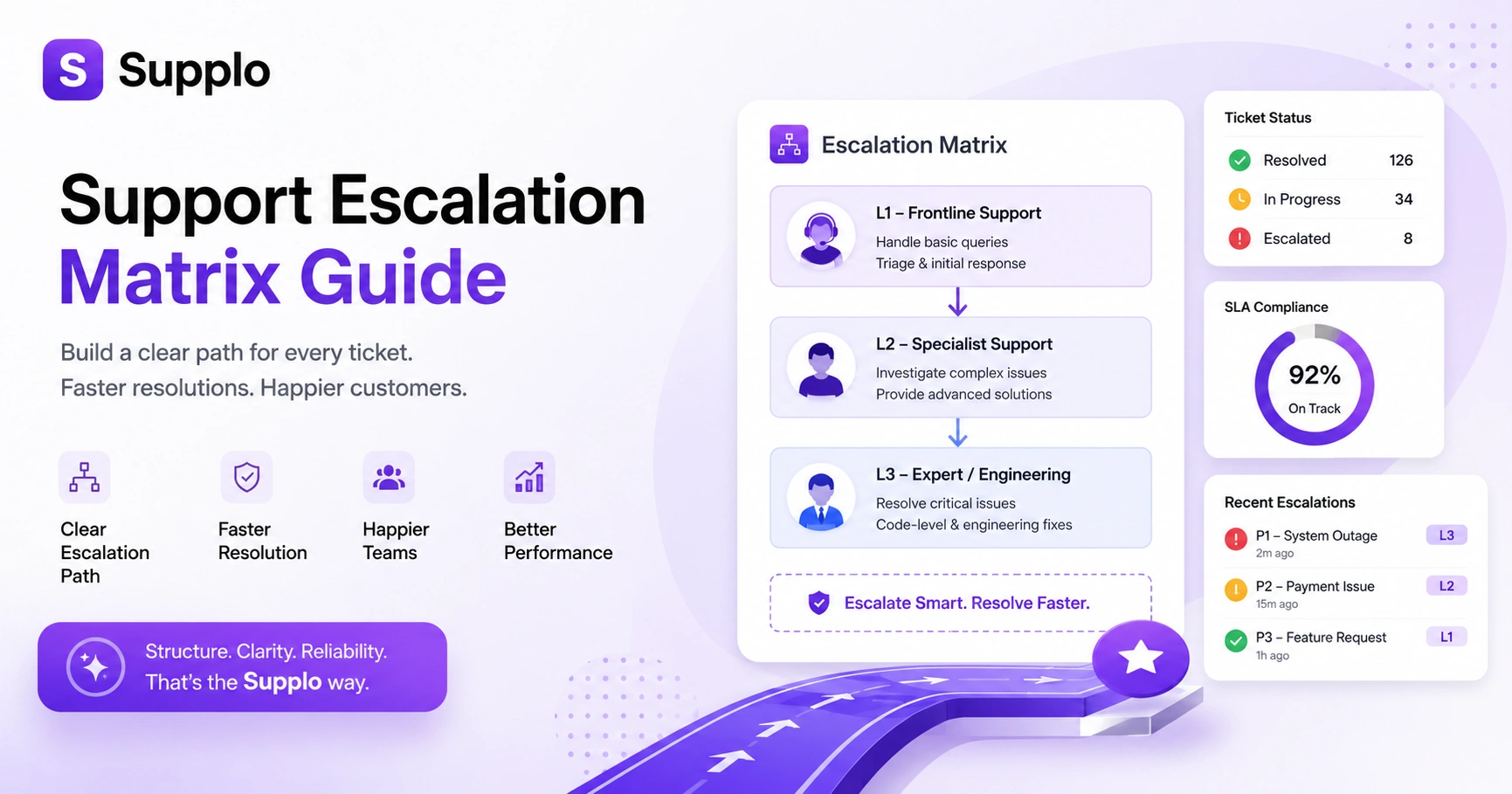
- Know when to escalate: Some situations require a supervisor or another department. The best agents recognise that early. Using Supplo's AI agent, you can flag these moments automatically for a seamless handoff.
Mastering De-escalation Techniques for Support Staff
De-escalation is a skill. It's not something you're born with; you learn it, practice it, and get better over time.
The core idea? Slow everything down. When a customer is angry, they're moving fast emotionally. Your job is to be calm in the storm. Lower your voice speed. Type deliberately. Use empathetic language like That sounds incredibly frustrating or I'd feel the same way.
De-escalation Checklist:
- Slow down your speech and typing to signal calm.
- Apologise for the inconvenience the situation caused (not for the customer's feelings, that's different)
- Use the HEAR acronym: Hear them out, Empathise, Apologise (for the situation), Resolve.
- Focus on what can be done, not what can't
- Give the customer small choices to restore their sense of control.
For teams handling WhatsApp customer support, these techniques need to translate into text. That's harder, which is why having templates and AI-assisted replies can help agents stay on track.
Managing Challenging Customer Interactions Without Losing Your Cool
Here's the truth no one tells you: burnout is real in support. Managing tough interactions isn't just about the customer; it's about protecting your own mental health, too.
Strategies for Maintaining Composure:
- Post-call ritual: After a hard interaction, take 60 seconds. Stretch. Drink water. Write one positive note about how you handled it. Reset.
- Leverage automation: Why waste your best agents on password resets? Let Supplo's AI agent handle the easy stuff at $0.04 per resolution. Save your humans for the conversations that actually need them.
- Separate the anger from the person: The customer isn't mad at you. They're mad at the situation. Repeat that in your head if you need to.
- Set boundaries: It's okay to say I want to help you, but I need us both to speak respectfully for me to do my best work. That's not rude, it's professional.
The Role of AI in Enhancing the Traits of Top-Tier Support Agents
Let's clear something up: AI isn't here to replace your support team. It's here to make them unstoppable.
Think about it this way. Your best agents have empathy, patience, and problem-solving skills. But they only have so much energy in a day. If they're spending half their time answering Where's my order? Or, how do I reset my password? They're exhausted before the tough tickets even arrive.
That's where AI comes in. Supplo's AI agent handles those repetitive inquiries automatically, at a flat $0.04 per resolution. It learns from your knowledge base, so it actually gets smarter over time. It even translates languages automatically, turning a monolingual agent into a multilingual one instantly.
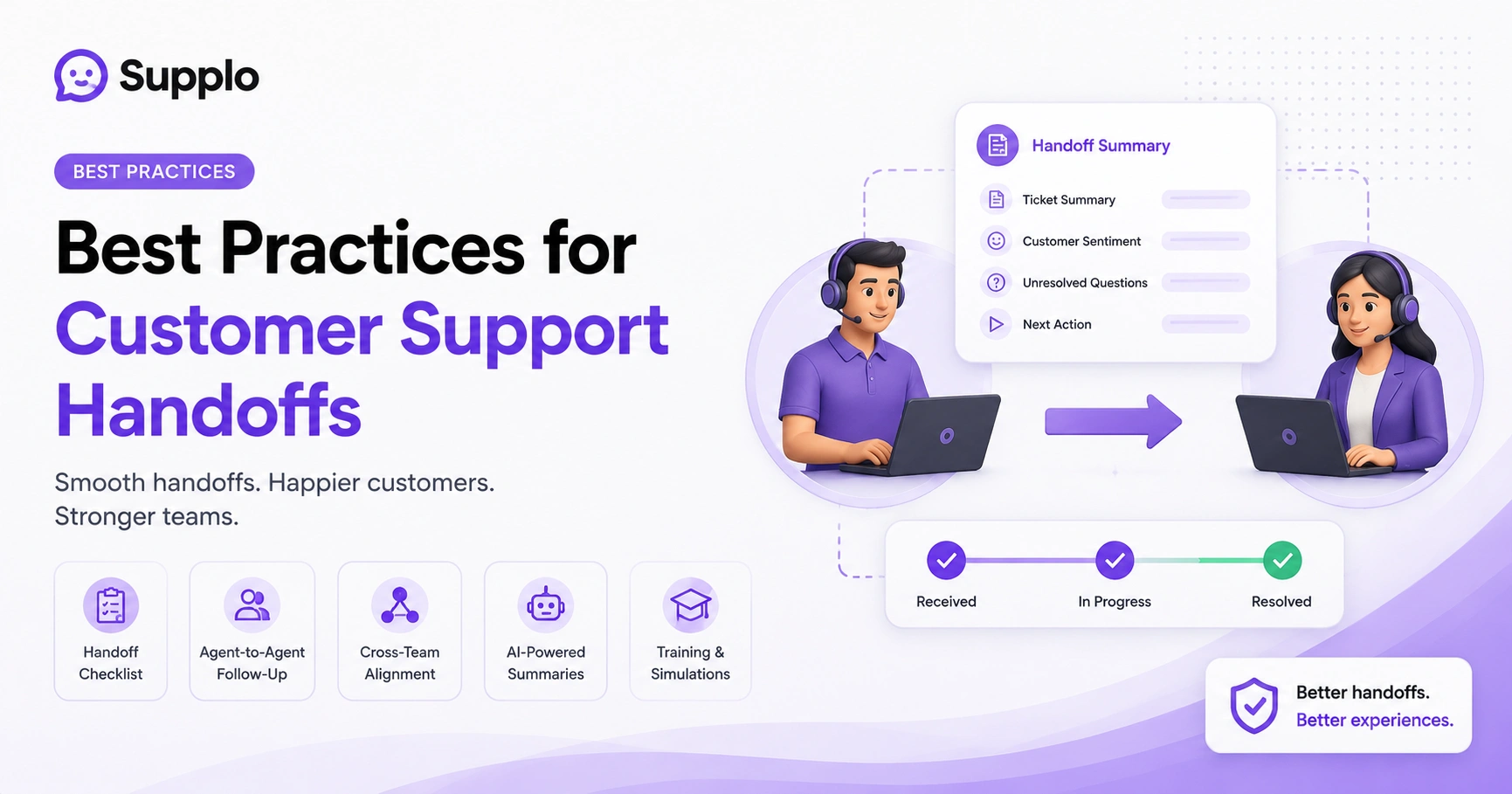
When does a conversation need a human? The AI flags the sentiment and hands off cleanly, with full context. No repetition. No frustration. Just a smooth transition where the human picks up exactly where the AI left off.
The result? Your agents spend their energy where it matters most: on complex problems, emotional conversations, and customers who genuinely need a human touch.
Ready to see how AI amplifies your support team?
Start your free 14-day trial of Supplo today. No credit card required. Start Free Trial →
Necessary Skills for Customer Service in a Multilingual, Omnichannel World
Your customers aren't just calling a phone number anymore. They're messaging on WhatsApp, sliding into your Instagram DMs, sending Telegram messages, and firing off emails, sometimes all in the same day.
That means your agents need to handle multiple channels from one place. Tools like Supplo's unified inbox keep everything organised, but the skill of context switching still falls to the agent.
A DM on Instagram should feel casual and quick. An email should be more structured and professional. A WhatsApp message falls somewhere in between. The best agents know how to adjust their tone without losing consistency.
Omnichannel awareness also means recognising when a customer has already started a conversation on another channel. Nothing frustrates a customer more than having to repeat themselves. A good agent catches that and says I see you started with us on WhatsApp earlier, let me pull that up.
Speed expectations vary by channel, too. Customers on WhatsApp expect replies in minutes. Email can take an hour or two. Agents need to prioritise accordingly.
For teams managing Instagram DMs or Telegram support, having the right infrastructure makes all the difference.
How to Assess Attributes of Effective Support Staff During Hiring
You can't just ask Are you empathetic? In an interview, I expect a useful answer. Everyone says yes.
To really assess what makes a good customer support agent, you need to test them.
Hiring Assessment Methods:
- Ticket triage simulation: Give candidates 10 tickets and ask them to prioritise by urgency. See how they think.
- Role-play: Have them practice saying no to a customer request without sounding dismissive. It's harder than it sounds.
- Writing samples: Give them a real angry customer email and see how they'd respond. Look for validation before solutions.
- Failure scenario: Ask about a time they failed a customer. Listen for accountability, not excuses.
The best candidates will ask clarifying questions before jumping to conclusions. They'll validate the customer's feelings first. And they'll show genuine curiosity about the product or service they'd be supporting.
From Agent to Advocate – Building a Support Team Your Customers Trust
Here's the ultimate goal: turn every interaction into a trust-building moment.
A customer who feels heard, understood, and helped doesn't just go away satisfied. They tell their friends. They write positive reviews. They become loyal advocates for your brand.
But building that kind of team requires infrastructure. You need a knowledge base that's easy to update. You need a unified inbox that prevents conversations from falling through the cracks. You need pricing that lets you scale without surprise bills, like Supplo's transparent flat pricing.
Trust is built when a customer doesn't have to repeat themselves across departments. It's built when your support experience feels the same whether they email, chat, or message on WhatsApp. It's built when your agents have the tools and the capacity to actually care.
Invest in your team's well-being. A burned-out agent cannot be a good agent. Give them the tools, the training, and the breathing room to do their best work.
Supplo is not affiliated with any app or website. Please follow each app's terms and local regulations.
Struggling with high ticket volume and angry customers?
Supplo's AI learns from your knowledge base and resolves up to half your tickets instantly. When a handoff is needed, it's clean and context-rich.
Key Takeaways
- Empathy is king, the single most important trait. Everything else builds on this foundation.
- De-escalation is teachable. Validation, pacing, and offering choices can be learned and practised.
- AI amplifies good traits. Let AI handle 80% of simple tickets. Save your humans for the conversations that need real empathy.
- Hire for potential, train for technique. Use scenario tests to find candidates who naturally validate customers. Then train them on your tools.
- Omnichannel fluency is non-negotiable. Modern agents must handle multiple channels and adapt their tone for each one.
Build a support team your customers love.
With unified inbox, automated translation, and transparent flat pricing (starting free!), Supplo is the all-in-one workspace for modern support teams. Get Started with Supplo.
Accepting Crypto, Binance Pay, Payeer, GCash, and more.
FAQ
What is the most important quality of a good customer support agent?
Empathy, hands down. Without it, an agent can't truly understand the customer's frustration. All the technical skills in the world won't matter if the customer doesn't feel heard.
Can AI really help with handling angry customers?
Yes, but strategically. AI handles the simple stuff, password resets, order status, and basic FAQs, so humans aren't fatigued when the tough conversations come. For truly angry customers, AI (like Supplo's AI agent) recognises the sentiment and hands off to a human with full context.
What are the best de-escalation techniques for support staff?
Active listening, validating feelings, apologising for the inconvenience (not for the customer's emotions), and offering small choices to restore control. Slowing down your pace also helps.
What skills does a support agent need for omnichannel support?
Context switching, platform-specific tone awareness, and the ability to track conversations across channels. A unified inbox tool like Supplo's inbox makes this much easier.
How do I hire an agent who is good with difficult customers?
Use scenario-based tests. Give them a simulated angry customer email. Look for candidates who validate feelings first before jumping to solutions. The best ones do both naturally.
How can I train my existing support team to handle challenging interactions better?
Regular role-playing, a library of best response templates, and clear escalation paths for when conversations go sideways. Tools that automatically translate messages also reduce friction.
What is the difference between a good agent and a great agent?
A good agent solves the ticket. A great agent solves the ticket, leaves the customer feeling heard, and adds a note to the knowledge base so that the question never needs to be asked again.
Compliance line: Supplo is not affiliated with any app or website. Please follow each app's terms and local regulations.