On this page
Honestly, customer support deflection gets a bad rap. Some folks hear "deflection" and think "dodge" or "ignore." But that’s not it at all.
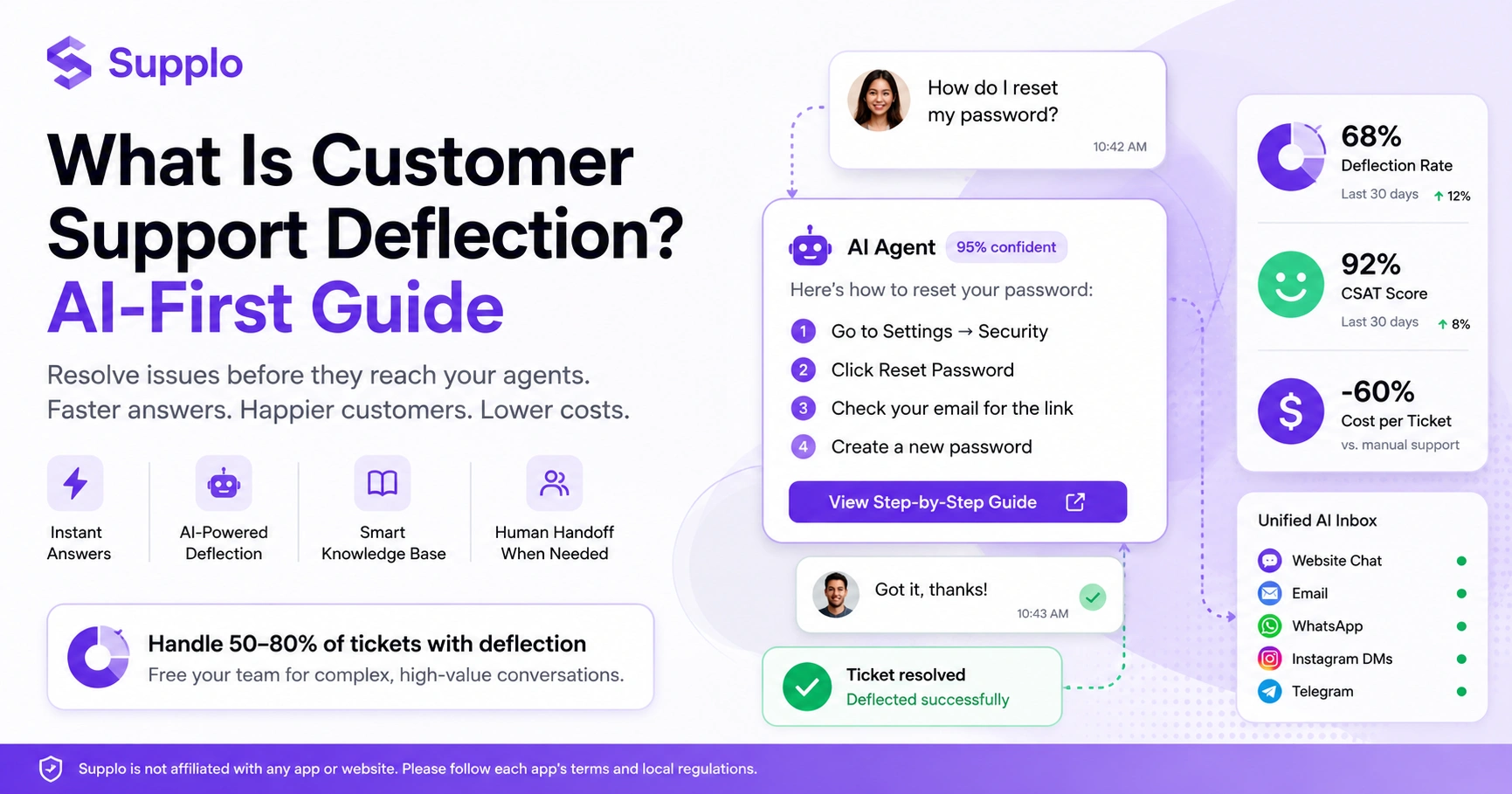
Customer support deflection is the smart process of resolving a customer’s problem before it ever reaches a human queue. Think of it as giving someone the fastest path to a working answer, through self-service or automation, so they don’t have to wait for an agent. Done right, a strong deflection setup can handle 50-80% of your incoming tickets, depending on how well you’ve built it.
Quick Answer
- Definition: Deflection means solving customer tickets via self-service or automation so no human agent touches them.
- How it Works: AI reads the ticket, matches it to your knowledge base and delivers an instant answer.
- Common Issues: Poor self-service content and over-aggressive AI lead to customer frustration.
- Best Practices: Use a well-trained AI agent and a comprehensive knowledge base.
- Measuring Success: Track deflection rate and customer satisfaction (CSAT).
What is Customer Support Deflection? A Fresh Definition
Let’s get this straight from the start. Customer support deflection is all about proactive resolution. You intercept a common question, like "How do I reset my password?" and serve up the answer instantly via a knowledge base article or an intelligent AI agent. The ticket never lands in an agent's lap.
It’s not about being rude or dismissive. It’s about respecting your customer’s time. For most teams that invest in a solid setup, deflection handles a huge chunk of ticket volume, usually between half and four-fifths of repetitive inquiries. That frees your human agents to wrestle with the complex, nuanced stuff that actually requires a brain and a heart.
A healthy system is measured by its deflection rate: tickets deflected versus total incoming tickets. And to get there, you need three things: a reliable knowledge base, smart AI, or a super-clear self-service flow.
How Does Support Deflection Work
When you strip away the jargon, deflection is a pretty straightforward process. A customer sends a question via chat, email, or social DM. Before it hits a human queue, an AI agent intercepts it, matches the intent against your knowledge base and delivers a concise answer.
If the answer hits the mark and the customer says "yep, that worked," the ticket is closed. No human hands. Poof. Gone.
The truly reliable systems are self-learning. They check historical conversations and your help center content to find the best match. And here’s the key: the system only deflects when it's highly confident, usually 85-95% sure. If it’s unsure, it gracefully hands off to a person. That’s how you build trust, not frustration.
What Are the Common Pitfalls of Deflection And Why They Fail
Let’s be real, most deflection efforts crash and burn for two main reasons: bad content or an over-eager AI.
If your knowledge base is a dusty graveyard of outdated articles or written in corporate-speak, customers won’t find what they need. If your chatbot is set to deflect everything aggressively, you’ll end up with frustrated customers who feel like they’re talking to a brick wall.
Reliable deflection requires a gentle hand-off. If the AI can’t answer with confidence, it needs to say, "I’m not sure, let me get a human." Forcing deflection without a fallback is a surefire way to tank your CSAT scores.
AI Customer Support Deflection: The Reliable Upgrade to Manual Self-Service
Basic keyword bots? They’re pretty much outdated. Modern AI customer support deflection uses machine learning to understand the intent behind a ticket, not just the words.
This is a massive upgrade. An AI agent trained on your product language and past tickets learns to get smarter over time. It can handle multi-language queries instantly, huge for global teams. The best systems even detect customer sentiment, offering a calm, empathetic tone or escalating quickly if someone is clearly frustrated.
And from a budget perspective, it’s a dream. You pay a flat cost per resolution (like Supplo’s $0.04 per AI resolution), making support costs predictable and scalable.
Setting Up AI Chatbots Deflection the Right Way
Setting this up isn’t magic. It’s a series of smart, intentional steps.
- Feed the AI. Start by feeding your AI agent your existing knowledge base and past support conversations. The more data, the better.
- Route everything through AI. Configure the bot to answer common questions across your website widget, unified inbox for chat, email and social DMs and messaging channels.
- Set your confidence threshold. This is crucial. Most teams set it between 85% and 95%. If the AI’s confidence is below that line, it automatically hands off to a human.
- Monitor the gaps. Every day, check what the AI couldn’t answer. Those are the gaps you need to fill in your knowledge base.
Building the Best Self-Service for Deflection
Here’s a stat you can bank on: roughly 20% of your support request types are responsible for 80% of your ticket volume, the Pareto Principle at work.
Your job is to build a knowledge base that stomps those top 20% into the ground. Write short, direct, human articles that solve the problem without needing a follow-up. Use the language your customers actually use (not your internal jargon). Structure everything with clear headings and bullet points. Make it searchable. Make it easy.
A well-organized knowledge base is the engine of any successful deflection strategy.
Implementing Self-Service Deflection
Ready to build? Here’s a simple, repeatable process:
- Step 1: Export your last 500-1000 tickets and categorize them. Find the patterns.
- Step 2: Create or update knowledge base articles for the top 10-15 recurring question types.
- Step 3: Connect your shiny new knowledge base to your AI agent or chatbot.
- Step 4: Monitor your deflection rate and CSAT score weekly. Fill in the gaps where customers are still reaching out.
What Customer Self-Help Deflection Looks Like in Practice
Let’s paint a picture.
A customer lands on your website and starts a chat: “How do I update my billing info?” The AI immediately sends a step-by-step guide with a link to the settings page. The customer says, “Got it, thanks!” The ticket is closed. No agent needed.
Social media works the same way. Someone DMs you on Instagram asking about shipping times. The AI responds via your shared inbox. If it works, great. If not, the AI asks a clarifying question or passes it to a human.
The golden rule? A deflected ticket should leave the customer satisfied, not feeling brushed off.
Measuring Your Deflection Rate and Choosing the Right Tools
Your deflection rate is simple math: (Tickets resolved by AI or self-service / Total incoming tickets) × 100.
A healthy goal? Aim for 50-80% within the first 90 days.
When choosing a tool to help you get there, look for one with flat pricing (not per-agent, which gets expensive fast). You also want built-in multichannel support, so one AI can handle email, chat, WhatsApp and social DMs from a single place. Supplo’s transparent per-workspace pricing is a solid example of a scalable model for growing teams.
Common Questions About Customer Support Deflection
This section addresses the most common concerns. The core takeaway: deflection is not the same as ignoring customers. It’s offering a faster, better path to an answer.
- Will deflection make my customers angry? Only if it’s rigid with no human fallback.
- Can deflection work for complex technical issues? Nope. It’s best for repetitive, well-documented stuff.
- What ROI can I expect? A major reduction in ticket volume, typically a 40-70% cost drop on common queries.
Final Checklist: Done-for-You Deflection Setup
Here’s your cheat sheet for a reliable setup:
- Connect AI to email, website widget, WhatsApp, Telegram, Instagram and Facebook Messenger.
- Write or update your top 15 FAQ/knowledge base articles.
- Set your confidence threshold to 90% or higher for deflection.
- Test the AI with real customer queries from your last month of tickets.
- Monitor the deflection rate weekly and adjust content as needed.
FAQ
Is customer support deflection safe for customer relationships?
Yes, when it’s done right. Fast, accurate answers actually boost satisfaction. Never force deflection when the AI is uncertain. Always offer a path to a human.
Why does deflection fail so often?
Usually because the knowledge base is a mess: if it's outdated, incomplete, or hard to navigate, customers won’t find answers. The second most common culprit is an AI that hasn't been trained properly on your specific product.
Can deflection handle complex technical issues?
Generally, no. It’s built for the high-volume, repetitive stuff like password resets and billing questions. Complex issues should always go to a human.
What happens to the ticket if the AI deflects it incorrectly?
A good system asks the customer if the answer helped. If they say no, the ticket escalates automatically and the interaction is logged to improve the knowledge base.
How is deflection rate calculated?
Deflection rate = (Tickets resolved by AI or self-service / Total incoming tickets) × 100. Healthy systems aim for 50-80% over the first 90 days.
What is the difference between deflection and automation?
Automation covers general ticket processing (auto-replies, sorting). Deflection is a specific type of automation that proactively resolves the ticket so no human ever touches it.
Does deflection work equally well for email, chat and social media?
Absolutely, when the AI is unified across channels, one AI agent that handles your website chat can also manage emails, WhatsApp messages, Instagram DMs and Telegram queries from a single inbox.
Compliance line: Supplo is not affiliated with any app or website. Please follow each app's terms and local regulations.