On this page
Let's be real for a second. If you run any online business, angry customers aren't a matter of if; they're a matter of when. One frustrated message in your live chat, a scathing email, or a public social media rant can snowball fast. It messes with your team's head and can take a real bite out of your reputation.
This guide isn't fluff. It's the practical stuff that actually works. We're talking real scripts, real strategies, and real tools to help you handle angry customers online without losing your cool or your humanity.
This is written for support pros, team leads, and business owners who want to improve their digital customer service. You'll learn how to cool down heated chats, reduce the number of people who leave and never come back, and even turn a bad experience into a win. We'll cover when to let AI handle things, when to step in yourself, and how to know if what you're doing is actually working.
Quick Answer
- Acknowledge the customer's exact problem and feelings right away. No delay, no deflection.
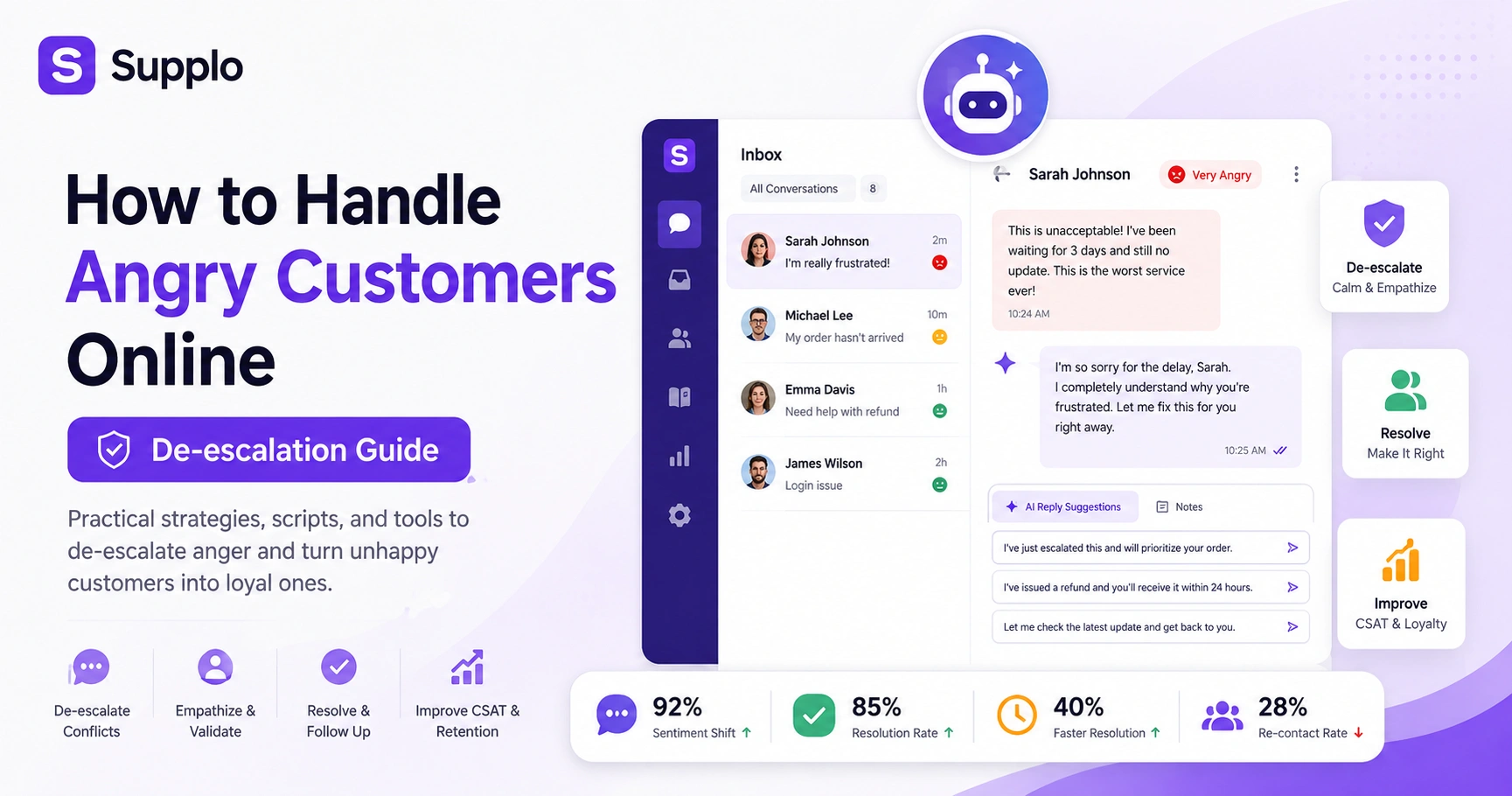
- Use a response formula: acknowledge → validate → state the fix → define next steps.
- Kill the robot phrases. Never say "calm down" or "that's our policy" without explaining why.
- A shared inbox is your best friend. It keeps the whole conversation in one place so you never miss context.
- Use AI for the easy stuff, and hand off smoothly when things get emotional.
- Track real outcomes like sentiment shift (was the customer less angry after you replied?) and re-contact rate (did they have to ask again?).
Why Customers Get Furious Online
Here's a hard truth: most of that anger wasn't born in your inbox. It was already brewing.
Your customer probably waited 48 hours for a reply. Or got bounced between email and chat like a pinball. Or their payment failed with zero explanation. By the time they reach you, they're already primed to blow. The real fix isn't just a better apology; it's fixing those friction points in the first place. Slow responses, broken self-service, and confusing checkout flows? Those are the real culprits.
A lot of people show up already frustrated from earlier failed attempts to get help. They feel like just another ticket number. And in text? Tone gets lost fast. A simple we'll look into it can read as we don't care. That's why addressing the underlying issues is half the battle when you're trying to handle angry customers online.
The First 60 Seconds: How to Respond to Irate Online Customers Without Making It Worse
Those first few seconds? They set the emotional floor. Not the ceiling, the floor. Get it right, and you can build upward. Get it wrong, and you're digging a hole.
Lead with the specific problem. Don't just say sorry for the inconvenience. That's white noise. Name their issue. I see your order #12345 was supposed to arrive yesterday, and it didn't. Then validate their feeling: That's completely understandable to be frustrated. Then state what you're going to do, and how fast.
Use their name. It sounds small, but it's huge. It signals you're actually paying attention. And skip the defensiveness entirely. Don't make excuses before they've even asked for one. Instead, set a real, honest expectation about when and how you'll fix things. That immediate validation? It's everything when responding to irate online customers.
A Proven Script for Managing Online Customer Complaints
Alright, here's a template you can steal. It's got four parts, and it's dead simple:
- Acknowledge the specific issue – Not your order has an issue. Say I see your order #12345 was delayed by 3 days.
- Validate the feeling – That's frustrating, especially when you need it for the weekend.
- State the fix – I've just upgraded your shipping at no cost. You'll get tracking in 10 minutes.
- Confirm next steps – Check your email for the tracking number. If it doesn't arrive by tomorrow, reply here, and I'll handle it personally.
See what happened there? It's specific. It's human. It's not some corporate script that could apply to literally anyone. Lead with the actual problem, not a generic apology. Offer a real fix. Then tell them exactly what happens next so they're not left guessing.
This is online complaint handling at its most effective.
Online Customer Service Anger Management: What to Say and What Never to Say
Some phrases are like gasoline on a fire. Here's what to never say:
- Calm down (literally the worst thing you can type)
- It's not a big deal (it is a big deal to them)
- This is our policy without context (sounds like you're hiding behind rules)
- It was your mistake (blame is never productive)
- I can't do anything (kills hope instantly)
Instead, try language that says we're on the same team:
- Let's fix this together.
- I want to make this right.
- Here's what I can do.
- I'm sorry this happened.
The difference is subtle but massive. I'm sorry you feel that way. It sounds like a backhanded shrug. I'm sorry this happened with genuine empathy without judgment. That small shift can de-escalate a lot of tension in online customer service anger management.
Steps to Resolve Online Complaints When You Can't Pick Up the Phone
Without voice tone or body language, your words have to work harder. When you're resolving complaints over text, clarity is everything.
Use numbered steps for anything complex. Break it down so there's no room for confusion. If the platform allows it, add screenshots or even a quick video clip showing exactly what to do. And here's the big one: keep the whole conversation in one thread. Don't send them to check their email for details or promise a callback. If it's not in the chat window, it might as well not exist.
Bullet points and numbered lists make instructions easy to scan. Visual aids like GIFs or annotated screenshots help even more. And always, always summarize what happens next so the customer walks away with a clear picture.
When you're providing steps to resolve online complaints, think like a teacher, not a bureaucrat.
Want to test these scripts in a real tool? Start a free 14-day trial at Supplo, no credit card needed.
Best Practices for Online Customer Support That Cuts Through the Noise
Speed matters. But accuracy matters more. I've seen companies obsess over response times while delivering completely wrong answers. And you know what? A fast wrong answer makes people angrier than a slightly delayed correct one.
Here's what actually works:
- Use a shared inbox so two agents don't reply to the same person. Awkward and annoying.
- Set up automated acknowledgments that say we got your message and set a real expectation.
- Make sure your team can see the full customer history before typing a single word.
Acknowledge receipt immediately, even if it's automated, so that they know they're not shouting into the void. And focus on complete resolution time, not just first response time. Getting them the right answer is way more important than getting a quick answer.
How to Resolve Online Customer Complaints Using AI Without Losing the Human Touch
AI gets a bad rap when it comes to angry customers. But used right? It's a superpower.
A solid AI agent can handle the first wave, pulling answers from your knowledge base for simple questions like " Where's my order? Or how do I reset my password? And when it detects real frustration (repeated questions, certain keywords, caps lock), it hands it off to a human with full context. That's the sweet spot.
Supplo's AI agent does exactly this. It learns from your past conversations, gets smarter over time, and never drops the ball on the handoff. The goal isn't to replace your team, it's to buy them time so they can focus on the hard stuff.
Think of it as your frontline filter. Simple complaints get instant answers. Complex or emotional ones get a warm transfer to a human who already knows the story.
If you're using a tool that charges $0.99 per resolution, try Supplo at $0.04 per resolution instead. See how AI can handle the first wave of anger for you.
Effective Online Complaint Handling with a Shared Inbox
Here's a common nightmare: A customer emails you, then sends a WhatsApp, then hops over to Instagram DMs, and you have no idea it's the same person. So you ask them to repeat themselves. Again. And they lose their minds.
A shared inbox fixes that. It pulls everything, email, chat, WhatsApp, Telegram, and Instagram, into a single thread. Your team sees the full story in one place and replies from one interface. No tab-hopping. No repeated questions.
Supplo's email ticketing system makes sure every interaction is logged. Whether customers reach you through WhatsApp customer support, Telegram support, or Instagram DMs, it all lives in one thread. No context switching. No dropped conversations.
Supplo is not affiliated with any app or website. Please follow each app's terms and local regulations.
Digital Customer Anger Resolution: When to Hand Off and When to Automate
Not every angry customer needs a human. Seriously. Some people want their password reset or their tracking number, and they want it now. An AI can handle that instantly and move on.
Save your humans for the stuff that actually needs them: nuanced complaints, emotional conversations, exceptions to policy. That's where empathy and judgment make the difference.
Train your AI to detect escalation signals: such as repeated frustration. Caps lock. Certain trigger words. When it spots those, it routes directly to a human agent, no dead ends.
Automate the simple stuff for speed and consistency. Keep the emotional stuff human. And use escalation detection features, like keyword triggers, tone analysis, or excessive time spent on a query in the widget, to prioritize high-stakes interactions.
Supplo is not affiliated with any app or website. Please follow each app's terms and local regulations.
Measuring Quality Online Support Methods: Do You Know If You're Actually Helping?
First response time and CSAT scores are fine. But they don't tell you if you actually resolved the anger.
Here's what to track instead:
- Complaint resolution rate – Did you fix it on the first try?
- Sentiment shift – How angry were they before you replied, and how angry afterward?
- Re-contact rate – If they reach out twice for the same thing, you didn't resolve it.
Watch the sentiment shift in your conversations. Measure how often customers come back with the same issue; that's your real failure metric. And sample a handful of tickets each week for quality assurance. Score your agents on empathy, accuracy, and resolution speed.
Also, think about your pricing model. Per-resolution pricing? That can push your team to rush. Flat-rate pricing, as the one Supplo offers, lets you focus on solving problems rather than counting interactions.
Stop losing context between channels and start resolving complaints faster. Get started with Supplo's shared inbox and self-learning AI today.
Key Takeaways
- Acknowledge specifically: Address the customer's exact issue and feelings immediately, avoiding generic apologies.
- Structured Resolution: Implement a clear script that acknowledges, validates, fixes, and outlines next steps.
- Tactful Language: Know what to say (empathetic, collaborative phrases) and what to avoid (dismissive or blaming language).
- Unified Context: Use a shared inbox to keep all communication channels (email, chat, social) in one thread, preventing context loss.
- Smart AI Integration: Leverage AI for rapid, simple resolutions and seamless, context-rich handoffs for complex or emotional complaints.
- Measure De-escalation: Track metrics such as sentiment shifts and re-contact rates to ensure you're truly resolving anger, not just responding to it.
FAQ
How do you handle a very angry customer online without making things worse?
Acknowledge their specific problem, apologize without being defensive, and state exactly what you'll do next. Avoid generic we understand scripts.
What should you never say to an irate customer in live chat?
Never say calm down, it's not a big deal, this is our policy (without context), or that's your fault. These phrases escalate anger.
Can AI really help with angry customers, or does it make them angrier?
Yes, when used correctly. AI can answer simple complaints instantly and hand off complex or emotional issues to a human. The key is a clean handoff, not a dead end.
How fast should you respond to an upset customer online?
Within minutes for live chat, within an hour for email. Even an automated acknowledgment that sets a clear expectation can defuse a lot of anger.
What if the customer starts swearing or being abusive in chat?
Stay professional. Set a boundary once: I want to help, but I need us to communicate respectfully. If it continues, you're allowed to disengage and flag for a supervisor.
How do you resolve a complaint when the customer won't accept your solution?
Ask what would make it right from their perspective. Sometimes, a small concession, a discount, a free upgrade, resolves the emotional issue even if the operational fix is the same.
What is the best way to train support agents for digital anger management?
Use real chat transcripts in training, role-play de-escalation, and teach agents to identify common emotional triggers before they respond.
Compliance line: Supplo is not affiliated with any app or website. Please follow each app's terms and local regulations.