On this page
Billing questions are a critical test for any customer support team. They touch on the sensitive intersection of money, trust, and service. This guide is for customer support managers, team leads, and business owners looking to improve their processes for handling billing questions with practical strategies and robust training.
It will help you build a reliable and customer-centric approach to billing inquiries, ensuring financial clarity and maintaining customer trust.
Quick Answer
- Billing inquiries are often emotionally charged; prioritise clear, accurate communication over sheer speed.
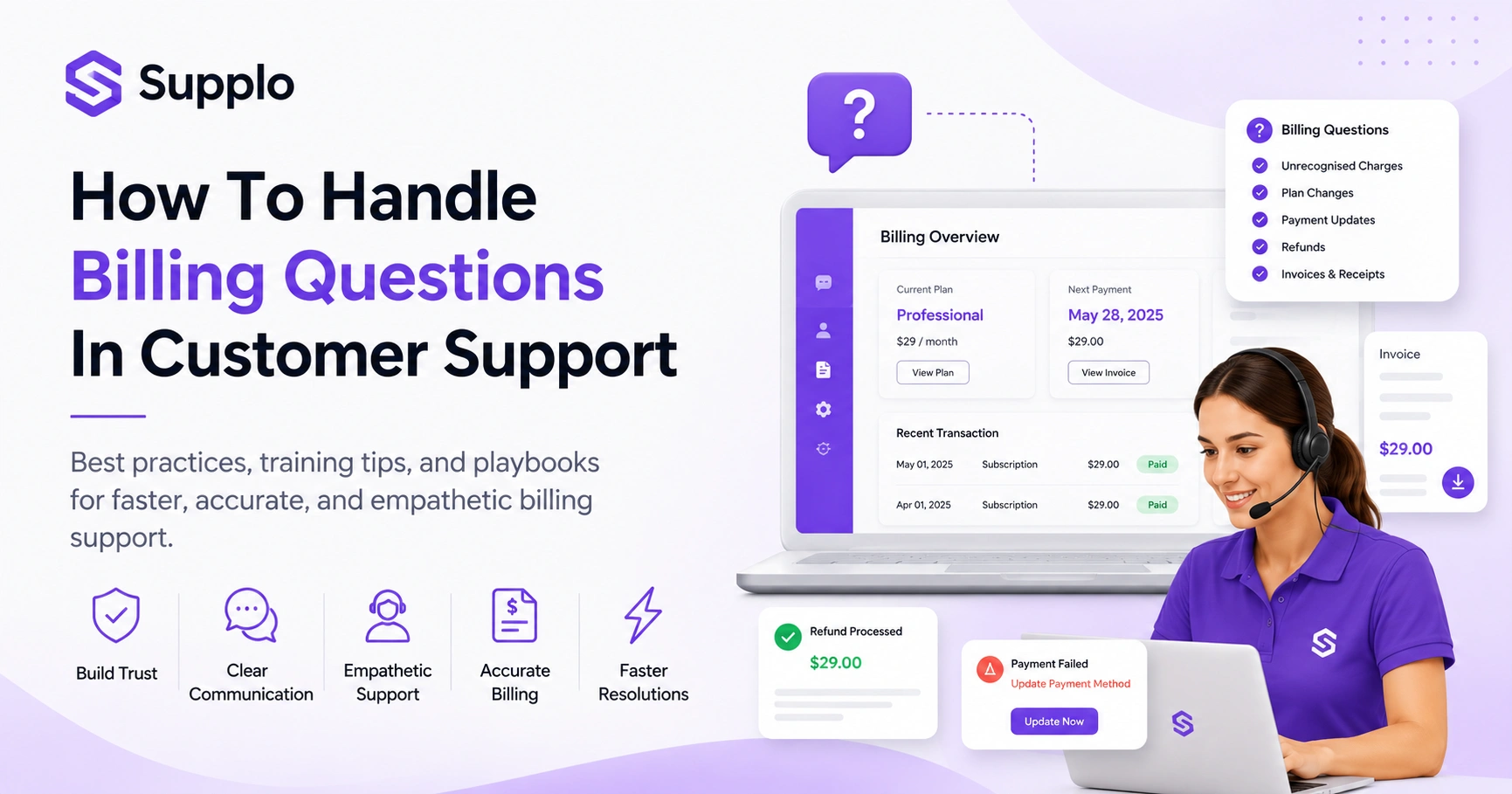
- Most billing questions fall into categories like unrecognised charges, plan changes, payment updates, refunds, and invoices.
- Implement strict verification processes and consistent policies to avoid errors and build trust.
- Train your team not just on process, but on empathy and de-escalation for sensitive financial discussions.
- Leverage automation for routine requests but ensure human oversight for complex or high-risk billing issues.
Why Handling Customer Billing Questions Tests Your Support Team’s Reliability
Billing questions are uniquely stressful because money, trust, and account access all converge at once. A wrong amount or a delayed refund doesn’t just frustrate a customer, it shakes their confidence in your entire business. How reliably you handle those moments defines whether a customer stays or leaves.
These financial interactions carry higher emotional stakes and shorter patience windows than general product questions. Speed alone doesn’t build trust; accuracy does. Getting the amount right and explaining why matters more than a 30-second reply.
Handling billing questions in customer support on first contact reduces churn and builds long-term customer loyalty. A reliable billing experience becomes a competitive advantage when competitors are slow or opaque.
The Anatomy of a Billing Inquiry
Most billing inquiries fall into five predictable categories: charges they don’t recognise, plan upgrades or downgrades, payment method updates, refunds, and invoice questions. Recognising the type instantly makes your team faster and more consistent. The underlying question is almost always: Am I being treated fairly?
Why was I charged this amount? covers duplicate charges, prorations, taxes, and unexpected fees. Can I change my plan? Often hides a need to control the budget or add features. How do I update my card or payment method? It is common but rarely urgent unless tied to an expiring subscription. When will my refund arrive? tests how transparent your refund process truly is. Can you send me an invoice or a receipt? Usually indicates a need for compliance or reimbursement. You can streamline the process for these frequent requests by integrating an effective email ticketing system for billing support requests.
Supplo is not affiliated with any app or website. Please follow each app's terms and local regulations.
Billing Support Best Practices for Faster, More Accurate Responses
Start by confirming the customer’s identity and account details before discussing any billing information. Then, acknowledge the financial impact; even a small overcharge feels big to the person paying it. Use a consistent verification process so your team doesn’t skip steps under pressure.
Verify the account with your email, the last 4 digits of your card, or a one-time code before sharing any billing details. Use templates for common responses, but train your team to personalise the tone so it doesn’t sound robotic. Always include the exact amount, date, and reason for any charge or refund in your answer. If you need to escalate, set a clear time expectation and actually meet it; overpromising recovery times damages trust more than waiting. Document every billing interaction in your support tool, like a unified inbox for billing conversations across email, chat, and social, so customers don’t have to repeat themselves.
How to Train Your Team for Managing Billing Issues in Customer Service
Customer support training for billing questions should start with empathy before the process. Role-play the three most stressful scenarios: a disputed charge, a failed payment that caused service interruption, and a refund request that exceeds your policy. Your team needs to know not just what to say, but how to de-escalate when money is involved.
Run live practice sessions where the customer is upset about a charge they don’t recognise. The goal is calm clarification, not defensiveness. Teach your team to explain the why behind billing policies so they sound helpful, not robotic. Cover payment methods your business accepts, including crypto options like Binance Pay and Payeer, and regional methods like GCash, AmanPay, and DOKU. Include training on handling cross-border billing concerns and currency conversions for global customers. Use recorded call or chat examples from your own support history to show what went right and what didn’t.
Building Customer Service Billing Best Practices: Policies and Playbooks
Write your billing policies in plain language and make them accessible to both your team and your customers. A good playbook covers refund windows, proration logic, handling failed payments, and how to explain taxes or fees. The best policies reduce questions before they happen, and a live chat widget for instant billing support can provide quick answers.
Define your refund policy clearly, including the time window, return method, and any restocking or processing fees. Document how prorations work for mid-cycle plan changes so every agent explains it the same way. Create a script for explaining why a payment might fail: insufficient funds, expired card, or regional payment block with providers like Nigeria and South Africa cards, Skrill, or Payoneer. Include a checklist for handling billing disputes without escalating unnecessarily. Review and update your playbook quarterly as your pricing or payment methods change.
Creating Effective Billing Support Training Modules for New Hires
Your billing support training modules should follow a simple arc: understand the billing system, handle the top five inquiry types from memory, then practice real scenarios without a script. Each module should end with a quiz that requires the agent to resolve a billing question correctly before moving on.
- Module 1: Billing system navigation, where to find invoices, payment history, and account details.
- Module 2: The five inquiry types and the exact resolution path for each.
- Module 3: Soft skills for billing, tone, empathy, and how to say no to a refund request without losing the customer.
- Module 4: Payment methods and regional quirks, including crypto payments via Binance Pay and regional providers like GCash.
- Module 5: Escalation triggers and when to loop in a senior agent or finance team.
Using Automation to Handle Routine Customer Support Billing Inquiries
Automation can handle repetitive billing questions, such as "Where is my invoice?" Or, when will my card be charged? without ever involving a human. But it should also know when to step back. Automating answers for sensitive billing changes, such as updating a payment method, should still require verification before processing.
Use an AI agent that automatically handles billing inquiries to answer "What did I pay last month?" Or when does my trial end? instantly from your knowledge base. Automate the first response to every billing ticket with the account status and a clear next step. For payment failures, send an automated retry notice with a secure link to update the payment method. Flag any billing question that mentions refund, dispute, or chargeback for human review immediately. Keep your knowledge base current so the AI can explain your billing best practices without hallucinating.
Handling billing questions efficiently starts with the right foundation. Try Supplo free for 14 days and see how our AI agent resolves routine billing inquiries without adding headcount.
The One Question Every Billing Conversation Should Answer
Every billing interaction should leave the customer knowing exactly what happened, what happens next, and when. Ambiguity kills trust faster than a wrong charge. Whether it’s a refund, a failed payment, or a price increase, the customer should never have to guess the timeline.
- State the action taken: I’ve issued a $47.00 refund to your original payment method.
- State the timeline: It will appear in 5–7 business days, depending on your bank.
- State the next event: Your next billing date is March 15, and it will be $89.00.
- Ask one confirmation question: Does that answer everything about this charge?
- Never make promises you can’t confirm; say, "I’ll verify and email you within 2 hours," instead of "It’s done."
When a Billing Issue Requires a Human
Not every billing question can be resolved with a script or an AI answer. Chargebacks, disputed amounts over a threshold, and refund requests outside policy need a human who can make judgment calls. The framework is simple: if the answer could cost the company money or require a policy exception, it goes to a person.
- Escalate any billing question involving a chargeback or payment dispute to the bank.
- Send refunds above a dollar threshold (e.g., $200) to a team lead for approval.
- Loop in finance when the customer requests a custom payment plan or a retroactive discount.
- For legal or compliance-related billing questions, involve your legal team before responding.
- Document every escalation decision so your team learns which situations truly need a human.
If a billing question slips past automation, your team gets the full context in one inbox. Start your free trial at Supplo.io and manage billing support across email, chat, WhatsApp, and more from one place.
How to Measure Success in Handling Customer Billing Questions
Track how many billing tickets are resolved on first contact, how long it takes to close them, and whether the same customer asks the same billing question again within 30 days. The real measure isn’t resolution speed, it’s whether the customer understood the outcome well enough not to come back.
- The first-contact resolution rate for billing tickets indicates how well your team and automation work together.
- Average handling time for billing vs non-billing tickets reveals where your process is slowing down.
- A repeat billing rate within 30 days indicates that your answer didn’t fully address the question.
- The customer satisfaction score (CSAT) for billing interactions specifically tells you whether trust was maintained.
- Escalation rate from billing to finance or management highlights where policy gaps exist. You can also compare pricing for billing support tools to understand the cost-effectiveness of your current setup.
Transparent billing support isn’t just about tools; it’s about a system your customers trust. See how Supplo keeps your team reliable and your costs predictable. Start your free trial today.
Key Takeaways
- Billing inquiries are high-stakes interactions requiring accuracy, empathy, and clear communication.
- Categorise common billing questions to streamline responses.
- Train your team to handle sensitive financial discussions and de-escalation.
- Employ automation for routine tasks, freeing human agents to focus on complex issues.
- Measure success by customer understanding and the reduction of repeat inquiries.
FAQ
What is the most common billing question in customer support?
The most common billing question is Why was I charged this amount? Customers often see an unexpected charge and want an immediate breakdown of what they’re paying for.
How quickly should a customer support team respond to a billing question?
Ideally, acknowledge the billing inquiry within 15 minutes and resolve it within 24 hours. Faster responses reduce frustration, but accuracy matters more than speed.
Can AI handle billing questions without human help?
Yes, AI can handle routine billing questions like invoice requests, payment due dates, and plan costs. For refunds, disputes, or account-specific changes, a human should still confirm the resolution.
How do I train support agents to handle angry customers about billing?
Start by teaching active listening and validation, and acknowledge the frustration before explaining the charge. Then, role-play real billing scenarios so agents practice staying calm and focused on solutions.
Is it safe to automate payment method updates in customer support?
Automation can initiate the update process, but you should always verify the customer’s identity before processing any change to their payment method. Never share full payment details in chat or email.
What should a billing support training module include?
A module should cover billing system navigation, the top five inquiry types, soft skills for financial conversations, payment method knowledge, and escalation guidelines. End with a practical quiz.
Why do billing questions cause more customer frustration than other inquiries?
Because money is personal, a billing mistake feels like a broken promise, and customers often worry about hidden fees or being overcharged. Transparency and speed are the only antidotes.
Compliance line: Supplo is not affiliated with any app or website. Please follow each app's terms and local regulations.