On this page
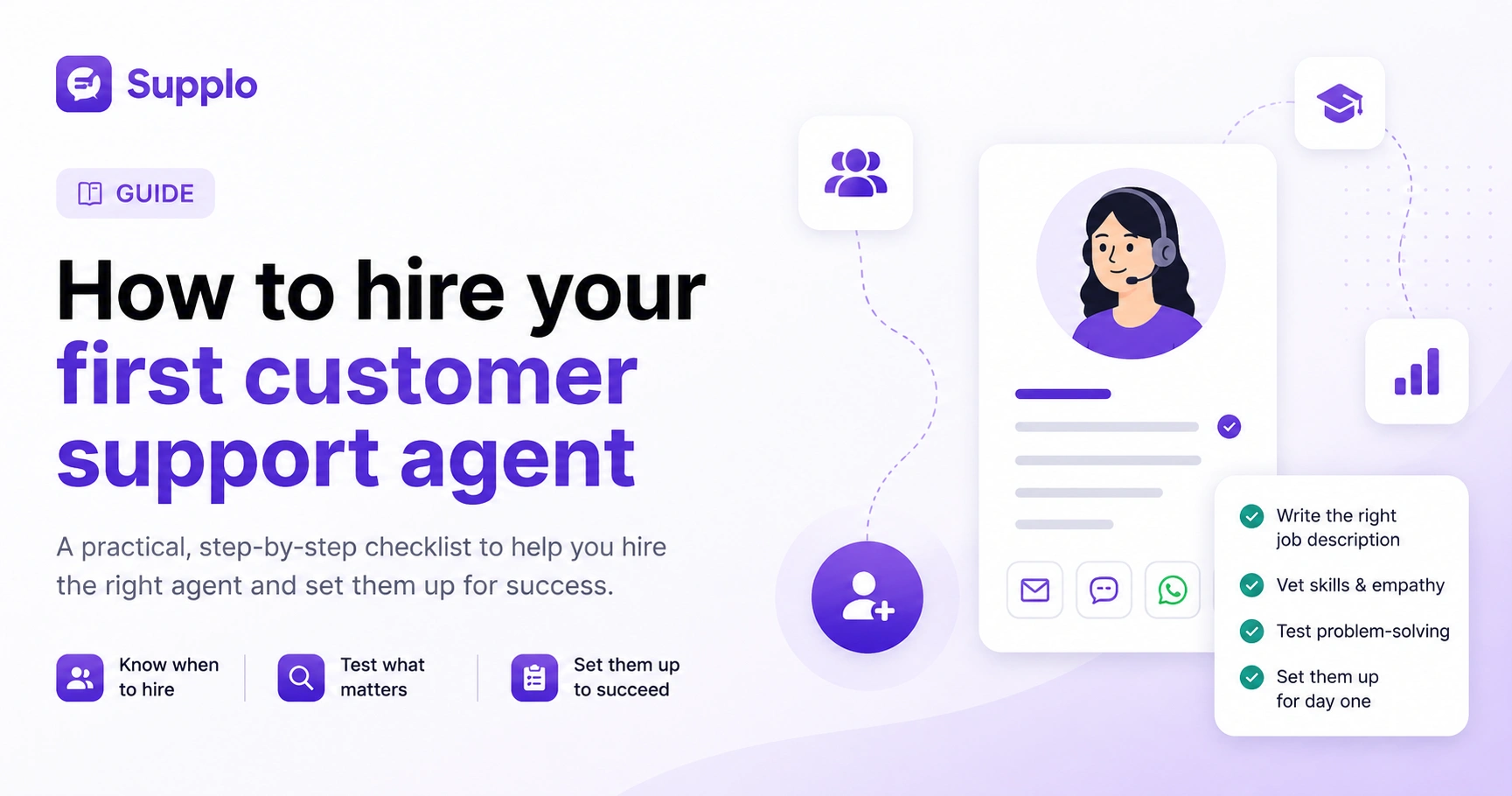
So you're thinking about hiring your first customer support agent. Smart move, but also a little terrifying, right?
This guide walks you through exactly when to hire, what to look for and how to set them up so they don't quit in two months. Whether you're a solo founder drowning in tickets or a small business owner who's tired of copy-pasting the same answers, this checklist keeps you from making expensive mistakes.
We'll cover the real signs it's time to hire, how to write a job description that attracts the right person (not just anyone) and what tools you absolutely need before day one.
Let's get into it.
Quick Answer
- When to hire: If you miss messages or spend half your day on support, it's time, not when revenue hits X.
- What to test: Written simulations (not phone screens) are the best predictor of a great first agent.
- The must-have tool: A shared inbox + knowledge base + AI agent (like Supplo) makes your first agent productive on day one.
- Common trap: Hiring for experience rather than solo-work fit leads to turnover within 60 days.
The Right Time to Hire vs. The Fear of Hiring
There's no magic customer count that tells you it's time. But the signs are pretty obvious once you stop ignoring them.
You're missing messages. Replies take hours, sometimes days. And you're spending half your day answering the same five questions instead of building your product.
That's the signal. Not when you hit some revenue milestone. Not when you "feel ready." When your personal ping-pong is hurting retention, hire, even if payroll makes you nervous. A first agent buys back your time to grow the business.
- Revenue vs. response time: If you're losing leads because replies take over 4 hours, it's time.
- Emotional readiness: You don't need a full brand guide yet, but you do need a shared inbox and a basic knowledge base.
- The "Founder Trap": Owners who handle support well often wait too long to delegate. Don't be that founder.
- Part-time vs. full-time: For high-volume businesses (like e-commerce), full-time wins; for low-ticket SaaS, start part-time.
- Cost perspective: A good agent costs less than the churn from bad support.
Supplo is not affiliated with any app or website. Please follow each app's terms and local regulations.
Writing Your First Support Agent Job Description That Attracts the Right People, Not Just Bodies
Your first support agent job description should emphasize adaptability over experience. You need someone who can learn your product fast, write clear replies and know when to escalate. Avoid generic "customer service agent role" language; tailor it to your product's quirks.
- Title matters: Customer Support Agent vs. First Support Team Member, which tests better? In our experience, the latter attracts people who want to grow with you.
- What to include: Your product's complexity, expected response times and tech stack (e.g., email + live chat + WhatsApp).
- What to omit: multitasking guru and rockstar; these attract the wrong candidates.
- Example job description template:
- Title: First Support Team Member
Responsibilities:
- Respond to customer inquiries via email, live chat and messaging platforms.
- Resolve common issues and escalate complex ones.
- Maintain a consistent tone and follow brand guidelines.
Qualifications:
- Strong written communication skills.
- Ability to learn new products quickly.
- Basic tech proficiency (email, chat, CRM).
- Patience and empathy in customer interactions.
- Tools: Supplo Inbox, Supplo AI Agent
- Mentioning tools upfront: If you use AI-assisted inboxes or a support platform, say so. It filters out people who aren't comfortable with tech.
Essential Skills for Your First Support Agent: What to Look For And What to Ignore
The essential skills for first support agent hires are teachable, except empathy and written clarity. You can train product knowledge, but you can't train someone to care. Focus on communication, basic problem-solving and comfort with async tools.
- Top 3 must-haves: Clear written communication, basic tech proficiency (email, chat, CRM) and intellectual curiosity.
- Top 3 to ignore: Previous support experience, degree in communications, "phone skills" (unless you do heavy voice support).
- The 80/20 rule: 80% of daily tickets are simple (password resets, order status, basic troubleshooting); hire someone who can handle that without stress.
- Soft-skill red flags: Candidates who blame the customer during a scenario test. Big no.
- Culture fit vs. skill gap: For a single-agent team, culture fit wins every time. You'll be working closely together.
How to Vet Communication Skills and Empathy in Customer Service
The best way to test communication skills for support is a written simulation: have them respond to a real customer complaint during the interview. You're not looking for a perfect answer; you're looking for tone, clarity and ownership. Empathy shows up when they apologize first, explain second and fix third.
- Scenario test template: "A customer says your product broke their workflow. Draft the first reply."
- What to look for: Acknowledgment of frustration, a clear next step, no blame.
- Red flag: Overly defensive or robotic replies.
- Optional phone screen: Listen for patience and active listening, not scripted answers.
- Peer review: After hiring, ask your current team (if any) to review their test replies.
The Non-Negotiable Problem-Solving Framework: How to Test Key Competencies for Support Reps
Problem-solving skills for a support agent aren't about solving everything; they're about knowing what you can solve, what needs a second look and when to loop in the team. Test this with a real bug ticket: give them incomplete info and see if they ask the right clarifying questions.
- The Four-Bucket test: Can they categorize a ticket as Informational, Troubleshooting, Bug Report, or Feature Request?
- The escalation rule: They should be comfortable saying "I don't know, but I'll find out" and actually following up.
- Tool-assisted problem solving: How to use a knowledge base as a safety net.
- Key competency test: Give a vague complaint and a detailed one, see if they treat them differently.
- Why first response time matters more than resolution speed for a solo agent: Customers care more about knowing someone's listening than getting an instant fix.
Your First Customer Support Hire Checklist
A first customer support hire checklist keeps you from skipping steps when you're busy. Phase one: define your average ticket types and build a basic knowledge base. Phase two: write a clear job description (see H2-2) and test with simulations. Phase three: onboard in pair mode, not lecture mode; they shadow for two days, then start with low-risk tickets.
- Pre-listing: Audit your 10 most common support questions; your job description should reflect reality.
- Interview flow: Screening call → written simulation → culture chat → reference check.
- Hiring timeline: From listing to first day, budget 3-4 weeks.
- Onboarding checklist: Product tour, tool orientation, first week goals.
- Tool access list: Email, live chat, shared inbox, knowledge base.
Tools You Need Before They Start: Shared Inbox, Knowledge Base and Why AI Matters
Before day one, your agent needs a single workspace. In this shared inbox, every customer conversation (email, chat widget, WhatsApp, Telegram, Instagram DMs, Facebook Messenger) lives in one thread-based view. A knowledge base they can search and an AI agent that can deflect repetitive questions are not luxuries; they're reliability insurance.
- The shared inbox is non-negotiable: No more hunting through personal email or DMs.
- Knowledge base basics: 10–15 common answers your agent can reference or modify.
- Why an AI agent matters: When your agent is offline, AI handles the first response; you don't lose tickets.
- Recommended setup: Supplo combines inbox + AI agent + knowledge base in one place, no stitching tools together.
- Cost of not having tools: Missed messages = unhappy customers = more work for your agent.
Ready to see how a shared inbox + AI agent works in practice? Start a free 14-day trial of Supplo, no credit card required and your first agent will thank you for it. Try Supplo Now.
Setting Your Entry-Level Support Agent Up for Success
Your entry-level support agent role should be low-pressure for the first two weeks. Let them shadow, answer easy tickets with review and build a personal FAQ document. By week three, they should handle 80% of first-contact conversations solo and know exactly when to pull you in.
- Week 1: Product deep-dive (watch demos, use the product), tool orientation, shadowing.
- Week 2: Take over email and chat with co-pilot review before sending.
- Week 3: Own simple ticket types alone; escalate bugs and complex complaints.
- Week 4: First solo day; check in at the end of the day; review tone and accuracy.
- Milestone: By day 30, they should be able to resolve common issues without your input.
Common First-Hire Mistakes And How to Avoid Re-Hiring in 60 Days
The biggest mistake is hiring for "experience" instead of "fit for solo work." An agent who thrived in a team of 10 may struggle when they're the only one. Other pitfalls: skipping the knowledge base, expecting them to learn 100% of the product before taking tickets and failing to define escalation rules clearly.
Mistakes:
- Hiring someone who can't work independently; test this during the interview.
- No documentation: your agent will ask the same questions you've answered 50 times.
- Overloading on day one; give them a week to absorb, not a checklist.
- Not setting first response time expectations (e.g., reply within 30 mins during work hours).
- Ignoring mental load: a solo agent carries all the pressure; check in weekly.
When to Scale From One Agent to a Full Team
You know it's time for agent #2 when your first agent starts missing resolution time targets or shows signs of burnout. A second hire is easier; you know what the role actually looks like. Use your first agent's feedback on what they wish they'd known to write a better job description for number two.
- Signs of need: Ticket volume grows 30% month-over-month, average reply time doubles, or customer complaints spike.
- How to involve your first agent: Ask them what a second person would take off their plate.
- Budgeting for growth: Look for tools that scale without per-seat pricing (most flat-rate options make two agents cheaper than two seats on legacy platforms).
- Transition tips: When you add a second agent, the first becomes an informal lead; define that clearly.
- Avoid over-hiring: One agent can handle ~100–150 simple tickets per month, depending on complexity.
If you're worried about manually stitching together email, chat, WhatsApp, Instagram and Telegram, Supplo unifies them into a single thread-based inbox. Try it free; your first agent will be productive on day one.
Key Takeaways
- Right time to hire: When you're missing messages or spending too much time on support.
- Job description: Emphasize adaptability and tailor to your product.
- Essential skills: Focus on communication, empathy and basic tech proficiency.
- Testing: Use written simulations and scenario tests.
- Problem-solving: Test their ability to ask clarifying questions and escalate appropriately.
- Pre-hire tools: Set up a shared inbox, knowledge base and AI agent.
- Onboarding: Start with shadowing and low-risk tickets.
- Avoid mistakes: Don't overload on day one or skip documentation.
- Scaling: Add a second agent when the first starts to struggle.
FAQ
What salary should I offer my first customer support agent?
The salary depends on your location, the role's complexity and whether it's full-time or part-time for a remote, global hire; research local market rates for entry-level support roles. Always factor in tool costs and any compliance requirements.
Can I use AI as my first support agent instead of hiring a human?
An AI agent can handle up to 80% of repetitive tickets and is great for first-line deflection, but it cannot replace human empathy, nuance, or escalation for complex cases. Most growing businesses start with AI handling basics and a human handling the rest.
Do I need a knowledge base before hiring my first support agent?
Yes, even a simple list of 10-15 common answers will dramatically shorten ramp-up time. A knowledge base helps your agent answer consistently and gives your AI agent something to pull from when you're offline.
How long does it take to train a first support agent?
Expect two weeks for them to feel comfortable with product and tools and four weeks to be fully independent on simple tickets. If your product is complex, add a week. Speed comes from clear documentation, not longer training.
Should I hire a part-time or full-time first support agent?
If your support volume is predictable and under 50 tickets a week, start with part-time. If you're growing fast or support hours are long, full-time is better. The key is consistency; customers remember slow replies more than part-time hours.
How do I set first response time expectations for a solo agent?
Use tools like shared inbox SLA timers and automated replies to set expectations. A common standard: reply within 30 minutes during working hours. Outside hours, an AI agent can acknowledge the message and promise a human reply the next business day.
What support tools do I need before my agent starts?
At minimum: a shared inbox (that unifies email, chat and messaging apps), a knowledge base and an optional AI agent for after-hours coverage. Supplo combines all three into a single workspace, so you're not juggling separate subscriptions.
Compliance line: Supplo is not affiliated with any app or website. Please follow each app's terms and local regulations.