On this page
Running a startup is expensive enough without watching your customer support costs balloon every month. But here's the thing: you can't just slash the budget and hope for the best. Cut too deep and your customers will feel it. Cut smart and you can actually improve service while spending less.
This guide breaks down practical ways to optimize your startup's customer service costs without making your support team miserable or your customers frustrated.
Quick Answer
If you're short on time, here's the cheat sheet:
- Ditch per-seat or per-resolution pricing and switch to a flat per-workspace model instead. Your budget will thank you.
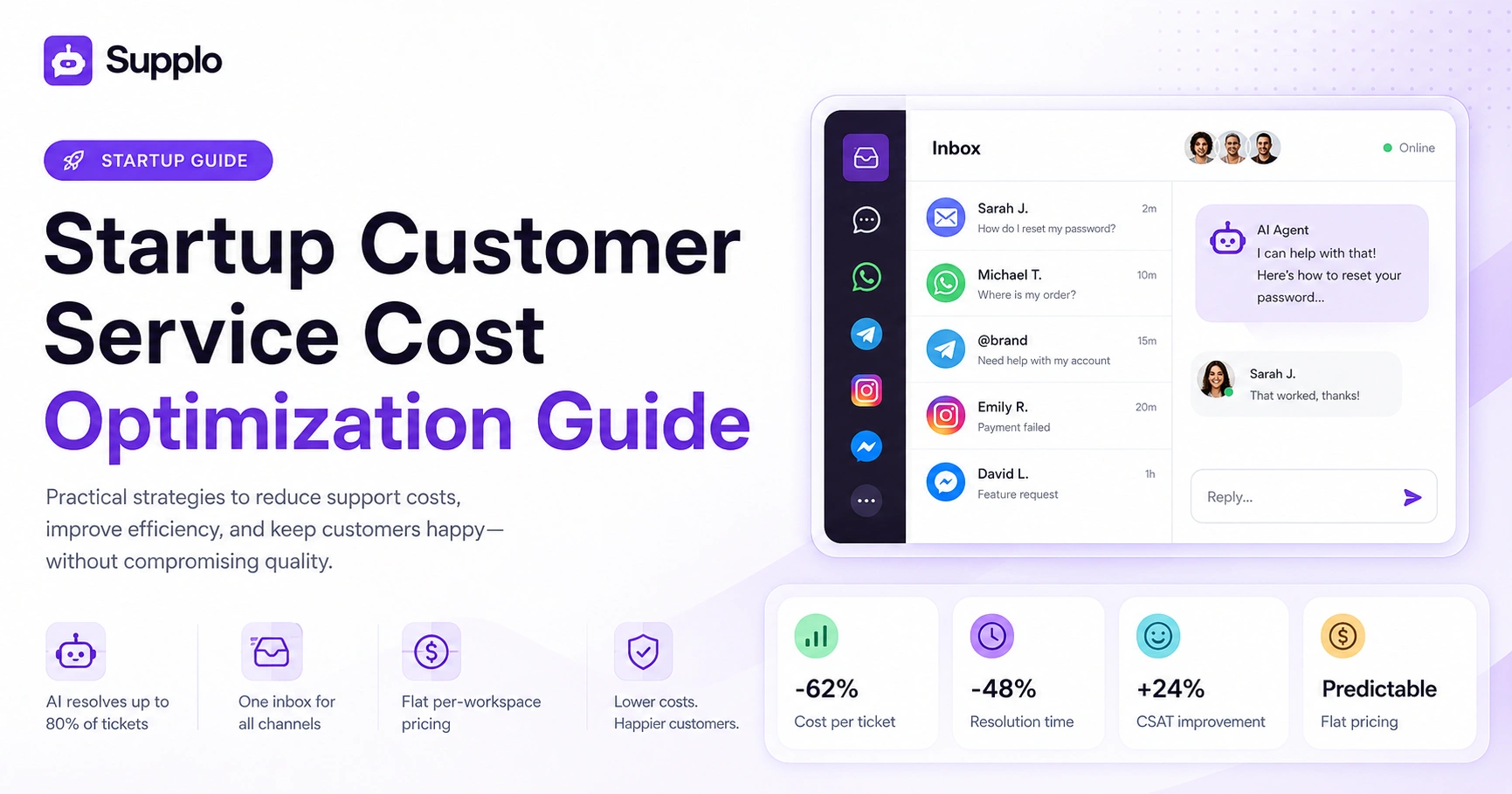
- Bring everything into one shared inbox: email, chat, WhatsApp, Telegram, Instagram, Facebook Messenger. One place. One view.
- Let a self-learning AI agent handle the repetitive stuff by training it on your knowledge base. It can resolve up to 80% of those "I forgot my password" tickets on its own.
- Track cost per ticket and CSAT every quarter to ensure your savings aren't coming at the expense of quality.
Why Customer Support Costs Can Sink a Startup Budget
Here's a scenario that plays out way too often: you sign up for a popular support tool thinking $99 per agent sounds reasonable. Then you hire more people. Now you're paying $500+ a month just for the software. Then you add an AI chatbot that charges $0.99 per resolution and suddenly your monthly bill is doing push-ups.
The problem isn't your team. It's the pricing model.
- Per-seat pricing punishes growth. Every new hire adds another line item to your bill.
- Legacy AI chatbots look cheap until they aren't. Per-resolution fees with hidden minimums can double your costs faster than your ticket volume grows.
- Inefficient routing wastes time. Multiple agents touching the same ticket means you're paying twice for one problem.
Supplo's approach? Flat per-workspace pricing that doesn't penalize you for adding team members or handling more tickets. Predictable. Scalable. No surprises.
How to Leverage AI to Lower Startup Support Overhead Without Replacing Your Team
AI isn't here to steal your support team's jobs. It's here to take over the boring stuff so your humans can focus on the tricky, high-value issues that actually need a brain.
A self-learning AI agent that pulls directly from your knowledge base and past conversations can handle the repetitive 80% of tickets. We're talking password resets, order status checks, basic "how do I" questions. The stuff that makes your team want to scream.
The trick? Pick an AI that charges a flat cost per resolution, think $0.04, instead of per-agent fees. That way, the more tickets it handles, the more value you get.
- Self-learning AI means less manual scripting and training time for your team.
- Seamless handoffs from AI to humans are non-negotiable if you want to maintain quality.
- Look for AI that learns from your actual knowledge base, not some generic model that doesn't know your product.
Speaking of which, Supplo's AI agent trains on your content, not a one-size-fits-all bot. That makes a difference.
The Most Affordable Customer Support Solutions for Startups Tech Stack
Here's what a lean, mean support stack looks like: an AI chatbot, a shared inbox and a knowledge base, all in one place. Why? Because integrating three separate tools means paying for three subscriptions and a bunch of Zapier bridges that break every other week.
Look for platforms that don't charge per agent or per seat. Supplo bundles all these features into a single workspace with flat pricing. Perfect for bootstrapped startups that need to watch every dollar.
- No per-seat charges = your bill stays flat even as you hire more people.
- A unified platform means one subscription, not three.
- Support for email, chat, WhatsApp, Telegram, Instagram DMs and Facebook Messenger all in one place.
Check out how Supplo handles email ticketing, WhatsApp support and Telegram support without needing separate tools.
How a Shared Inbox for Startup Support Cost Savings Actually Works
Imagine your support team doesn't have to juggle five different tabs, no more switching between email, chat, Twitter DMs and Instagram messages. A shared inbox collapses everything into a single thread view.
The result? Your team responds faster, misses fewer messages and doesn't need expensive routing software to figure out who handles what: fewer tools, less overhead, happier customers.
- No more double-handling. When agents can see everything in one place, tickets don't get passed around like a hot potato.
- Full context in thread-based views reduces resolution time because nobody has to ask, "What happened before?"
- Internal notes and assignments keep everyone on the same page without Slack pings.
Take a look at how Supplo's shared inbox works. It's designed to reduce the chaos.
Lowering Startup Support Expenses Through Smarter Automation and Self-Service
Automation isn't just a buzzword; it's a money-saver. When you automate ticket tagging, routing and canned responses, your team spends less time on busywork and more time on actual problems.
Self-service takes it a step further. A solid knowledge base or FAQ portal lets customers find answers without ever contacting support. And when they don't contact support, you don't pay for that interaction.
Together, automation and self-service can cut inbound ticket volume by up to 80%. That's a direct hit to your monthly support spend.
- Automated workflows handle triage and assignment without human input.
- A knowledge base reduces dependence on live agents for basic questions.
- Self-service first models train customers to help themselves, which saves everyone time.
Supplo's knowledge base makes it easy to build and maintain self-service content.
Practical Steps for Startup Customer Care Cost Cutting That Don't Hurt Satisfaction
Here's a approach that works:
- Audit your current ticket volume. What questions come up most? Tag them, categorize them, find the patterns.
- Deploy AI on the top 5 repetitive question types first. Let it handle those before touching anything else.
- Build knowledge base articles for each of those top questions. Give customers a way to help themselves.
- Switch to a flat-priced, unified platform to eliminate per-seat and per-resolution fees.
- Measure CSAT closely during the transition. If satisfaction drops, adjust your approach.
The goal isn't just to spend less; it's to spend smarter.
Building an Efficient Startup Support Model with a Single Unified Inbox
An efficient support model doesn't require your agents to be tab-juggling ninjas. It centralizes everything into one inbox so they can focus on conversations, not context switching.
When one agent can handle email, chat and social DMs without switching tools, you cover more channels with fewer people. That's the math that makes finance teams happy.
- The unified thread view includes the full conversation history across channels. No more "can you repeat that?"
- Internal collaboration tools reduce the need for separate Slack channels for every ticket.
- Assignments and statuses keep tickets from falling through the cracks.
Supplo's team inbox management is built exactly for this, reducing costs by consolidating channels.
Why AI Customer Service Cost Reduction for Startups Relies on Accurate Self-Learning
Here's the thing about generic chatbots: they're dumb. If your AI doesn't learn from your specific content, it'll give wrong answers, frustrate customers and escalate everything to your team anyway. That defeats the whole purpose.
Accurate self-learning AI trains on your knowledge base and past conversations. It learns your product, your tone, your common issues. That's when the real cost reduction happens, when the AI resolves tickets so your team doesn't have to.
- The AI should be trained on your product docs, FAQs and historical tickets. Not Wikipedia.
- Look for tools that show confidence scores so human agents know when to step in.
- Avoid chatbots that require constant manual script updates. That's just trading one problem for another.
You can see how Supplo's AI agent learns from your content and improves over time.
How to Structure Your Startup Customer Service Cost Optimization Plan
Ready to build your plan? Here's a simple framework:
Month 1: Audit and Select
- Review current ticket volume and costs
- Identify the top 5 repetitive question types
- Choose a unified platform with flat pricing
Month 2: Migrate and Train
- Move your channels to the new platform
- Train the AI on your knowledge base
- Set up automation rules for routing and tagging
Month 3: Optimize and Review
- Switch off legacy tools
- Review cost-per-ticket and CSAT metrics
- Adjust automation rules based on results
Ongoing: Quarterly Reviews
- Monitor cost-per-ticket reduction
- Adjust AI training as your knowledge base grows.
- Ensure CSAT stays consistent or improves.
- Include a cost-per-ticket calculation before and after. Numbers don't lie.
- Set target reduction rates for ticket volume and resolution time.
- Schedule quarterly reviews to keep everything on track.
Check out Supplo's pricing to see how a flat per-workspace model fits into this plan.
Common Pitfalls That Kill Cost Savings And How to Avoid Them
Here are the mistakes I see startups make over and over:
- Switching to a per-resolution AI chatbot without checking ticket volume projections. Costs can explode if volume spikes.
- Not training the AI on your actual content. A chatbot that doesn't know your product is worse than no chatbot at all.
- Ignoring channel consolidation. Paying for separate tools for email, chat and social unnecessarily doubles your costs.
How to avoid them:
- Choose flat fee models over per-resolution pricing. They're safer and more predictable.
- Keep your knowledge base updated. Stale content weakens AI performance.
- Consolidate everything into one platform. Fewer tools = fewer bills.
Supplo isn't affiliated with any app or website. Please follow each app's terms and local regulations.
Key Takeaways
- Move from per-seat or per-resolution pricing to a flat per-workspace model to control costs.
- Centralize email, chat, WhatsApp, Telegram, Instagram and Facebook Messenger in a single shared inbox.
- Deploy self-learning AI trained on your knowledge base to resolve up to 80% of repetitive tickets autonomously.
- Measure cost-per-ticket reduction and CSAT quarterly to ensure savings don't come at the expense of quality.
FAQ
What is the most important factor in reducing customer support costs for startups?
The biggest factor is choosing a platform that charges a flat fee per workspace rather than per agent or per resolution. This prevents costs from scaling unpredictably as your team and ticket volume grow.
Can AI really lower startup support expenses without hurting customer satisfaction?
Yes, if the AI is trained on your specific knowledge base and hands off cleanly to humans when needed. Self-learning AI can resolve up to 80% of repetitive tickets autonomously, which frees your team to focus on complex issues and maintain satisfaction.
What's the difference between per-seat pricing and per-resolution pricing for AI chatbots?
Per-seat pricing charges you for each agent using the tool, so your bill grows with team size. Per-resolution pricing charges for each ticket the AI resolves, which can skyrocket as volume increases. Flat per-workspace pricing is the most predictable option for startups.
Is a shared inbox really cheaper than separate tools for each channel?
Yes. A shared inbox eliminates the costs of multiple subscriptions and integrations and the time lost toggling between tools. It also reduces double-handling of tickets, allowing fewer agents to handle more volume.
What are the most affordable customer support solutions for startups?
The most affordable solutions bundle AI chatbots, a shared inbox and a knowledge base into a single platform with flat pricing. Supplo is one example that fits this model, offering transparent pricing without per-seat or per-resolution fees.
How quickly can I expect cost savings after switching to a unified support platform?
Most startups see savings within the first month after migration, since they immediately stop paying for multiple subscriptions and per-agent fees. The bigger savings come as the AI learns and resolves more tickets autonomously, often within the first 60 days.
What mistakes should I avoid when trying to cut support costs?
Avoid switching to a per-resolution AI chatbot without checking your ticket volume projection. Also, don't skip training the AI on your content; uninformed chatbots frustrate customers and escalate to humans, erasing savings.
Compliance line: Supplo is not affiliated with any app or website. Please follow each app's terms and local regulations.